Web Design & Development Services for Canadian Businesses That Actually Converts
Your website should be your hardest-working salesperson. It greets every visitor, answers the same questions a hundred times a week, and never calls in sick.
But if it was built from a template and left to fend for itself, that salesperson has no pitch, no path and no follow-through – and it is quietly costing you customers every month.
Volt Studios is toronto-based web design and development agency. We design and build custom, conversion-focused websites for Canadian businesses – from Toronto law firms to Vancouver e-commerce brands. Every build is strategy-first, mobile-first, WCAG 2.1 AA accessible and SEO-ready.




Reserve Your 30-Minute Web Design Call
We’ll review your goals, check your website, and show how we can design one that drives growth.
What is web design and development?
Custom web design and development is the strategy, design and engineering of a website built for one specific business – rather than a pre-built template adapted to fit.
For Canadian businesses, it means a site tuned to how your buyers actually decide: mobile-first, conversion-focused, accessible under WCAG 2.1 AA, and ready for the Canadian market from day one.
Is Your Website Quietly Costing You Customers?
Most struggling websites don’t look broken. They just don’t sell – and the signs are easy to recognize:
- Mobile visitors leave within seconds – the experience frustrates instead of persuading.
- Inquiries have flatlined, even though your traffic numbers look fine.
- You hesitate before sharing your URL with a prospect.
- Every small content change requires a call to your developer.
- Competitor sites look five years newer and load twice as fast.
- Your paid ads send clicks to a page that doesn’t match the promise.
None of these are cosmetic problems. They all point to the same root cause: a site that was built as decoration, not as a sales tool – no conversion strategy, weak information architecture, and no SEO or performance foundation under the design.
That is what we fix, and it is where every Volt Studios build starts.
The Math of a Leaking Website
Here’s what staying as-is actually costs.
Say 2,000 people visit your site each month. At a 1 percent inquiry rate, that’s 20 inquiries. The same traffic on a conversion-focused build – 2.5 percent is a typical range – produces 50. At a $2,000 average customer value, that difference is roughly $60,000 a year in revenue, from visitors you already have.
Now add what’s harder to see: ad clicks landing on a page that doesn’t convert, deals lost on credibility before the first call ever happens, and the developer labour every headline change requires.
An underperforming website doesn’t just sit there – it leaks. And every month you wait, the leak compounds.
The Lead Engine Framework: Five Stages from Strategy to Growth
A website is an engine: every part exists to turn attention into qualified inquiries. Cheap builds often skip the work that happens behind the screen, then wonder why the finished site looks good but fails to generate leads.
We build differently. Every stage has a clear purpose, deliverables, and quality gate. You know what we’re doing, what you’re reviewing, and what you’re paying for before the next phase begins.
Step 1: Strategize
We start with a focused goals workshop covering your business objectives, revenue targets, ideal buyers, competitors, existing website performance, and current acquisition channels.
From there, we map the buyer journey: what brings someone to your website, what information they need, what objections they have, and what should move them toward an inquiry or purchase.
You receive a conversion strategy brief that becomes the decision-making document for the entire project. It defines your primary conversion goals, target audiences, messaging priorities, key calls to action, page requirements, and measurement framework.
Nothing gets styled until the strategy says what the website needs to accomplish.
Quality Gate: You approve the strategy before we move into architecture.
Step 2: Architect
Once the strategy is approved, we turn it into the site’s structure.
We build the sitemap and information architecture, define page relationships, establish navigation, and map the conversion paths between key pages. We then create wireframes for the most important templates so you can see how information and calls to action will work before visual design begins.
Page goals are agreed at this stage. So are the core user journeys.
Think of it as laying out the showroom floor before choosing the paint, lighting, or furniture. We solve structure first so design has a clear job to do.
You review and approve the floor plan rather than trying to make structural decisions after development has already started.
Quality Gate: Sitemap, wireframes, page goals, and conversion paths are approved before visual design.
Step 3: Design
Now we bring the strategy and architecture to life.
Your website is custom-designed in Figma, including layout, typography, colour palette, imagery, components, responsive behaviour, and key interactions. The visual system is built around your positioning and audience rather than adapted from a generic template.
You receive two structured revision rounds, with feedback collected and applied systematically rather than through an endless cycle of small changes.
This is the love-it-before-we-build-it gate: you see exactly what the website is intended to look and feel like before development begins.
Nothing proceeds to code until the designs are approved.
Quality Gate: Final Figma designs are approved before development.
Step 4: Build and Launch
With the design approved, development begins on a staging environment.
We build the website responsively so the experience works across desktop, tablet, and mobile. Depending on the project, the site can be developed on WordPress, Shopify, or a custom stack, with the build version-controlled in Git where appropriate.
Development is followed by structured quality assurance covering:
- Cross-device and cross-browser testing
- Core Web Vitals and performance testing
- PageSpeed Insights and Lighthouse checks
- WCAG 2.1 AA accessibility checks
- Forms, navigation, buttons and conversion paths
- Analytics and tracking verification
- On-page SEO and schema markup
- Technical launch checks
- Redirects and indexing requirements where applicable
We configure Google Analytics 4, Google Search Console, and Microsoft Clarity, then train your team on the CMS and provide documentation so you’re not dependent on us to make every small change.
Once everything passes the launch checklist, we move the website from staging to production.
Quality Gate: The website passes QA and launch checks before production deployment.
Step 5: Grow (After Launch)
Launch isn’t the finish line. It’s the point where the website starts producing real performance data.
At around 90 days, we review the website against the metrics defined during Stage 1. Depending on your goals, that can include qualified inquiries, conversion rate, organic rankings, search visibility, traffic quality, Core Web Vitals, and other agreed business metrics.
We use that data to identify what should be improved next.
For many clients, this becomes an ongoing website care plan covering maintenance, updates, technical improvements, and smaller conversion improvements. Alongside that, the SEO and content engine can continue building organic visibility and compounding the value of the website over time.
The goal is not simply to launch a website.
The goal is to build a website that becomes more useful to the business as it gathers data, attracts traffic, and generates opportunities.
What Building the Lead Engine Looks Like
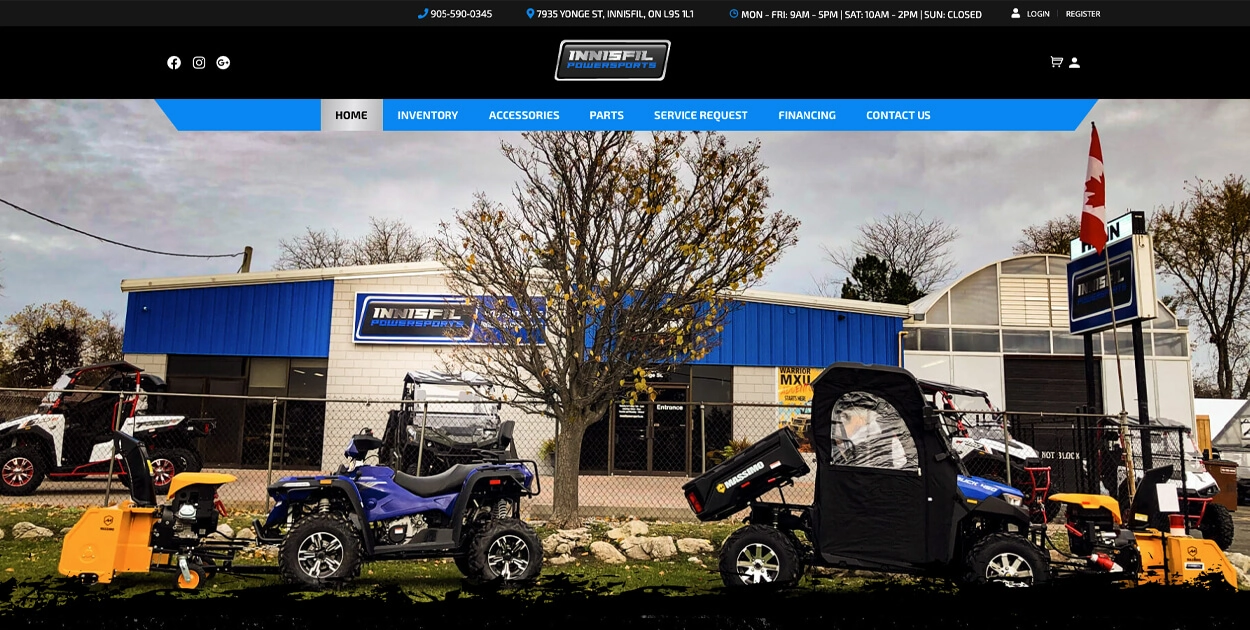
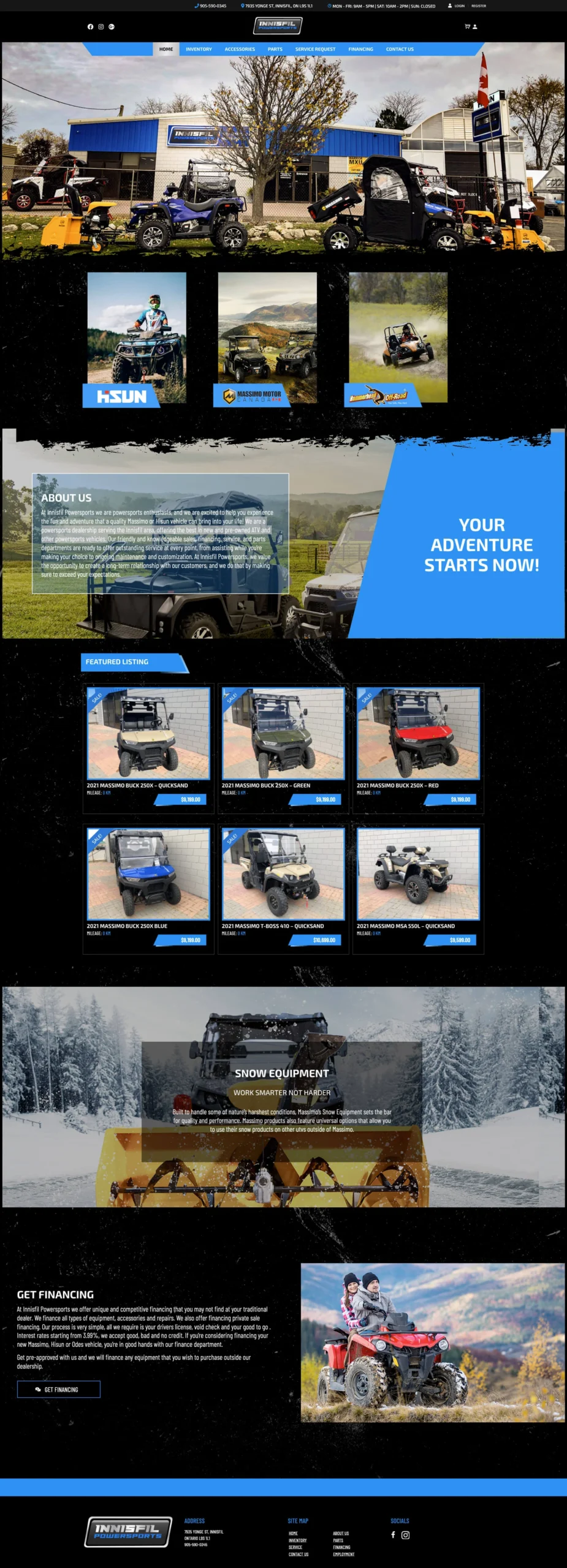
Volt Studios designed and developed Innisfil — a custom website connecting sellers, buyers, and lenders with instant loan approvals. See the Website design story.
The Problem
The Canadian automotive financing space is trust-poor. Traditional dealerships hide the financing conversation until the customer is already in the room; online lenders bury approval flows in forms and fine print. Innisfil’s founding thesis was that transparency could be a product: show buyers what they qualify for, up front, without the dealership theater.
The challenge for Volt Studios was making that thesis tangible — a brand that feels trustworthy to first-time visitors, a marketplace complex enough to handle inventory, applications, and real-time lender decisions, and a user experience simple enough that a buyer could go from browsing to approved in minutes. Every screen had to reduce anxiety, not add it.
Our Approach
The engagement began with brand strategy: a neutral, finance-forward identity that positioned Innisfil as the transparent middle ground between private sellers, buyers, and lenders — explicitly not a dealership.
From there, Volt Studios designed the Lead Engine Framework: fast, filterable vehicle listing pages; clean vehicle detail pages with condition transparency; and an application flow that asks for the minimum data lenders actually need, then returns instant decisions.
Under the hood, the development team built the integrations that let inventory, applications, and approvals flow in real time, with an internal-linking architecture and technical SEO foundation designed to scale with catalog growth. Educational financing content — guides, calculators, and explainers — was wired into the buying journey so SEO traffic converts instead of bouncing.
Results:
The platform launched with the full marketplace loop working end-to-end: sellers list, buyers shop, financing approves in real time.
“They delivered a fast website and platform and helped clearly showcase services,” said Michael Patterson, General Manager. “Communication was easy, everything stayed on schedule, and the results matched exactly what we were looking for.”
For a category where credibility is the entire product, the design did its job: a first-time visitor understands within seconds what Innisfil is, why it’s different, and what to do next.
Web Design & Development Pricing in Canada
Starter
A professionally designed, conversion-focused website with all the essential features your business needs
CAD 2599
- Custom website design in Figma
- Responsive WordPress development
- Up to 8 core pages
- Custom sitemap and page structure
- Conversion-focused page layouts
- Mobile and desktop optimization
- Contact forms and lead capture
- Basic on-page SEO setup
- Schema markup for key pages
- Google Analytics 4 & Search Console setup
- Basic performance optimization
- 30-day post-launch support
Best For: New and small businesses that need a professional website built to generate inquiries.
Professional
For: Established campaigns needing expert oversight and continuous optimization.
CAD 4599
- Custom website design in Figma
- Up to 15 core pages
- Advanced sitemap and information architecture
- Advanced service and industry pages
- Blog and content structure
- Advanced conversion paths
- Custom forms and lead-generation elements
- Advanced on-page SEO & Schema
- Core Web Vitals optimization
- WCAG 2.1 AA accessibility checks
- Two structured design revision rounds
- 30-day post-launch support
Best For: Growth-stage companies that need more from their website and want their website to actively support lead generation.
Business
For: Large e-commerce operations and high-ticket B2B with sophisticated targeting needs.
CAD 6599
- Custom website design in Figma
- 20+ core pages
- Advanced information architecture
- Comprehensive buyer journey mapping
- Custom page templates
- Advanced content architecture
- Custom website functionality
- Advanced forms and interactive elements
- Advanced technical SEO foundation
- Comprehensive schema implementation
- Advanced analytics and event tracking
- Detailed website documentation
- 60-day post-launch support
Best For: New and small businesses that need a professional website built to generate inquiries.
Why Volt Studios?
Volt Studios is a Canadian digital marketing agency whose design and development team has launched more than 100 Canadian websites – law firms in Toronto, Shopify brands in Vancouver, service companies in Calgary and Montreal.
We are the agency that tells you what your website leaks before asking you to spend more.
Common Questions about Web Design and Development Services
How much does a website cost in Canada?
Most Canadian business websites cost $2,500-$12,000 CAD from a professional agency; e-commerce builds on Shopify run $3,000-$30,000, and custom web applications start around $30,000. Page count, functionality, integrations and content move the number. All Volt Studios prices exclude GST/HST, and every quote is fixed-price after the strategy call.
How long does it take to build a website?
A business website typically takes 6-10 weeks from strategy workshop to launch; e-commerce builds take 8-14 weeks. The single biggest factor is content readiness – which is why the content plan is front-loaded in week one and launch dates are set from it, not from optimism.
Do I own my website after it's built?
Yes – 100%. You own the live site, the staging site, the Figma design files, and the hosting, domain and analytics accounts, all registered in your name from day one. There is no lock-in: if you ever leave, everything leaves with you.
WordPress or Shopify - which should I choose?
WordPress suits content-driven sites: service businesses, blogs and lead generation. Shopify suits businesses whose revenue is product sales – and it’s a Canadian-founded platform we know deeply. If you’re unsure, we settle it in the Stage 1 strategy workshop, based on how your buyers actually buy.
Is SEO included in a Volt Studios website?
The on-page SEO foundation is included: search-friendly architecture, metadata, schema markup, Core Web Vitals targets and Search Console configuration on every key template. Ongoing SEO – link building, content production, authority growth – is a separate service, and your new site is built ready for it.
Can I update the site myself?
Yes. Your site is managed in a CMS built for non-developers, and training is part of the deliverable: a live session, written documentation and a training video. Most clients update text, images, pages and blog posts themselves within the first month – no developer required.
What happens after launch?
Every build includes 30 days of post-launch support, then a 90-day performance review against the metrics set in Stage 1 – inquiries, conversion rate, rankings and Core Web Vitals. After that, most clients move onto a website care plan covering maintenance, updates and small improvements.
What if I need changes later?
Small changes are handled through a care plan or ad-hoc support hours – you’re not locked into anything. Larger changes, like new sections, features or campaign landing pages, are quoted as fixed-price mini-projects. And because you own the site and the files, any developer can work on it, including your own.
Can You Redesign My Existing Website?
Absolutely. Our website redesign process preserves what’s working (top-ranking content, design elements customers love) while updating what isn’t (slow pages, poor mobile experience, low conversion). We implement 301 redirects to preserve your search rankings.
Can you rebuild my site without hurting current rankings?
Yes, when migrations follow SEO and technical best practices. That includes URL mapping, redirects, preserving authority pages, and improving Core Web Vitals, internal linking, and schema so you maintain and then grow visibility.
Do you only work with Toronto clients?
No – we work with businesses across Canada, from St. John’s to Victoria, and every build runs remotely with the same process and the same team. For Quebec businesses, we build bilingual English-French sites that serve both markets properly.
Book Your Free Website Strategy Session
Thirty minutes, no pitch theatre. We’ll look at your current site, map your biggest conversion leaks, and give you an honest CAD budget range – whether or not you end up hiring us.
Prefer to talk first? Call 437-747-6976 or email hello@voltstudios.ca. Or browse the case studies and see the before/after numbers for yourself.
Related Services
Local SEO
Improve your local search visibility with optimised Google Business Profiles, location signals, and locally relevant pages.
Ecommerce SEO
Optimise your ecommerce site structure, product pages, and technical foundation to improve rankings and organic sales.
PPC Services
Drive paid Traffic to grow and scalewith the best Framework a Marketing agency can have.
Content Strategy
Build a search-focused content system that connects your topics, entities, and expertise to strengthen organic visibility.