The home services digital marketing industry is worth over $75 billion annually, and the competition for digital attention within that market has never been more intense than now. Understanding the current landscape isn’t optional, it’s the foundation of every good decision you’ll make about where to invest your marketing budget.
You built your contracting business by referrals from satisfied clients, a magnetic sign on your truck, maybe a listing in the Yellow Pages back when that still meant something. For years, the phone rang often enough to keep your crew busy.
But somewhere between 2020 and today, the calls got quieter. The leads that used to arrive without much effort are now going to a competitor you’ve never met, a company that ranks at the top of Google for every search your best customers are typing.
The uncomfortable truth facing Canadian home service contractors in 2026 is the way homeowners find and hire tradespeople has fundamentally changed, and most businesses haven’t kept pace. This guide exists to change that.
This guide is the most comprehensive playbook available for Canadian contractors who want to build a sustainable, predictable pipeline of qualified leads through digital marketing. The strategies in this guide are built specifically for the Canadian market you operate in.
Why the Old Ways of Getting Clients No Longer Work
Let’s be direct about what has changed and why the strategies that served contractors well for decades are now producing diminishing returns.

1. Referrals alone can’t scale your business.
Word-of-mouth remains valuable but referrals are inherently unpredictable. They can’t be turned on when your schedule goes quiet in February. They don’t reach the homeowner in Mississauga who just moved in six months ago and has no local network yet. According to BrightLocal’s 2025 Consumer Review Survey, 87% of consumers now use Google to evaluate a local business even when they’ve received a personal recommendation.
2. Print and directory advertising have collapsed.
The Yellow Pages directories that once delivered qualified leads to businesses across Toronto, Calgary, and Halifax now reach a fraction of their former audience.
3. Traditional website-and-wait is no longer a strategy.
Many contractors built a basic website five or eight years ago and have been operating under the assumption that its presence is sufficient. In 2026, a static website with no ongoing SEO, no GBP optimization, and no conversion architecture isn’t a digital asset — it’s a digital placeholder. A website that isn’t actively maintained is quietly losing ground every month.
4. The competitive landscape has been professionalized.
In most major Canadian markets, the top positions in Google search results are no longer occupied by contractors with the most years in business — they’re occupied by contractors who invested earliest and most consistently in digital marketing. Independent contractors competing against these organizations without a strategic approach are fighting with one hand tied behind their back.
5. AI is reshaping how search results look.
In 2026, Google’s AI Overviews appear in an estimated 4.5% to 12.5% of home service searches in Canada, generating direct answers at the top of the results page before a user ever scrolls to organic listings. Research indicates these AI-generated summaries have reduced click-through rates to the first organic result by as much as 65% in affected query categories. This means that contractors who were previously satisfied with a first-page ranking can no longer assume that ranking translates into the same volume of traffic it once did.
How Homeowners in Canada Find Contractors Online
Understanding the customer journey in 2026 requires looking beyond the oversimplified idea of a homeowner typing a keyword into Google.
Google dominates contractor discovery at every stage. Across Canada, Google mediates more than 70% of contractor discovery decisions, encompassing organic search results, the Google Maps Pack, and the increasingly prominent Google Local Services Ads (LSA) format that now appears above organic results with a verified Google badge.
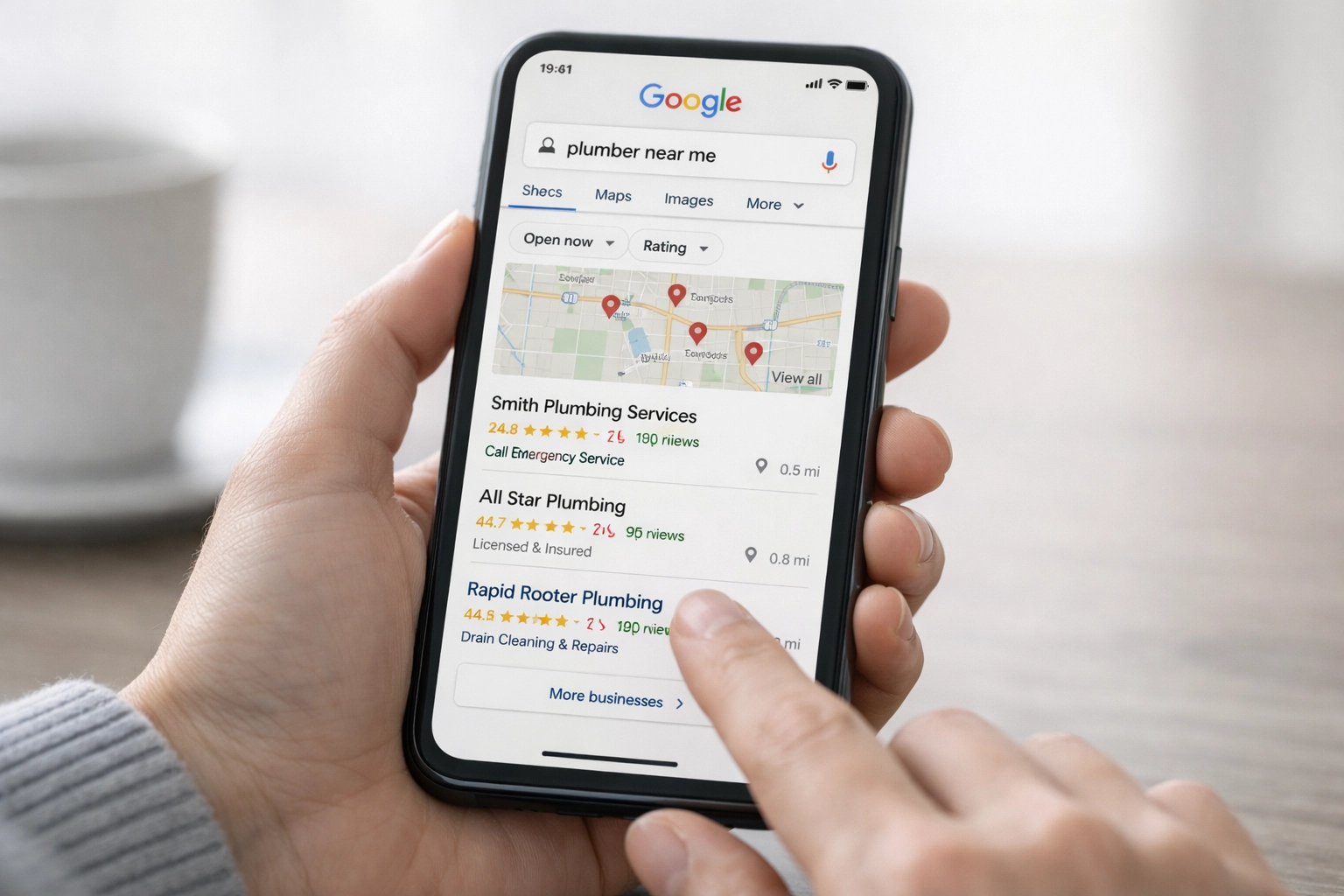
For contractors, the implications are significant: you need a presence in all three of these Google environments simultaneously. A business that ranks organically but hasn’t claimed its Google Local Services Ads listing is leaving visible real estate on the table in every single search query.
The Three Pillars: SEO, PPC, and Web Design Working Together
Imagine you’re building a custom home in Calgary. You wouldn’t pour the foundation, then walk away and skip the framing. You wouldn’t finish the drywall before the structure is sound. Every trade depends on the one before it, and the finished home only holds its value when every element works together. Digital marketing for Canadian home service contractors works exactly the same way.
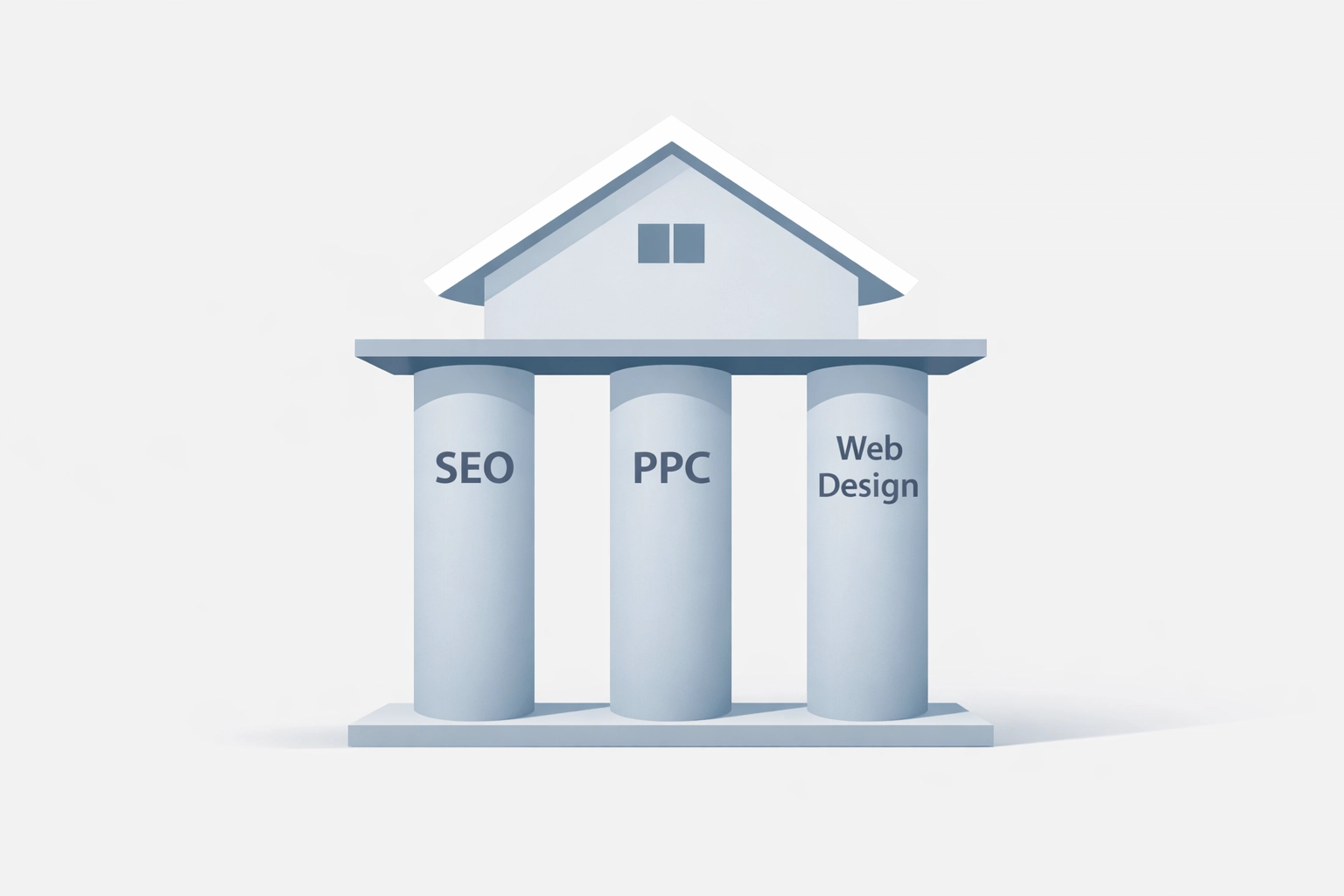
SEO, PPC, and web design aren’t three separate services you pick from a menu. They’re three interdependent pillars that, when coordinated properly, create a growth system capable of generating returns that dwarf what any single channel could produce alone.
Why You Can’t Just Do One and Ignore the Others
The PPC-only trap is the most common.
A roofing contractor in Mississauga spends $4,000 a month on Google Ads, gets consistent leads, and decides that’s the business. Then Google updates its Local Services Ads algorithm, competition in the auction intensifies from a national franchise and the moment they stop paying, every single lead stops arriving.
There’s no asset. No compounding growth. Just a rented audience that disappears the second the credit card is declined.

The SEO-only gamble is the opposite mistake.
Organic search is the most powerful long-term channel in home services digital marketing in Canada, but it takes time.
A plumber in Edmonton optimizing for organic traffic today may wait six to twelve months before seeing meaningful lead volume. During that runway period, their competitors on paid search are capturing every high-intent search query.
Organic growth without paid support during the development phase is like building a house with no temporary power.
The pretty website problem is perhaps the most frustrating.
Countless Canadian contractors have invested $8,000 to $15,000 in a beautifully designed website that generates almost no business. Without SEO, no one finds it. Without PPC, no traffic arrives during the organic ranking period.
A high-performance website without traffic strategy is a billboard in the middle of a forest.

When these three pillars are built and maintained together, you get compounding advantages that no single-channel approach can replicate.
Ready to stop guessing and start growing? Volt Studios builds integrated digital marketing systems purpose-built for Canadian home service contractors. Book your free strategy session and find out exactly what your local market opportunity looks like.
The Volt Studios Website Growth System Explained
At Volt Studios, we’ve distilled years of working with Canadian contractors into a structured methodology we call the Website Growth System. Here’s how the three pillars function within that system:
Pillar 1: Web Design — Your Foundation
Every engagement begins with the foundation. We build or rebuild your website to function as a conversion engine, not a digital brochure.
This means fast load times that meet Canadian mobile browsing expectations (over 70% of local service searches now happen on mobile devices), clear service-area pages that signal geographic relevance to Google, trust elements like licensing information and verified reviews, and calls-to-action strategically placed based on conversion data from the home services vertical.
Your website is the asset that every other marketing channel depends on. Without a high-performing foundation, every dollar you spend on SEO and PPC is partially wasted.
Pillar 2: SEO — Your Framing
Once the foundation is sound, we build the structure that will carry the weight of long-term organic traffic. This includes local SEO optimization targeting your specific service areas inluding Greater Toronto Area, Metro Vancouver, Calgary’s communities, or smaller regional markets where competition is lower and opportunity is often higher.
We develop Google Business Profile authority, build location-specific service pages, and execute content strategies that answer the exact questions Canadian homeowners ask before hiring a contractor.
Pillar 3: PPC — Your Finishing Work
Paid search, including Google Search Ads and Local Services Ads, is the finishing layer that makes the whole system immediately functional while the framing sets.
PPC generates leads from day one, tests which messaging converts best in your specific Canadian market, and protects your brand visibility in competitive auctions. As your organic rankings mature, we reduces spend in categories where you’ve earned strong organic positions and redirecting budget toward new service lines or geographic expansion.
When these pillars operate as an integrated system with clear SMART goals tying every activity to business outcomes, the returns are substantial and well-documented. Canadian contractors investing $2,000 to $4,000 monthly in a coordinated program typically achieve 300% to 400% annual ROI once the system matures.
These aren’t theoretical numbers. They reflect what happens when web design, SEO, and PPC stop operating as separate line items and start functioning as a single, coordinated growth engine built specifically for the Canadian home services market.
Understanding the system is one thing. Executing it correctly requires a precise, market-specific approach.
Pillar 1: Web Design That Converts Visitors Into Calls
Your website is not a digital brochure — it is your highest-performing salesperson, working around the clock to convert curious searchers into booked appointments.
Yet the majority of Canadian contractor websites still treat their online presence as an afterthought: slow to load, difficult to navigate on a phone, and lacking the trust signals that turn a visitor into a caller.

In 2026, that gap between a mediocre website and a conversion-optimized one is measured directly in revenue. Traffic without conversion is simply wasted ad spend. If your website is not engineered to generate calls, every dollar you invest in Google Ads, local SEO, or social media is leaking into a bucket with a hole in it.
The standard benchmark for a well-optimized contractor website sits between 8% and 15% conversion rate on organic traffic. Most Canadian contractor websites convert at under 3%. Closing that gap is entirely a web design problem, and it is entirely solvable.
Must-Have Features for Contractor Websites
Every dollar of design investment should be evaluated against one question: does this element make it easier or harder for a visitor to call or book?
With that filter in mind, the following features are non-negotiable for any home services website competing in the Canadian market in 2026.
- Prominent Click-to-Call Buttons on Every Page: Your phone number must be clickable, visible without scrolling, and present on every single page of your website. Research consistently shows that click-to-call buttons placed above the fold can increase call volume by 30% or more compared to phone numbers buried in a footer.
- One-Click Booking and Real-Time Availability: Canadian homeowners increasingly expect the same on-demand convenience from their plumber or electrician that they get from booking a restaurant on OpenTable. Visitors who can book a time slot without picking up the phone convert at significantly higher rates, particularly among the 25–45 demographic that dominates home services searches in urban Canadian markets.
- Social Proof Positioned Strategically, Not As an Afterthought: Reviews and testimonials should appear on your homepage, your service pages, and adjacent to every call-to-action. Do not relegate social proof to a dedicated “Testimonials” page that no one visits.
- Clear Service Area Definition: Every service page should explicitly state the cities, municipalities, and regions you serve. This is both a conversion element and an SEO signal.
- Simple Contact Forms With Minimal Fields: Every additional field on a contact form reduces completion rates by approximately 10%. For most contractor websites, the optimal form captures three pieces of information: name, phone number, and a brief description of the job.
- Trust Badges and Credentials Above the Fold: Display your TSSA certification, ECRA licence number, BBB accreditation, or relevant provincial credentials as visual badge elements near the top of your homepage.
- AI Chatbots for After-Hours Capture: In 2026, AI-powered chat widgets are capturing approximately 27% of after-hours website impressions for contractor businesses that have implemented them. Tools like Tidio, Drift, and industry-specific solutions integrated with your CRM mean no lead goes uncaptured, regardless of when they arrive on your website.
Mobile Optimization and Page Speed
Over 68% of home services searches in Canada now happen on a mobile device, and that number climbs to over 75% for urgent service categories like emergency plumbing, furnace repair, and after-hours electrical.
If your website provides a substandard mobile experience, you are effectively invisible to the majority of your potential customers — even if you rank on page one.
The Three-Second Rule Is Now the Industry Standard. Websites that take longer than three seconds to load lose approximately 53% of mobile visitors before a single word is read. Page speed is a confirmed Google ranking factor, and the gap between a 1.8-second load time and a 4.2-second load time can represent multiple positions on a local search results page.
Core Web Vitals: The Technical Benchmarks That Matter
Google’s Core Web Vitals framework measures three specific performance signals that directly influence your search rankings:
- Largest Contentful Paint (LCP): The time it takes for your main content block to load. Target under 2.5 seconds.
- Interaction to Next Paint (INP): How quickly your page responds to user interactions like button clicks. Target under 200 milliseconds.
- Cumulative Layout Shift (CLS): How much your page elements shift around as it loads — a common problem on contractor sites with oversized banner images. Target a score under 0.1.
Free tools like Google PageSpeed Insights and GTmetrix can benchmark your current performance and identify the specific issues dragging your scores down.
Mobile-First Design Is Not Optional
Mobile-first means designing the phone experience first, then scaling up to desktop — not the reverse. Practically, this means touch-friendly buttons with a minimum tap target of 48×48 pixels, font sizes no smaller than 16px for body text, forms that do not require zooming to complete, and navigation menus that collapse cleanly without obscuring content.
Your click-to-call button should be large enough to tap with a thumb while holding a phone in one hand.
Actionable Web Design Checklist for Canadian Contractors
☐ Click-to-call button visible above the fold on mobile
☐ Website loads in under 3 seconds on mobile (test with Google PageSpeed)
☐ Core Web Vitals scores in “Good” range for LCP, INP, and CLS
☐ Real-time booking or scheduling widget installed
☐ Google reviews displayed on homepage and service pages
☐ Service area cities named explicitly on every relevant page
☐ Contact form with three fields maximum
☐ AI chatbot configured for after-hours lead capture
☐ Licensing and insurance credentials displayed above the fold
☐ All images compressed to WebP format
☐ Hosting on a Canadian server for optimal domestic load times
☐ Mobile navigation tested on iOS and Android devices
A website that scores well on every item in this checklist will consistently outperform competitors in both search rankings and call conversion — compounding the return on every other marketing investment you make.
Pillar 2: SEO for Canadian Home Service Companies
Search engine optimization remains the highest-ROI long-term channel for Canadian home service contractors. Google’s AI Overviews now reduce click-through rates to the number-one organic position by as much as 65%, meaning ranking alone is no longer enough.
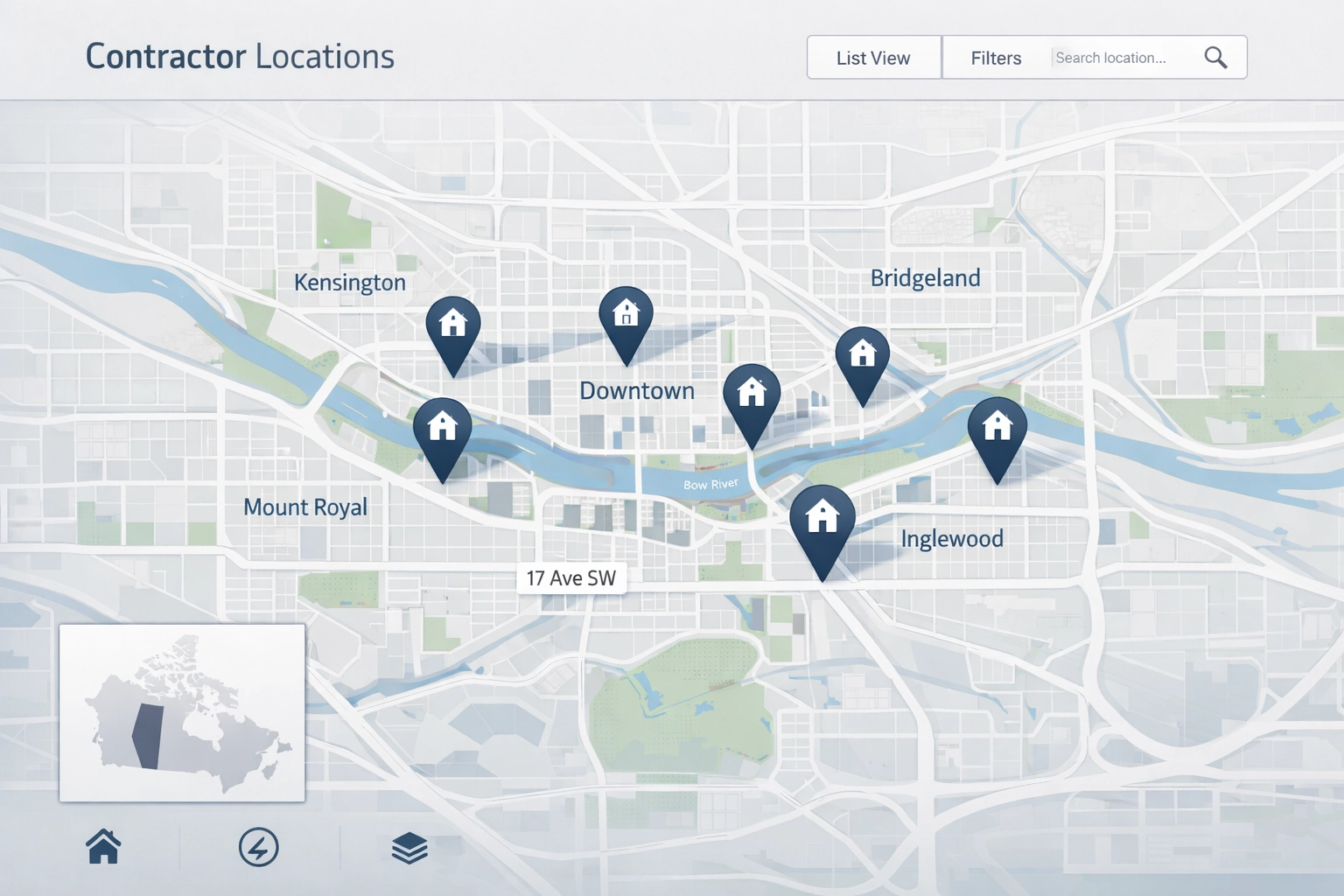
To compete in Canadian markets requires a layered SEO strategy that combines technical precision, hyper-local targeting, and content architecture designed for both human readers and large language models. The good news is most of your local competitors haven’t adapted yet.
Local SEO Fundamentals for Contractors
For any home service company, local SEO is the foundation everything else is built on. Over 70% of home service searches happen on Google, and the majority of those searches trigger a Map Pack result above the organic listings. Winning that Map Pack placement is non-negotiable.
1. Google Business Profile:
Google Business Profile (GBP) is no longer a simple directory listing — it’s a fully interactive storefront that potential customers evaluate before they ever visit your website.
In 2026, an optimized GBP includes:
- Complete business information: NAP (Name, Address, Phone) consistency is critical. Your information must match exactly across your website, HomeStars profile, Houzz Canada listing, and every other citation. Even minor discrepancies like “St.” versus “Street,” or a missing suite number can erode your local ranking authority.
- Primary and secondary categories: Choose your primary category with surgical precision (“HVAC Contractor” outperforms “Contractor”), then add secondary categories for every relevant service you offer.
- Weekly GBP posts: Google rewards active profiles. Post project photos, seasonal promotions (think furnace tune-up specials ahead of a Canadian winter), and service updates at least weekly.
- Attributes and services: Fully populate your services section with descriptions that naturally include your core keywords. Enable every relevant attribute, including the newer “Online Estimates” feature, which now appears as a filter above traditional Map Pack results.
2. The Review Velocity Imperative
Google reviews control 20–25% of Map Pack ranking authority, making reputation management a direct SEO activity, not just a customer service function.
Critically, review velocity matters more than total review count.
A competitor with 40 reviews accumulated over three years is outranked by a contractor generating 3–5 new reviews every single month.
Build a systematic review acquisition process: trigger an automated SMS or email request 24 hours after job completion, make the Google review link a single tap, and train your field technicians to verbally mention reviews before leaving the property.
Respond to every review — positive and negative — within 48 hours. Google interprets owner responses as engagement signals, and prospective customers in places like Edmonton or Kitchener-Waterloo read those responses carefully before making a hiring decision.
3. Citation Building in the Canadian Ecosystem
Beyond GBP, authoritative Canadian directories compound your local SEO authority.
A fully built HomeStars profile with photos, verified reviews, and complete service descriptions functions as a secondary web presence that both ranks on its own and passes equity to your main domain.
Houzz Canada operates similarly, particularly for renovation contractors, interior designers, and landscaping companies.
Prioritize these two platforms above generic directories, then build citations across the Canadian Yellow Pages, BBB (Better Business Bureau Canada), and any provincial trade association directories relevant to your licence.
Service-Area Pages and Multi-City Targeting
One of the most powerful and consistently underutilized tactics in home services digital marketing across Canada is the strategic development of dedicated service-area pages.

If your plumbing company serves Greater Vancouver including Burnaby, Richmond, Surrey, Coquitlam, and Langley, a single homepage optimized for “Vancouver plumber” is leaving enormous search volume untapped. Each city and major neighbourhood represents its own search market with its own keyword demand.
The Service-Area Page Framework
Every service-area page must be genuinely unique and locally relevant — not a thin, templated page that simply swaps city names.
Google’s Helpful Content guidelines aggressively penalize low-value doorway pages. Instead, build pages that demonstrate authentic local knowledge:
- Local context: Reference specific regional challenges. An HVAC page targeting Winnipeg should address extreme temperature variance and the particular demands that place on heating systems. A waterproofing page for Burnaby should mention the region’s rainfall averages and soil conditions.
- Local trust signals: Embed Google Maps, cite your service radius, and mention any city-specific licences or permits your company holds. In Ontario, referencing your TSSA (Technical Standards and Safety Authority) registration on relevant service pages builds credibility and keyword diversity simultaneously.
- Localized testimonials: If you have reviews from customers in that specific city, feature them on the corresponding page.
- Schema markup: Implement LocalBusiness schema with the precise service area defined. This structured data is now essential not just for Google’s crawlers but for large language models that extract and synthesize contractor information for AI-generated answers.
Hub-and-Spoke Topical Architecture
Building topical authority requires a hub-and-spoke content architecture.
Your main service page (the hub) should link to and receive links from a cluster of supporting pages (the spokes) covering related subtopics in depth.
A roofing contractor targeting the Ottawa market might structure their architecture like this:
Hub: Ottawa Roofing Contractor (core service page)
Spokes:
- Types of Roofing Materials for Ottawa’s Climate
- How to Identify Ice Dam Damage
- Ottawa Roofing Permits and Regulations
- When to Repair vs. Replace Your Roof
- Flat Roof vs. Sloped Roof for Ottawa Homes
This architecture signals comprehensive expertise to Google and positions your content to capture long-tail voice search queries.
Programmatic Scale with Quality Control
For contractors operating across large service territories, programmatic page generation can scale service-area coverage efficiently.
The critical rule: every programmatically generated page must pass a quality threshold that includes unique local content, real service data, and genuine E-E-A-T signals.
Scaling thin pages is a penalty risk; scaling genuinely useful local pages is a competitive moat.
Content Marketing That Builds Trust
In 2026, content marketing for Canadian contractors has two simultaneous audiences: human homeowners doing research and AI systems synthesizing answers.
Satisfying both requires a commitment to depth, accuracy, and demonstrated expertise that goes beyond keyword insertion.

GEO: Writing for Generative Engine Optimization
Generative Engine Optimization (GEO) is now a core discipline for any contractor investing in organic search.
When a homeowner in Scarborough asks their AI assistant “how much does furnace replacement cost in Toronto,” the answer that surfaces is pulled from pages that are structured for extraction having clear headings, direct answers, factual specificity, and schema markup that helps language models understand the content’s context.
Practically, this means:
- Lead every major section with a direct, definitive answer before elaborating
- Use FAQ sections with question-format headings that mirror natural language queries
- Cite specific data, ranges, and Canadian-relevant figures (costs in CAD, references to provincial rebate programs like Ontario’s Home Efficiency Rebate Plus)
- Implement FAQ schema and HowTo schema wherever applicable
Featured snippets generate approximately 8% more traffic than a standard first-position result and serve as a primary source for AI Overview content. Capturing them requires answering questions more directly and completely than any other page on the topic.
The Contractor Trust Content Blueprint
Homeowners hiring contractors are making high-stakes decisions involving significant money and access to their homes. Content that genuinely reduces uncertainty converts browsers into leads.
High-performing content formats for Canadian contractors include:
- Buyer’s guides: “How to Choose a Licensed Electrician in British Columbia” addresses real homeowner anxiety while capturing mid-funnel search traffic and naturally incorporating regulatory references (BC Safety Authority licensing requirements) that signal genuine expertise.
- Cost transparency pages: “How Much Does a New Roof Cost in Calgary in 2026” with realistic price ranges, factors that affect cost, and honest explanations of why quotes vary. These pages consistently earn links from local media and real estate sites.
- Project showcase content: Detailed before-and-after case studies from real jobs in specific neighbourhoods. A kitchen renovation case study set in a Plateau-Mont-Royal triplex resonates with Montreal homeowners in a way no generic content can replicate.
- Seasonal and regulatory content: Canadian homeowners have seasonal needs (winterization guides, spring flood-proofing in flood-prone regions like the Fraser Valley) and regulatory questions (Ontario Building Code requirements for basement finishing, Alberta gas line permit rules). Contractors who own this content own the relationship at the research stage.
Consistency and Compounding Returns
Content marketing is a compounding investment. A blog post published today may not generate significant traffic for three to six months but content published consistently over 12 to 24 months creates a topical authority signal that becomes increasingly difficult for competitors to displace.
Commit to a minimum publishing cadence of two to four pieces per month, prioritize depth over volume, and audit existing content annually to update statistics, refresh seasonal information, and capture new keyword opportunities.
Building organic visibility through SEO creates the foundation of sustained lead generation but organic search alone rarely maximizes a contractor’s growth potential in competitive Canadian markets.
The fastest way to accelerate results is to fill schedule gaps during slow seasons, and target specific high-value services is through paid search advertising.
In the next section, we break down exactly how Canadian contractors should be running Google Ads and Local Services Ads campaigns to dominate their markets right now.
Pillar 3: PPC and Google Ads for Home Services
For Canadian home service contractors, paid advertising has evolved far beyond simple banner ads or basic search results.
In 2026, a sophisticated PPC ecosystem exists specifically designed for trades businesses and the contractors who understand how to navigate it are capturing market share at an extraordinary rate.
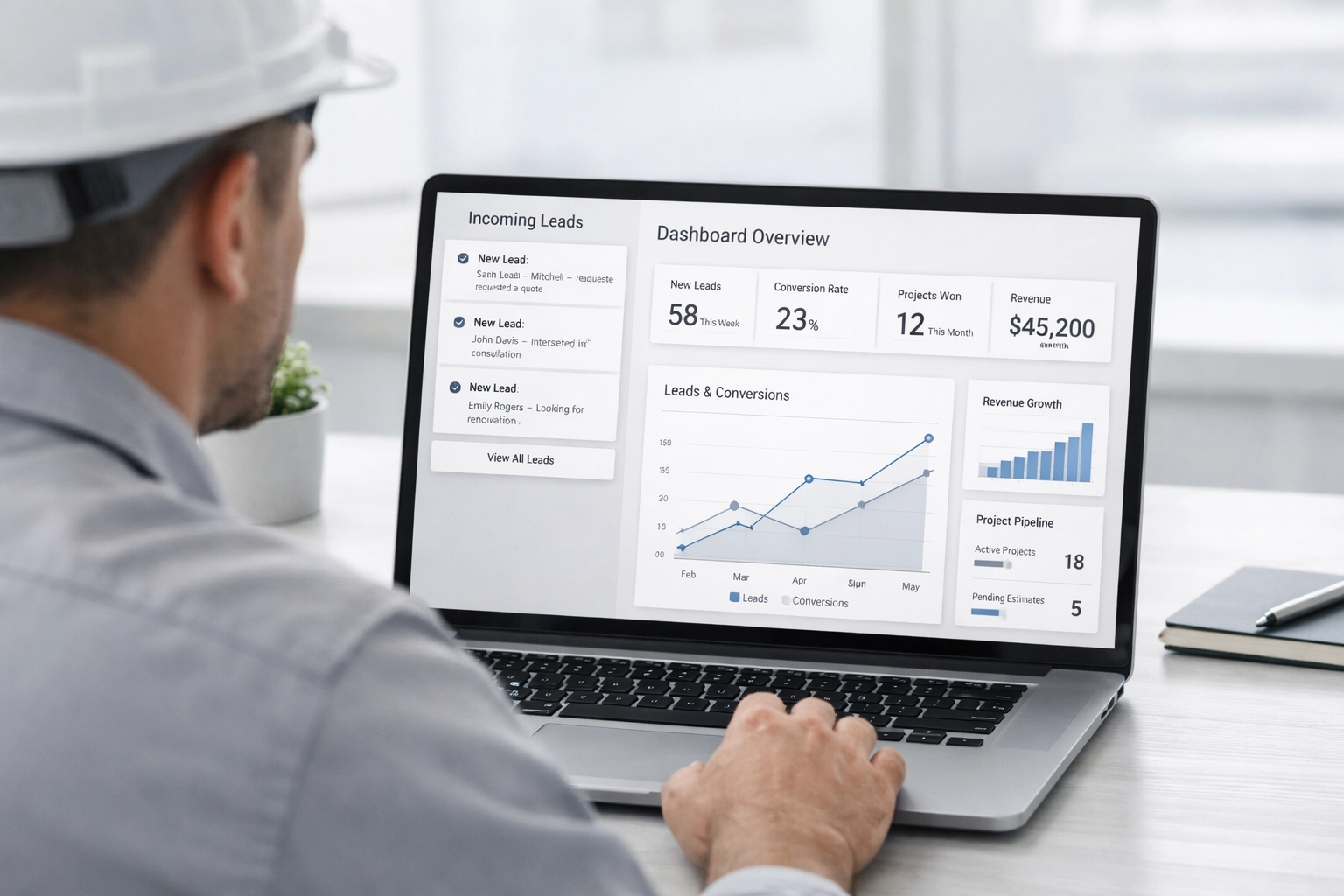
The fundamental advantage of PPC for home services is immediacy.
Unlike SEO, which builds authority over months, a well-structured Google Ads campaign can place your business in front of a homeowner searching “emergency furnace repair Mississauga” within hours of launch.
Google Local Services Ads
If you’re not running Google Local Services Ads (LSAs) in Canada, you are conceding the most valuable real estate in digital marketing to your competitors.
LSAs appear above all organic search results and above traditional Google Ads, commanding the top position on the search results page. This placement alone makes them non-negotiable for serious home service contractors.
Unlike traditional pay-per-click advertising, Local Services Ads operate on a pay-per-lead model — you are charged only when a customer actually contacts you through the platform, not for every click that lands on your page. This fundamental shift significantly improves budget efficiency, particularly for smaller contractors who cannot afford wasted spend.
The Google Verified Badge is the cornerstone of the LSA system. Earning this badge requires verifying your business licensing, proof of adequate insurance, and in many service categories, background checks for technicians.
Additionally, Canadian market data shows that 27% of home service search impressions occur during evening and overnight hours precisely when most contractor offices are closed. Automated booking through the LSA-ServiceTitan integration captures this demand that would otherwise be lost entirely.
Budget Allocation: What Should You Spend?
The most common mistake Canadian home service contractors make with PPC is treating their ad budget as a fixed, unchanging expense rather than a dynamic investment calibrated to market demand, seasonal fluctuations, and business growth objectives.
There is no universal correct budget — but there are clear, data-supported ranges that correspond to predictable ROI outcomes.
Small Contractors and Solo Operators ($2,000–$4,000/Month)
For contractors just establishing their digital advertising presence, or those operating in smaller markets such as Kelowna, Fredericton, or Sudbury, a monthly PPC investment between $2,000 and $4,000 CAD consistently generates returns in the 300–400% ROI range.
At this budget level, the priority is laser-focused geographic targeting, a limited set of high-intent keywords, and maximizing LSA presence over traditional search ads.
Every dollar should be working to capture in-market buyers within a clearly defined service radius.
Growing Regional Contractors ($3,000–$6,000/Month)
Contractors operating across multiple service areas will find the $3,000 to $6,000 monthly range delivers 400–600% ROI when campaigns are properly structured.
At this tier, a combination of Local Services Ads and traditional Google Search Ads allows you to dominate both the LSA premium placement and the standard paid search positions below it, effectively owning the top of the page across your entire service territory.
Established Multi-Crew Operations ($4,000–$8,000+/Month)
For established contractors running multiple crews and targeting sustained growth in competitive urban markets, the $4,000 to $8,000+ monthly investment range unlocks 600–2,000% ROI.
At this level, sophisticated campaign structures including competitor targeting, service-specific ad groups, and seasonal demand surge budgeting compound returns dramatically.
The upper end of this ROI range reflects high-margin services such as full HVAC system replacements or whole-home electrical panel upgrades, where a single converted lead can generate $8,000–$20,000 in revenue.
Ready to build a PPC strategy that delivers measurable ROI for your contracting business? The team at Volt Studios specializes exclusively in digital marketing for Canadian home service contractors. Book a free strategy call today and discover exactly what your market will bear.
Choosing the Right Digital Marketing Partner
Selecting the right digital marketing agency is one of the most consequential business decisions a contractor can make.
Whether you operate a plumbing company in Calgary, an HVAC business in Mississauga, or a roofing crew in Vancouver, your marketing partner must understand the unique demands of home services digital marketing in Canada.
Before you sign anything, watch for these deal-breaking warning signs that signal an agency is not the right fit for your contracting business.
1. Guaranteed #1 Rankings
No legitimate agency can promise first-place rankings on Google. Search algorithms are complex, competitive, and constantly evolving. Any agency that guarantees top positions is either misleading you or planning to use black-hat tactics that could result in your website being penalized — or removed from search results entirely.
2. Long-Term Contracts Without Performance Clauses
Beware of agencies locking you into 12- or 24-month agreements with no accountability milestones built in. Reputable partners align their success with yours. If an agency refuses to include performance benchmarks, reporting obligations, or exit clauses tied to underperformance, consider that a significant warning sign.
3. Vague or Non-Existent Reporting
Transparency is non-negotiable. If an agency can’t tell you exactly where your money is going, what metrics they’re tracking, and how those metrics connect to real business outcomes like booked jobs and phone calls, you’re flying blind with your budget.
4. No Industry-Specific Experience
A generalist agency that has never marketed a home services business may not understand the seasonal demand cycles, local service areas, emergency call dynamics, or licensing nuances that define your industry. Ask for case studies from contractors specifically — not just general small business clients.
5. Offshore or Outsourced Everything
Canadian contractors serve Canadian homeowners in specific provinces and municipalities. An agency that outsources all strategy, content, and communication offshore may not understand local market conditions, Canadian consumer behaviour, or regional SEO considerations like province-specific search intent.
Conclusion: Your Path to Predictable Growth Starts Here
In 2026, with over 78% of homeowners beginning their contractor search online and mobile searches for local trades up 43% year-over-year, the gap between contractors who thrive and those who struggle comes down to one thing: a deliberate, consistent approach to home services digital marketing in Canada.
The good news is that the path forward is clear, proven, and entirely within your reach.
Throughout this guide, we’ve built the case for three foundational pillars that separate high-growth home services businesses from the rest.
First, a conversion-optimized, locally-targeted website that works as your hardest-working sales tool — not just a digital business card.
Second, a dominant local SEO and Google Business Profile strategy that ensures you appear when homeowners in your service area are actively searching for exactly what you offer.
And third, a reputation and review system that builds trust before a single phone call is made, shortening your sales cycle and increasing average job value.
Together, these pillars don’t just generate leads — they create predictable, scalable revenue that lets you plan, hire, and grow with confidence.
Here’s your next step: book your free digital marketing audit with Volt Studios today. In a no-pressure, 30-minute strategy session, our team will review your current online presence, identify your biggest growth opportunities, and give you a clear, actionable roadmap.
The busiest season is always closer than it looks, and the contractors booking more jobs this year started building their digital foundation months ago. Now is the right time to act.