Canadian plumbers face a uniquely competitive local search landscape driven by emergency intent searches like “emergency plumber near me” spike during Ontario pipe-freeze events in January and February.
This guide addresses how to win those high-intent emergency searches while also building long-term organic visibility for planned services like bathroom renovations and water heater replacement.
Why Canadian Plumbers Struggle to Get Leads From Google
If you run a plumbing business in Toronto, Calgary, Vancouver, or anywhere else across Canada, you’ve likely noticed something frustrating: you search for your own services online and your company is nowhere to be found.
Instead, you see HomeStars, YellowPages.ca, and a handful of aggregator sites dominating every page one result.
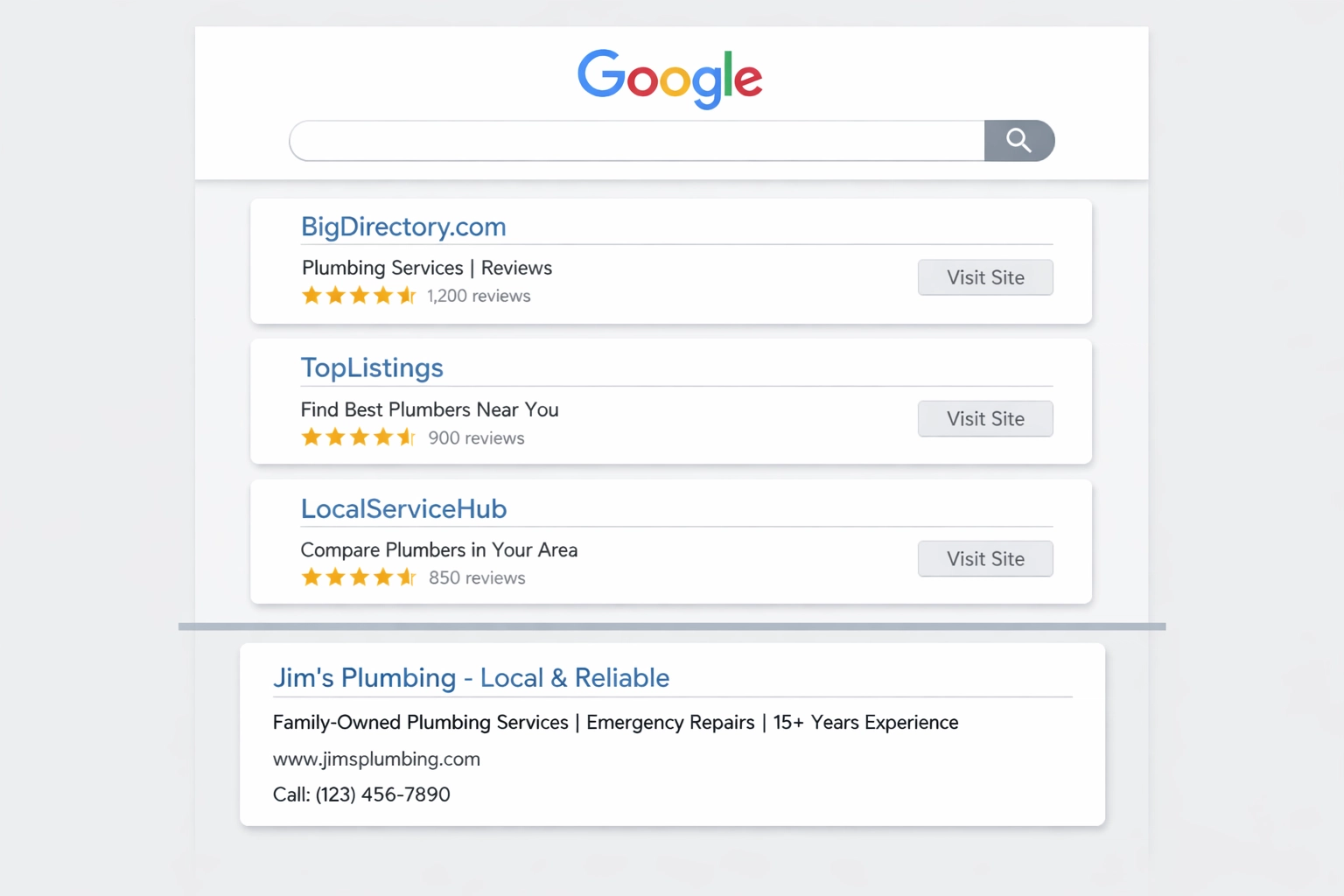
This isn’t bad luck—it’s a structural challenge baked into the way Google treats local service searches in Canada, and it’s costing independent plumbers thousands of dollars in lost revenue every single month.
Understanding why this happens is the first step toward fixing it.
Effective SEO for plumbers Canada isn’t just about stuffing your website with keywords and hoping for the best. It requires a clear-eyed look at who you’re actually competing against, what Canadian homeowners search for when a pipe bursts at 2 AM in January, and how the current search landscape can work in your favour once you know how to navigate it.
In 2026, Canadian homeowners conduct more local service searches than ever before.
How Google Ranks Plumbing Companies in Canada
If you’ve ever searched “plumber near me” or “emergency plumber Toronto” and noticed that the results look completely different from a regular Google search, the split between Local Pack results and organic rankings.
These two types of search results operate on different algorithms, reward different signals, and require different strategies to win.
Understanding how both work and how they interact is the foundation of any effective local SEO campaign for a Canadian plumbing business.
Plumbing is what SEO professionals call a “local intent” industry.
When someone searches for a plumber in Calgary or a drain cleaning service in Vancouver, Google knows with near-certainty that the searcher wants a local business they can call today, often within the hour.
This isn’t like searching for “how to fix a leaky faucet,” where Google might serve up a YouTube tutorial or a DIY blog.
Emergency plumbing searches, service-area searches, and “near me” queries all trigger Google’s local search features, which means your visibility in 2026 depends heavily on two very different battlegrounds: the Local Pack at the top of the results page, and the organic listings below it.
The Local Pack: What It Takes to Show Up in the Map Results
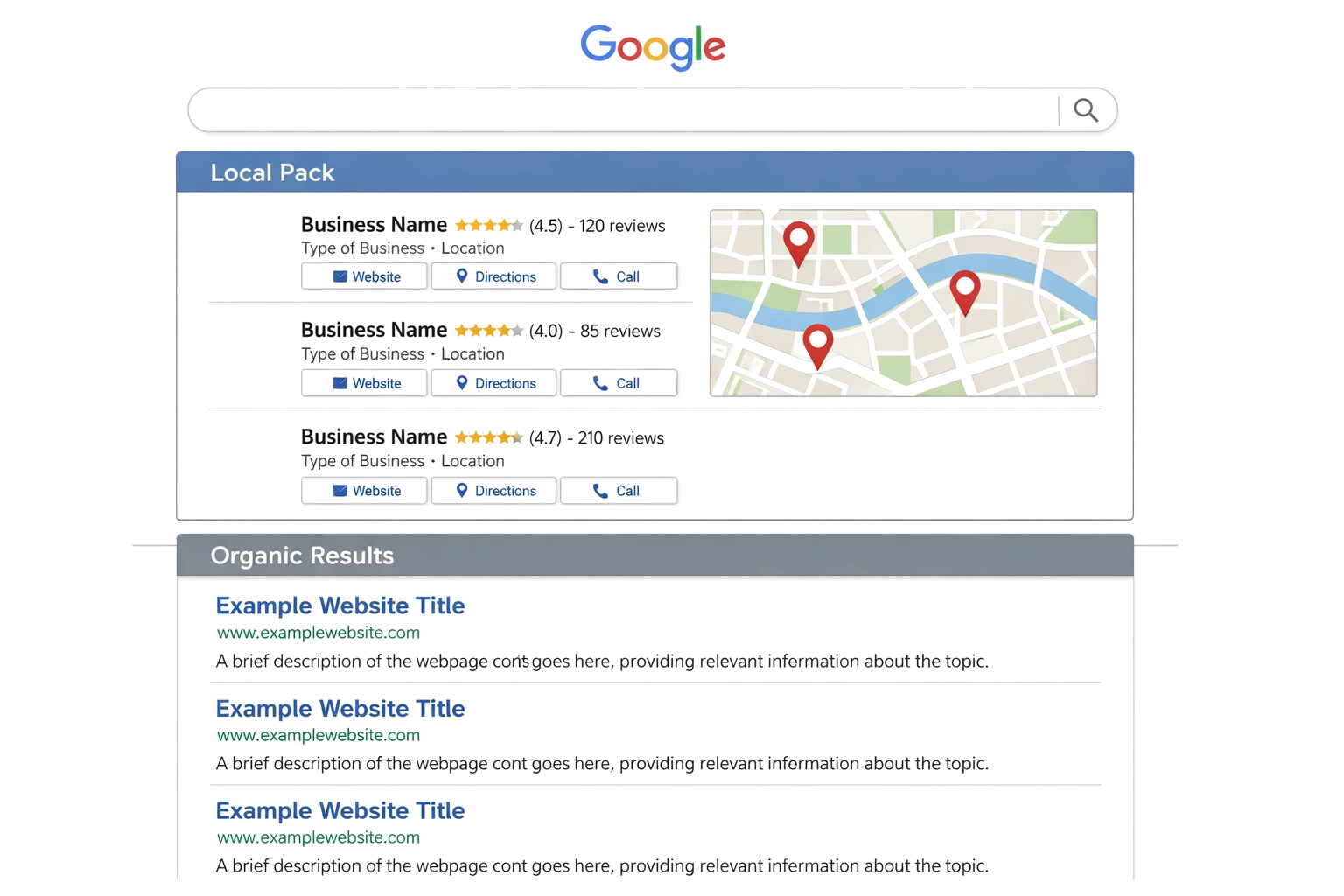
The Local Pack is that prominent section near the top of Google’s search results that displays a map alongside three business listings. Each listing shows a business name, star rating, review count, address, and a brief description.
For plumbers, this is prime real estate. Studies consistently show that the Local Pack captures the majority of clicks for high-intent local searches, and with only three spots available for all the plumbing companies in a city like Mississauga or Edmonton, competition is fierce.
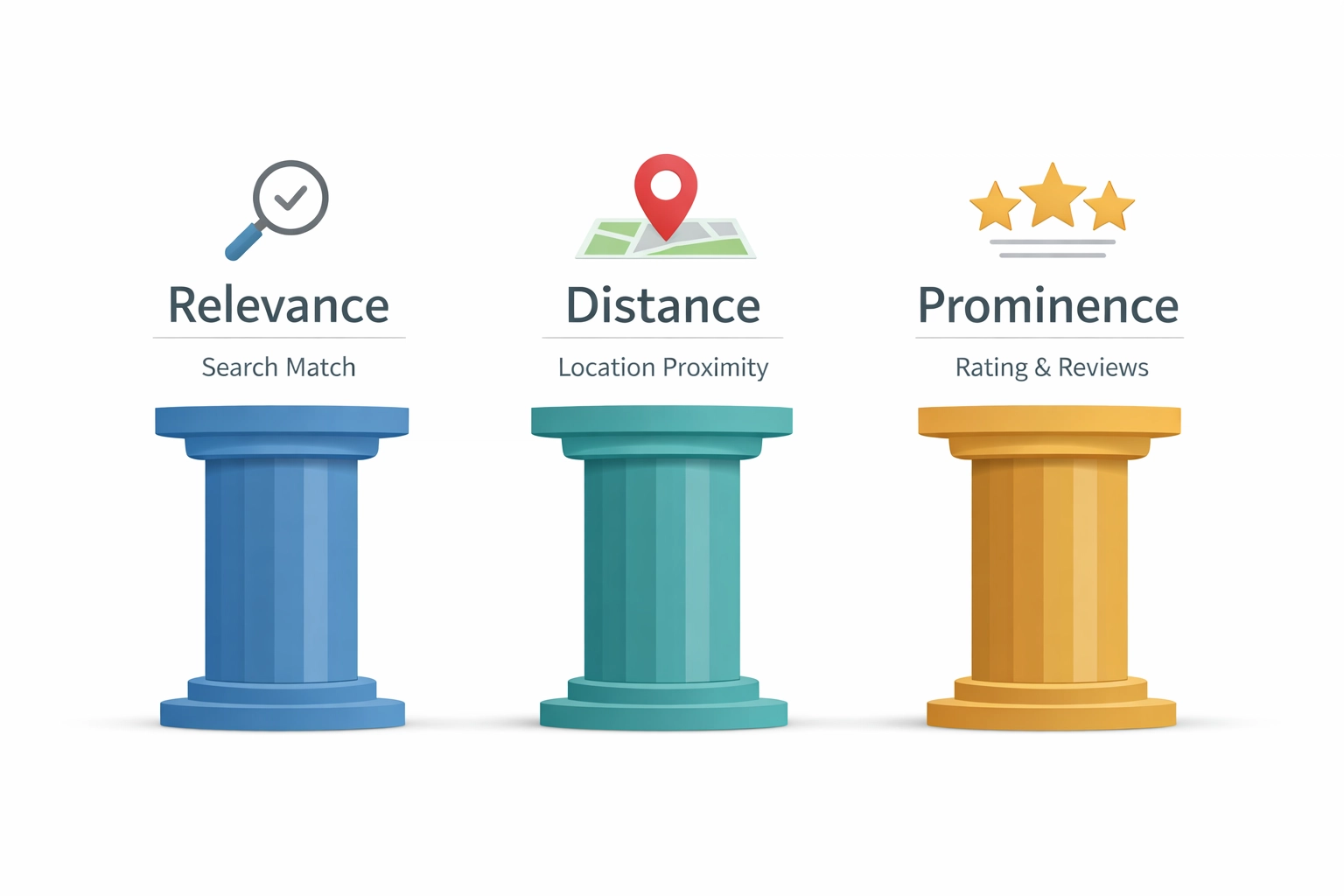
Google’s Local Pack algorithm is governed by three core ranking factors: Relevance, Distance, and Prominence.
Relevance refers to how well your Google Business Profile (GBP) matches what the searcher is looking for. If someone searches “hot water tank replacement Calgary” and your GBP lists water heater services, emergency plumbing, and residential plumbing, Google can confidently match your business to that query.
Distance is how close your business location (or your listed service area) is to the searcher. This is why a plumber based in North York might rank well for searches in that neighbourhood but struggle for searches in Scarborough. It also explains why adding accurate service areas to your GBP matters enormously for plumbers who travel across a city.
Prominence is where the real strategy lives. This factor measures how well-known and trusted your business is, both online and offline. Google evaluates prominence using signals like the number and quality of your Google reviews, the frequency of your review responses, the number of citations (listings on other websites like YellowPages.ca, HomeStars, and the Better Business Bureau), and even signals from your actual website.
Here’s a critical insight for any Canadian plumber reading this: HomeStars almost never appears in the Local Pack. Despite outranking individual plumbing websites in organic results for thousands of search terms, HomeStars cannot compete in the 3-pack because the Local Pack is reserved for Google Business Profiles tied to individual businesses with physical or verified locations.
This means that even if HomeStars outranks your website on the organic side, you have a clear path to Local Pack visibility that directory platforms simply cannot access.
To maximize your local pack ranking, you need to treat your Google Business Profile like a second website. That means uploading high-quality photos of your team and work, posting regular updates, responding to every review (positive and negative), listing every relevant service category, keeping your hours current, and ensuring your business name, address, and phone number (NAP) are absolutely identical to how they appear everywhere else on the internet.
Organic Rankings: What Plumbing Websites Need to Compete
Below the Local Pack, Google displays traditional organic search results. While these listings don’t carry the same visual prominence as the Map Pack, they still drive significant traffic.
Organic SEO Canada for plumbers is a longer game than GBP optimization, but the rewards are durable, compounding, and much harder for competitors to replicate quickly.
Organic rankings are determined by a completely separate algorithm that evaluates your website directly. The most important technical foundations include:
- Mobile Speed and Core Web Vitals. In 2026, the majority of plumbing searches happen on mobile devices. Google measures how quickly your website loads on a smartphone and uses that speed as a ranking signal. A slow website hurts your search rankings. Your plumbing website should load in under three seconds on mobile.
- HTTPS Security. If your website still runs on HTTP rather than HTTPS, Google flags it as “not secure” and deprioritizes it in rankings. Every plumbing website in Canada should have an active SSL certificate installed.
- Schema Markup. This is a layer of code added to your website that helps Google understand your content more precisely. For plumbers, LocalBusiness schema and Service schema tell Google exactly what services you offer, where you operate, your hours, and your pricing range.
- Content Depth and Quality. This is where many plumbing websites fall flat. Google rewards websites that comprehensively answer searchers’ questions. A single homepage with your phone number and a generic “we fix pipes” description will not rank for competitive terms in a major Canadian market. You need dedicated service pages for each offering, location-specific pages for each city or neighbourhood you serve, and a blog or resource section that addresses the questions your customers are already Googling.
- Reviews and Trust Signals. Reviews don’t only affect your Local Pack position but also influence organic rankings. Google uses review signals as a measure of your business’s real-world authority and trustworthiness. A plumbing website that embeds its Google reviews, links to its GBP, and actively generates new reviews sends stronger trust signals to the algorithm.
- Citations and NAP Consistency. Just as with local pack ranking, organic SEO benefits from consistent business information across the web. Canadian-specific directories like YellowPages.ca, Yelp Canada provincial Better Business Bureau chapters all serve as citation sources that reinforce your business’s legitimacy in Google’s eyes. NAP inconsistencies across these platforms create conflicting data that reduces Google’s confidence in your business and can suppress both your organic and Map Pack rankings simultaneously.
The businesses that understand SEO for plumbers Canada at this level are the ones booking solid jobs week after week, year after year, without depending on referrals or paid advertising alone.
Google Business Profile Optimization for Plumbers
If you take nothing else away from this guide, remember this: your Google Business Profile (GBP) is the single most powerful tool in your local SEO arsenal.
For Canadian plumbers competing in cities like Toronto, Calgary, Vancouver, and Ottawa, a fully optimized GBP is often the difference between appearing in the Local Pack and being buried on page two where potential customers rarely venture.
Studies consistently show that the Local Pack captures over 40% of all clicks for service-based queries, and in 2026, with voice search and mobile usage at record highs across Canada, that number continues to climb.
Understanding GBP for plumbers is not optional; it is the foundation of effective SEO for plumbers in Canada.
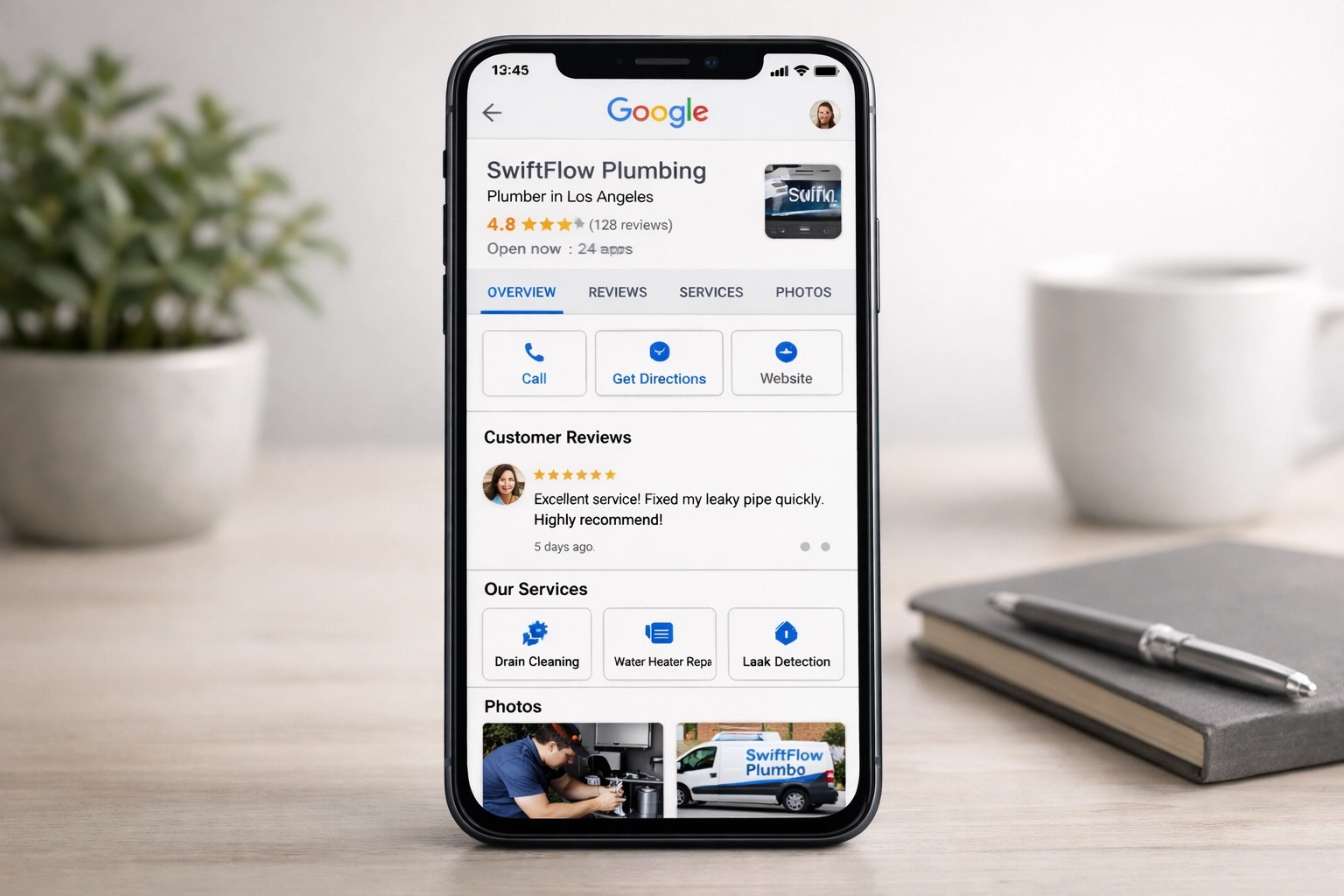
Google uses three primary factors to rank Local Pack results: relevance, distance, and prominence. Your GBP directly influences all three.
A sparse, incomplete, or incorrect profile signals to Google that your business may not be the most reliable result to show a homeowner dealing with a burst pipe at 11 p.m. in January.
Choosing the Right Primary Category
The single most impactful decision you will make in your entire GBP setup is selecting your primary business category. This one field carries enormous weight in Google’s local ranking algorithm, and many Canadian plumbers get it wrong.
Your primary category should almost always be Plumber.
Google allows you to select up to ten categories, so use them strategically. Other relevant secondary categories for plumbers in Canada often include: Drainage Service, Water Heater Installation Service, Gas Installation Service, and Septic System Service, depending on what you offer.
Avoid selecting “Plumbing Supply Store” as your primary category unless you actually operate a retail supply business. This category targets an entirely different search intent and will actively harm your ability to rank for service-based queries.
Here is your action step: log into your GBP dashboard today, navigate to Edit Profile, and review your primary and secondary categories. If “Plumber” is not sitting at the top, fix it immediately. This single change can produce noticeable ranking improvements within two to four weeks.
Beyond category selection, your business name must match exactly how it appears on your website, invoices, and other directories like YellowPages.ca and HomeStars. Inconsistency here — even something as minor as “Ltd.” versus “Limited” — creates what SEOs call NAP (Name, Address, Phone) inconsistency, which erodes Google’s trust in your listing.
Services, Q&A, and Review Responses That Win Jobs
Once your foundational profile information is locked in, the real work of Google Business Profile optimization begins.
Three features in particular — Services, Questions and Answers, and Review Responses — are consistently underutilized by Canadian plumbers and represent significant opportunities to outperform local competitors.
Services: Build Your Digital Menu
Google’s Services section allows you to create a structured listing of every service you offer, complete with custom names, descriptions, and optional pricing.
Treat this like a strategic keyword deployment zone. Rather than listing “Emergency Plumbing,” write: “24/7 Emergency Plumber — Toronto (burst pipes, flooding, gas leaks).”
Each service description can be up to 300 characters, which gives you room to naturally incorporate location-specific language and service-specific terms.
For a plumber serving the Greater Vancouver Area in 2026, a well-structured services section might include: Drain Cleaning and Hydro Jetting, Sump Pump Installation and Spring Maintenance, Water Heater Replacement (Tankless and Traditional), Frozen Pipe Repair and Winterization, Backflow Prevention Testing, and Bathroom and Kitchen Renovation Plumbing.
Q&A: Your Secret Long-Tail Keyword Weapon
The Questions and Answers feature on your GBP is one of the most overlooked local SEO tools in existence. Anyone can post a question to your profile, and anyone can answer — which means if you are not actively managing this section, competitors or even misinformed strangers might be shaping the perception of your business.
The strategic play here is to seed your own questions and answer them yourself.
Think about the questions your dispatcher fields every single week: “Do you offer same-day service in Mississauga?” “How much does it cost to replace a water heater in Calgary?” “Are you licensed for gas line work in Alberta?” “Do you service Kanata and the west end of Ottawa?” Post these questions from your personal Google account, then log into your business account and answer them with detailed, keyword-rich responses.
This tactic directly targets long-tail search queries that your potential customers are already typing into Google. It also populates your profile with fresh, relevant content that reinforces your service area and specialties — all signals that support your broader local SEO for plumbers Canada strategy.
Review Responses: Rank Higher While Building Trust
Reviews are a confirmed Local Pack ranking factor, and your response strategy matters as much as the reviews themselves.
Canadian homeowners read responses carefully before making hiring decisions, and Google rewards businesses that demonstrate active engagement.
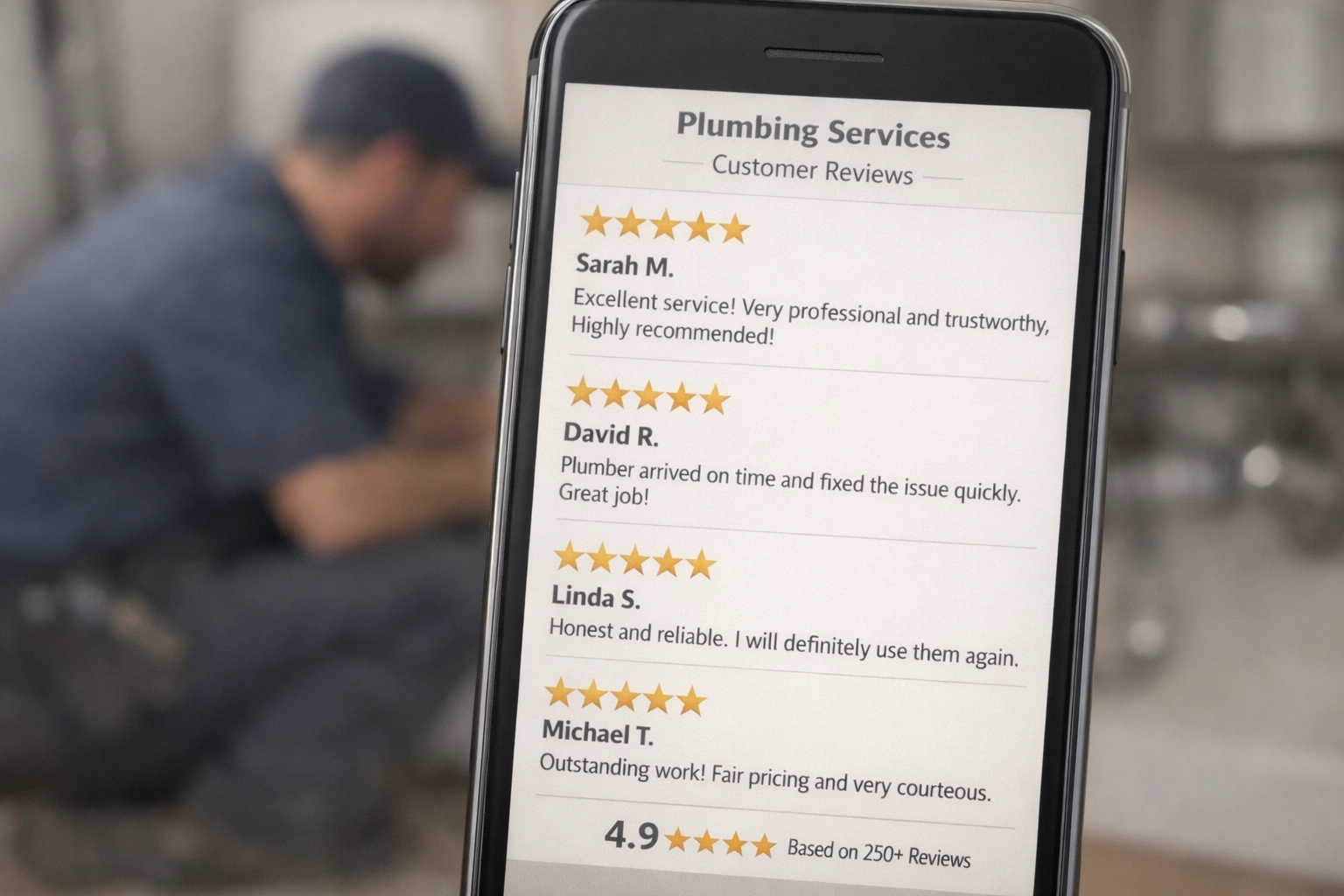
For every positive review, respond within 24 to 48 hours. Reference the specific service performed and naturally include your location.
For example: “Thank you so much for trusting us with your hot water tank replacement in northeast Calgary, Sarah! We are glad we could get your family back to hot water the same day. Please do not hesitate to call us for any future plumbing needs.”
This response contains the service, the city, and a warm human tone — exactly what both Google and future customers want to see.
For negative reviews respond calmly, professionally, and without being defensive. Acknowledge the concern, offer to resolve it offline, and provide a phone number or email. Never argue publicly.
Photos, Posts, and Attributes
Upload a minimum of 10 to 15 high-quality photos to your GBP: your team in branded uniforms, your service vehicles with company signage, before-and-after shots of completed jobs (with customer permission), and your physical location if you operate a shop.
In 2026, Google increasingly uses image recognition to validate business legitimacy. Geotag your photos by ensuring location data is embedded in the image files before uploading — free tools like GeoImgr make this straightforward.
Use Google Posts weekly. Share seasonal tips, limited-time promotions, and new service announcements. Each post keeps your profile active and gives Google fresh signals that your business is operating and engaged.
Finally, complete every available Attribute. Mark your business as offering emergency services, online booking, and senior-friendly service if applicable.
On-Page SEO: Building a Plumbing Website That Ranks
Your Google Business Profile gets you in the local pack, but your website is what converts curious searchers into paying customers — and what signals to Google that you deserve to rank for competitive keywords across your service area.
On-page SEO for plumbers is the art and science of structuring every page on your website so search engines can understand exactly what you do, where you do it, and why you’re the most authoritative choice in your market.
Done right, your website becomes your hardest-working employee: generating leads at 2 AM when a homeowner in Mississauga has a burst pipe, or when a property manager in Calgary needs a licensed plumber for a commercial renovation.
Before diving into specific page types, let’s establish the technical foundation that every Canadian plumbing website needs in 2026.
Your site must be mobile-responsive — over 70% of local service searches happen on smartphones, and Google’s mobile-first indexing means your desktop design is essentially irrelevant if your mobile experience is poor.
Page speed matters enormously: aim for a Largest Contentful Paint (LCP) under 2.5 seconds.
Your site needs HTTPS (a basic trust signal Google has required for years), and you should implement LocalBusiness and Plumber schema markup in your site’s structured data to help Google parse your business information, service offerings, and service areas without ambiguity.
Image optimization is frequently neglected by plumbing websites. Every photo should have descriptive alt text that incorporates relevant keywords naturally. Compress images using tools like ShortPixel or Imagify to reduce file size without sacrificing quality.
For your header tag hierarchy, every page should have exactly one H1 that clearly states the page’s primary topic and includes your target keyword and location where appropriate. H2 tags break the page into major sections, and H3 tags provide further granularity within those sections. This structure helps both readers and search engine crawlers navigate your content efficiently.
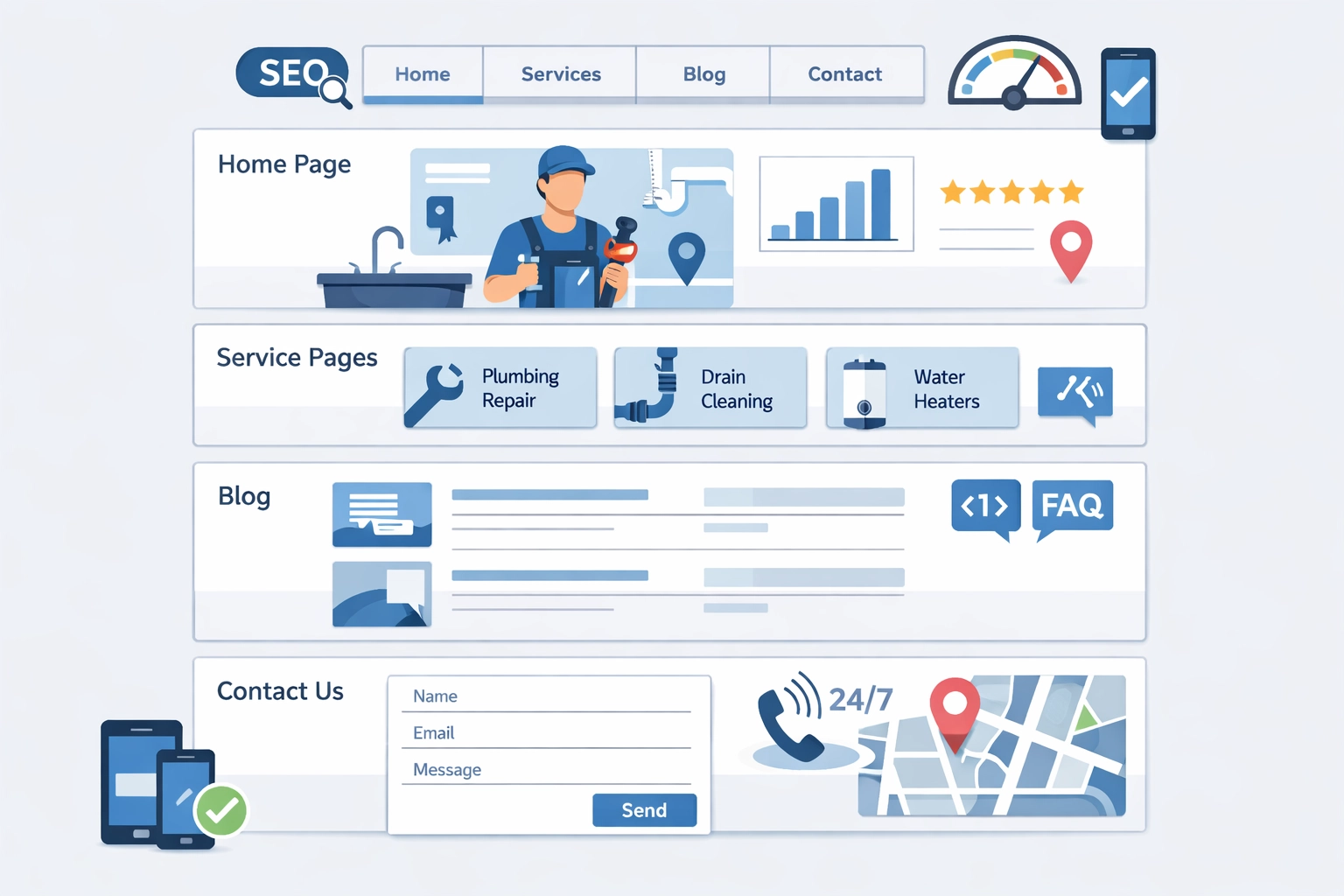
Service Pages vs. Blog Content: What to Prioritize
This is one of the most common questions Canadian plumbers ask when building out their content strategy, and the answer is clear: service pages come first, always.
Service pages are transactional — they target people actively searching for a plumber right now. Blog content is informational — it targets people researching problems they may or may not hire someone to fix.
For a plumbing business, the ROI on a well-optimized service page almost always exceeds the ROI on blog content, particularly in the early stages of your SEO investment.
Service page optimization requires both depth and specificity.
A page titled simply “Plumbing Services” is a wasted opportunity. Instead, build individual pages for each core service: drain cleaning, hot water heater installation and repair, pipe replacement, sump pump installation, backwater valve installation, gas line services, and emergency plumbing.
Each page should be a minimum of 600 to 800 words of genuine, helpful content — not keyword-stuffed filler, but content that actually answers the questions your customers are asking.
A well-structured service page should follow this architecture.
- Your URL should be clean and descriptive: yourcompany.ca/sump-pump-installation-edmonton.
- Your meta title should follow the format: “Sump Pump Installation Edmonton | Licensed Plumbers | [Company Name]” — keeping it under 60 characters and front-loading the primary keyword.
- Your meta description should be written like a compelling ad, around 150 to 160 characters, and include a clear call to action: “Expert sump pump installation in Edmonton. Licensed plumbers, upfront pricing, same-day service available. Call for a free quote.”
- The page body should address what the service involves, why homeowners specifically need sump pumps (spring snowmelt flooding, the city’s clay-heavy soil), what the installation process looks like, how long it takes, what licensing or permits are required under Alberta’s Safety Codes Act, and what the service costs in approximate ranges.
- Include an FAQ section targeting long-tail questions like “how much does sump pump installation cost in Edmonton” and “do I need a permit for a sump pump in Alberta.”
- Close with a strong conversion element: a phone number, a contact form, and ideally, a booking widget.
Blog content should come after your core service and location pages are built and optimized.
Use blog content to capture informational searches that build brand awareness and establish your expertise.
Internal linking is critical throughout your site.
- Every blog post should link to at least one relevant service page.
- Your homepage should link to your primary service pages and your top location pages.
- Your service pages should cross-link to related services — your drain cleaning page can link to your sewer inspection page, for example.
This creates a web of relevance that helps Google understand the topical depth of your site and distributes link authority across your most important pages.
Emergency Plumber Pages: How to Rank for High-Intent Searches
Searches like “emergency plumber Toronto” or “24 hour plumber Vancouver” represent some of the highest-intent, highest-value queries in the plumbing industry.
Someone typing these phrases into Google at midnight is not comparing options — they’re calling the first trustworthy result they see.
Ranking for these terms requires a dedicated emergency service page that is specifically optimized for this intent, not just a generic services page that mentions emergency services in passing.
- Your emergency plumber page URL should be straightforward: yourcompany.ca/emergency-plumber-toronto.
- The H1 should be direct and urgent: “24-Hour Emergency Plumber in Toronto — Available Now.”
- The content needs to immediately communicate availability (24/7, 365 days a year, including Canadian statutory holidays), response time (“Technicians dispatched within 60 minutes across the GTA”), and the types of emergencies you handle: burst pipes, severe water leaks, no hot water, blocked sewers, frozen pipes, gas line issues, and flooding.
Page speed is even more critical on emergency pages than anywhere else on your site.
A person with water flooding their basement will not wait four seconds for your page to load — they’ll hit the back button and call your competitor.
- Aim for sub-two-second load times on this page specifically.
- Place your phone number prominently above the fold, formatted as a clickable link for mobile users.
- Include trust signals immediately visible without scrolling: years in business, licensing information (citing provincial licensing requirements, such as Ontario’s Ontario College of Trades certification or BC’s TSBC licensing), and Google review ratings with a star display.
Implement LocalBusiness and EmergencyService schema markup on this page. While EmergencyService isn’t a standalone schema type, you can annotate your LocalBusiness schema with openingHoursSpecification showing 24/7 availability, which can generate rich results that display your hours directly in search results.
Location Pages for Multi-City Plumbing Companies
If your plumbing company serves multiple cities or municipalities, location pages are essential to capturing search traffic across your entire service area.
Location pages are individual pages targeting each city or neighbourhood you serve, and when done correctly, they are among the most powerful assets in your SEO for plumbers Canada strategy.
The critical mistake most plumbing companies make is creating thin, templated location pages that swap out the city name but offer no genuine local value.
Google has become increasingly sophisticated at identifying these cookie-cutter pages, and they often fail to rank meaningfully. In 2026, effective location pages need to be substantive and locally specific.
For a company serving both Ottawa and Gatineau, for instance, the Ottawa page should reference specific Ottawa neighbourhoods you serve (Kanata, Barrhaven, Gloucester), common plumbing issues in Ottawa’s older housing stock (lead pipe replacement in pre-1950s homes in Centretown and Glebe), and any Ottawa-specific bylaw considerations around permits and inspections.
- For URL structure, use yourcompany.ca/service-area/city-name or yourcompany.ca/plumber-city-name.
- Your title tag should follow the format: “Plumber in [City] | [Primary Service] | [Company Name]”.
- Each location page should have its own unique H1, unique body content, a locally embedded Google Map, location-specific testimonials where possible, and a list of specific neighbourhoods or postal code areas served.
For large service areas, consider building location pages in a tiered structure: a primary city page supported by neighbourhood-level pages for high-value submarkets like Etobicoke, Scarborough, or North York.
This tiered approach allows you to capture both broad city searches and the increasingly specific local searches that Google is rewarding with the rise of hyperlocal intent matching.
On-page SEO for plumbers operating across multiple cities is genuinely complex, but companies that invest in building this location page infrastructure properly create a competitive moat that is very difficult for newer entrants to overcome quickly.
PPC for Plumbers: When to Complement SEO With Google Ads
Search engine optimization builds the foundation of your long-term digital presence, but even the most robust SEO for plumbers Canada strategy has one unavoidable limitation: it takes time.
A new plumbing website in Edmonton or London, Ontario won’t rank on page one overnight.
In the meantime, customers are searching, pipes are freezing, and your competitors are capturing those leads. This is precisely where pay-per-click advertising enters the picture — not as a replacement for SEO, but as a powerful complement that fills gaps, accelerates growth, and covers your business during critical seasonal peaks.
Think of SEO as the equity you’re building in your digital real estate and PPC as the rental income that keeps cash flowing while that equity matures.
Canadian plumbers who use both channels strategically consistently outperform those who rely on one alone. The key is knowing which tool to deploy, when, and how much budget to allocate across Canada’s dramatically different seasons.
Google Ads vs. Local Services Ads for Canadian Plumbers
When most plumbers think of online advertising, they picture traditional Google Ads — the text-based listings that appear at the top of search results marked with a small “Sponsored” label.
But in 2026, Canadian plumbers actually have two distinct paid advertising options from Google, and understanding the difference between them is essential for maximizing your return on investment.
Google Ads (formerly AdWords) operates on a pay-per-click model.
You bid on specific keywords like “emergency plumber Toronto” or “water heater replacement Calgary,” and you pay each time someone clicks your ad, regardless of whether they actually call or book a job.
The average cost-per-click for plumbing keywords in major Canadian markets in 2026 ranges considerably by city: Toronto and Vancouver keywords can run $8 to $22 per click for competitive terms like “plumber near me” or “burst pipe repair,” while markets like Halifax, Regina, or Sudbury typically see CPCs between $4 and $11. This gap reflects both population density and the intensity of local competition.
To control costs with Google Ads plumbing campaigns, keyword match types matter enormously.
Broad match keywords will burn through your budget showing your ad to people searching for DIY plumbing videos or plumbing supply stores.
Phrase match and exact match targeting keeps your ads in front of high-intent buyers who are actively looking to hire a plumber.
Equally important are negative keywords — terms you explicitly exclude from triggering your ads. Every Canadian plumbing Google Ads account should include negatives like “how to,” “DIY,” “parts,” “supply store,” “apprenticeship,” and “plumbing school” from day one.
Your ad copy must speak directly to the pain point and the solution.
For emergency campaigns, lead with speed and availability: “24/7 Emergency Plumber — On-Site in 60 Min or Less — Serving Greater Calgary.” For maintenance campaigns, emphasize trust and value: “Licensed Plumbers Since 1998 — Upfront Pricing — No Surprise Fees — Book Online Today.”
Every ad should include a phone number callout extension and your service area to filter out callers outside your coverage zone.
Critically, PPC for plumbers only works if your landing page delivers on what the ad promises.
Sending paid traffic to your homepage is one of the most common and costly mistakes Canadian plumbing companies make.
Each campaign should direct visitors to a dedicated landing page with a single, clear call-to-action, trust signals like your license number and Google reviews rating, and a fast click-to-call button optimized for mobile.
Local Services Ads (LSA) appear even above traditional Google Ads in search results and operate on a fundamentally different model.
Rather than paying per click, you pay per lead — meaning you’re charged only when a potential customer calls or messages you directly through the ad.
In 2026, Local Services Ads Canada are available in most major Canadian markets including Toronto, Vancouver, Calgary, Edmonton, Ottawa, and Montreal, with ongoing expansion into mid-sized cities.
The defining feature of LSAs is the Google Guaranteed badge — a green checkmark that signals Google has verified your license, insurance, and background checks.
LSA leads in plumbing typically cost between $18 and $65 per verified lead depending on the market and service type, which often represents better value than Google Ads CPC costs when you factor in conversion rates.
For most Canadian plumbing businesses, the ideal paid strategy combines both: LSAs running continuously for brand trust and steady lead flow, with targeted Google Ads campaigns layered on top during high-demand periods and for specific high-value services like water heater installation or drain camera inspections.
Seasonal Budget Allocation: Winter vs. Summer in Canada
No country makes seasonal PPC strategy more critical than Canada. The same climate that drives Canadians to search “frozen pipe repair” in January drives entirely different queries by June.
Failing to adjust your budget accordingly means either leaving money on the table during peak demand or overspending during naturally slow periods.
Winter: The Emergency Surge (November through March)
For Canadian plumbers, winter is the highest-urgency search season. When temperatures in Winnipeg drop to -30°C or pipes freeze overnight in the Ottawa Valley, homeowners aren’t browsing — they’re calling the first credible plumber they find.
January 2026 data from plumbing markets across Canada consistently shows search volume for terms like “burst pipe repair,” “frozen pipe plumber,” and “emergency plumber” spiking 200 to 400 percent above summer baseline levels.
This is the season to increase your PPC budget aggressively. Prioritize emergency keywords, maximize your ad scheduling to cover nights and weekends when pipes typically burst, and ensure your call extensions are active 24 hours.
Spring: The Transition Window (April through May)
As snow melts across Canada, a new wave of urgent searches emerges.
Spring flooding, sump pump failures, and the aftermath of frozen pipe damage generate strong lead volume. Budget allocation should remain elevated with campaign messaging shifting toward sump pump installation, water damage assessment, and drain clearing after winter debris accumulation.
Summer: Maintenance and Renovation Season (June through September)
Summer search volume is lower urgency but higher average job value.
Homeowners in Toronto and Vancouver use warmer months for planned renovations. Allocate approximately 20 to 25 percent of annual budget here, but shift your keyword targeting toward renovation and replacement terms rather than emergency repairs.
Cost-per-click is generally lower in summer, giving your budget better reach.
Fall: Pre-Winter Preparation (October)
A brief but valuable window when Canadian homeowners are motivated by impending cold weather to address plumbing vulnerabilities.
Invest 10 to 15 percent of annual budget here targeting keywords like “winterize plumbing,” “pipe insulation,” and “water heater tune-up.”
Tracking ROI from your paid campaigns requires connecting Google Ads to call tracking software and your CRM so you can see actual booked jobs attributed to specific campaigns.
This data, reviewed monthly, tells you exactly which keywords, seasons, and ad formats are generating profitable customers versus expensive tire-kickers.
Finally, the question of when to prioritize organic SEO for plumbers Canada versus paid advertising comes down to your business timeline. If you need leads within the next 30 days, PPC delivers. If you’re investing in assets that will generate free traffic for years, SEO is irreplaceable.
Review Generation: The Plumber’s Secret Ranking Weapon
If you’ve invested time optimizing your Google Business Profile and building local citations, you’ve laid a solid foundation.
But here’s what separates the plumbers dominating Page 1 in Toronto, Calgary, and Vancouver from those buried on Page 3: reviews.
For SEO for plumbers Canada, reviews are not a bonus feature — they are the engine.
Google’s own documentation confirms that review quantity, quality, and recency are the second most influential ranking factor for the Local Pack, just behind proximity. If two plumbers offer identical services in the same neighbourhood, the one with 200 well-maintained Google reviews will consistently outrank the one with 40.
Why Google Reviews Move the Needle
Google’s local ranking algorithm evaluates three things: relevance, distance, and prominence. Reviews directly impact prominence.
A higher volume of positive reviews signals to Google that your business is well-established, trustworthy, and actively serving the community.
Beyond rankings, consider the conversion math: BrightLocal’s 2025 Consumer Review Survey found that 87% of consumers won’t consider a business with fewer than four stars.
For plumbing that threshold climbs even higher. Canadians, who tend to do significant due diligence before hiring tradespeople, read an average of 7-10 reviews before making a call.
Review velocity matters as much as total count. Thirty new reviews earned in a single month followed by nothing for six months actually triggers algorithmic suspicion.
Google rewards steady, organic growth — aim for 4 to 8 new reviews per month as a baseline, scaling up during your peak seasons in spring and fall.
How to Systematically Get Google Reviews After Every Job
Here’s where Canadian culture becomes a strategic asset.
Canadians are famously polite, but that same politeness can make the review ask feel awkward for both parties. The solution is to make the request feel natural, helpful, and low-pressure — not transactional.
The single best moment to ask is immediately after the customer expresses satisfaction.
Real ROI: What Plumber SEO Results Look Like in Canada
If you’ve ever asked an SEO agency when you’ll see results, you’ve probably heard something vague like “three to six months.” That answer doesn’t help you run a plumbing business.
You need to know what to expect, when to expect it, and how to measure whether your investment is actually paying off.
The Honest SEO Timeline for Plumbing Companies
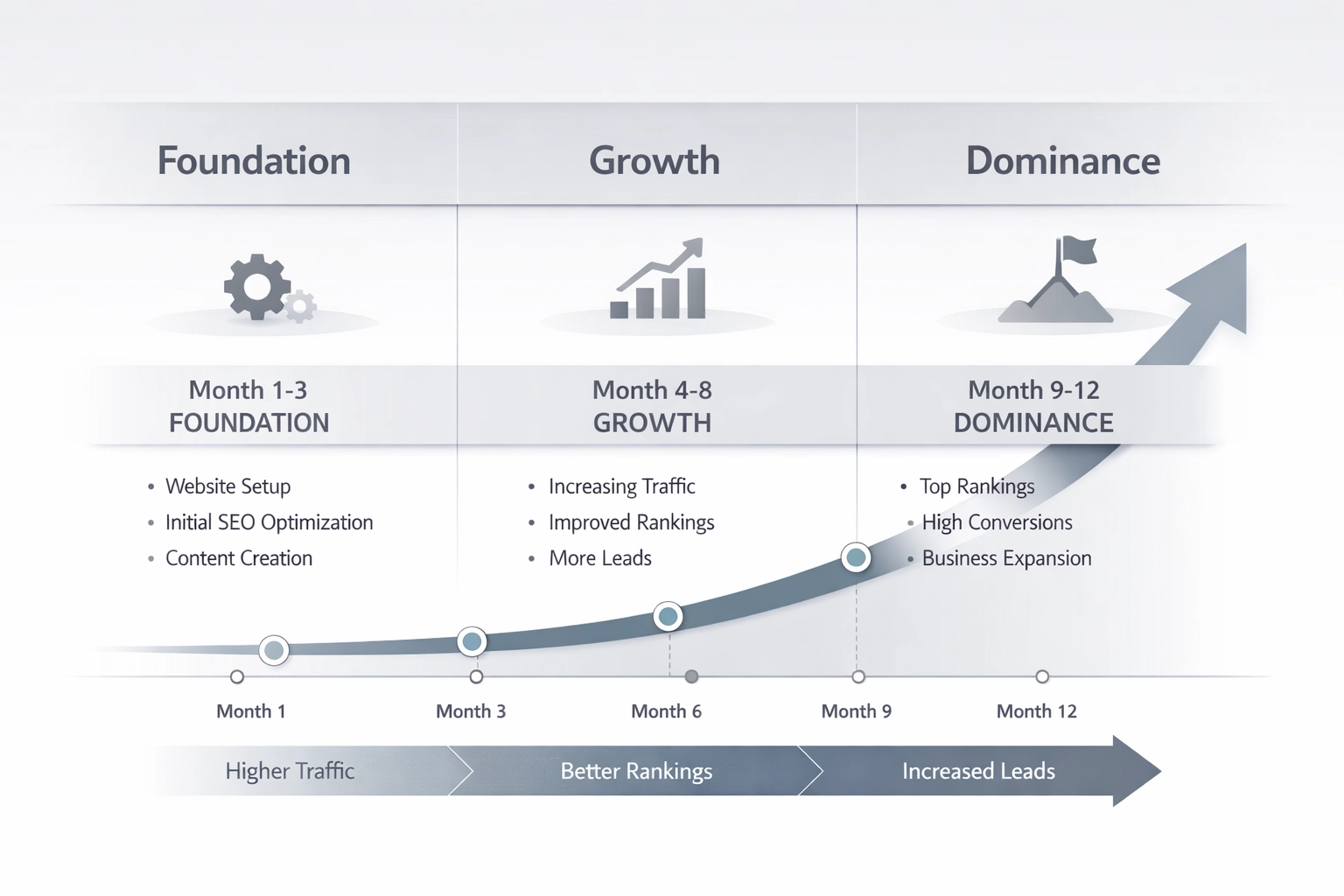
Months 1-3: Foundation and Early Signals
During the first three months, most of the work is invisible to you as a business owner. Your agency or in-house team is conducting technical audits, fixing crawl errors, building out your service pages, optimizing your Google Business Profile, and starting local citation cleanup.
You might see minor ranking improvements for low-competition keywords, but your phone isn’t ringing off the hook yet.
Organic traffic may tick up slightly, perhaps 10 to 20 percent above baseline if your site had existing content. Don’t panic. This phase is like laying the foundation before framing a house.
Months 4-6: Momentum Builds
This is where plumbing lead generation from organic search starts to become visible. Rankings for mid-competition keywords begin climbing.
A plumbing company in Calgary might start appearing on page one for “drain cleaning Calgary” or “hot water tank replacement NE Calgary” for the first time.
Call volume from organic search typically increases 25 to 50 percent compared to pre-campaign levels. Form submissions from service pages begin generating two to five qualified leads per week depending on market size.
Months 7-12: Compounding Returns
By month seven, well-executed campaigns produce results that are hard to ignore.
A plumber in the Greater Toronto Area targeting neighbourhoods like Mississauga, Brampton, and Etobicoke may now rank on page one for a dozen or more service and location combinations.
Monthly organic leads can reach 20 to 60 depending on market size and budget. Cost per lead from SEO typically drops to the $25 to $75 range, well below what paid ads deliver.
Month 12 & Beyond: Market Dominance
Plumbing companies that commit to SEO for 12 or more months begin to own their local market in search.
In Vancouver, where competition is fierce and home values are high, a plumber ranking in the top three positions for terms like “emergency plumber Vancouver” or “sewer line replacement Burnaby” can generate six figures in revenue from organic search alone annually.
Key Metrics Every Plumber Should Track
Tracking the right numbers separates guesswork from real business intelligence.
Set up Google Analytics 4 with goal tracking for form submissions and connect a call tracking solution like CallRail or WhatConverts to assign unique phone numbers to your organic traffic channel. This lets you see exactly how many calls come from Google search versus your HomeStars listing versus a YellowPages ad.
The metrics that matter most for plumbing lead generation from SEO include:
- Google Business Profile call volume week over week
- Keyword ranking positions for your top 10 to 15 service and location combinations
- Organic website sessions month over month
- Cost per lead calculated as total monthly SEO spend divided by leads generated
- Lead-to-customer conversion rate tracked through CRM or booking software.
If you’re spending $1,500 per month on SEO and generating 30 leads with a 40 percent close rate, your cost per customer is approximately $125. As rankings compound and traffic grows, that same $1,500 often produces 60 or 80 leads within 18 months, dropping your acquisition cost dramatically.
Seasonal Fluctuations Are Real and Predictable
Canadian plumbing businesses experience well-defined seasonal search patterns that affect your SEO results timeline.
Frozen pipe emergencies spike across Prairie and Central Canadian markets every January and February. Sump pump searches peak during spring thaw in April and May across Ontario and Quebec. Air conditioner-related plumbing and irrigation work drives summer traffic in BC and Alberta. Water heater replacement searches climb every October and November as Canadians prep for winter.
A smart SEO campaign accounts for these cycles by publishing seasonal content ahead of peak periods, optimizing Google Business Profile posts monthly, and tracking year-over-year organic traffic growth rather than panicking about a February to April fluctuation.
Red Flags That Signal Your SEO Isn’t Working
Not all SEO agencies deliver on their promises.
If you’re six months into an SEO for plumbers Canada campaign and you cannot see verifiable ranking improvements for at least five to ten target keywords, if your call tracking shows zero increase in organic phone calls, or if your agency refuses to share a Google Analytics access login, those are serious warning signs.
Reputable agencies provide monthly reporting showing ranking movement, traffic data, and lead attribution. Anything less is not acceptable.
Content Marketing Strategy for Plumbing Companies
Most plumbers think their website only needs service pages and a contact form. That thinking leaves enormous amounts of organic traffic — and revenue — on the table.
A strategic content marketing approach is one of the most powerful tools available when implementing SEO for plumbers Canada, allowing you to capture homeowners and property managers at every stage of their decision-making journey, not just when they’re ready to book a call.
Content marketing for plumbers is not about writing for the sake of it. It is about becoming the most trusted, most visible plumbing authority in your service area — online and off.
When a homeowner in Winnipeg searches ‘why does my basement flood every spring,’ or a property manager in Calgary asks ‘what is required for commercial backflow prevention in Alberta,’ you want your website to be the answer.
Commercial vs. Informational Content: Understanding the Difference
Before creating any content, you need to understand the two primary types of search intent your audience brings to Google.
Commercial content targets people ready to hire. These are your service pages — emergency plumbing, water heater installation, drain cleaning. They convert visitors into paying customers.
Informational content targets people in research mode. These are your blog posts, how-to guides, and FAQ pages. They build trust, establish authority, and generate organic traffic from searchers who are not quite ready to book but will be soon. Informational content also earns backlinks organically because other websites and journalists reference genuinely helpful resources.
The most successful Canadian plumbing companies invest in both.
Commercial pages bring in revenue today. Informational content compounds over time, consistently delivering new visitors and warm leads for years.
Blog Topic Ideas for Canadian Plumbers
Canada’s climate creates a uniquely rich library of plumbing blog topics that no generic American content template can replicate.
Your content calendar for 2026 should be structured around the seasons, because Canadian homeowners think about plumbing seasonally.
Winter Content (November through February): ‘How to Prevent Frozen Pipes in a Canadian Winter,’ ‘What to Do If Your Pipes Freeze Tonight,’ ‘How Cold Does It Have to Get for Pipes to Freeze in Ontario,’ ‘Winterizing Your Outdoor Hose Bibs Before the First Frost,’ ‘Why Your Water Heater Works Harder in Canadian Winters and How to Maintain It.’
Spring Content (March through May): ‘Spring Flooding and Your Basement: A Canadian Homeowner’s Guide,’ ‘How to Inspect Your Sump Pump Before Spring Thaw,’ ‘Why You Smell Sewer Gas in Spring and What to Do,’ ‘Checking Your Hot Water Tank After a Hard Winter,’ ‘Backflow Prevention Requirements in British Columbia — What Every Homeowner Needs to Know.’
Summer Content (June through August): ‘Outdoor Plumbing Upgrades Canadian Homeowners Love,’ ‘How to Set Up an Irrigation System Without Violating Water Bylaws,’ ‘What Causes Low Water Pressure in Summer,’ ‘Swimming Pool Plumbing Permits in Ontario — What You Need.’
Fall Content (September through October): ‘Fall Plumbing Maintenance Checklist for Canadian Homes,’ ‘How to Shut Off Your Outdoor Water Lines Before Winter,’ ‘Should You Insulate Your Pipes Before November,’ ‘Finding Hidden Leaks Before Your Heating Bill Spikes.’
Publish at least two to four blog posts per month in 2026.
Consistency matters more than volume. A plumbing blog with 48 well-researched articles outperforms one with 200 thin, rushed pieces every time.
Building FAQ Pages That Capture Featured Snippets
FAQ pages are among the fastest ways to win featured snippets.
When your FAQ page answers ‘How much does it cost to replace a water heater in Alberta,’ Google may pull your answer directly into position zero, delivering massive visibility at no added cost.
Effective plumbing FAQ pages should use proper schema markup (FAQPage schema), write answers in clear, concise language of two to five sentences, target one specific question per entry, and include answers relevant to Canadian standards and codes.
Reference the National Plumbing Code of Canada where applicable, or provincial codes like the Ontario Building Code, to add authoritative credibility that national or American competitors cannot match.
Create dedicated FAQ pages organized by category: water heater FAQs, drain cleaning FAQs, emergency plumbing FAQs, and permit and code FAQs. This structure helps with both user experience and Google’s ability to understand your topical coverage.
Building Topical Authority in the Plumbing Niche
Topical authority means Google recognizes your website as a comprehensive, trustworthy source on plumbing topics — not just a single page with some keywords on it.
Building topical authority requires content clusters.
A content cluster is a hub-and-spoke model. You create one detailed pillar page on a broad topic — say, ‘Water Heater Installation in Canada’ — and then create multiple supporting blog posts that go deep on subtopics: ‘Tankless vs. Tank Water Heaters for Canadian Winters,’ ‘How Long Does a Water Heater Last in a Hard Water Region,’ ‘Water Heater Permits Required in Manitoba,’ and ‘Signs Your Water Heater Is About to Fail.’
Each supporting post links back to the pillar page, and the pillar page links out to each supporting post. This internal linking structure signals to Google that you have broad, deep expertise — and your entire cluster rises in rankings together.
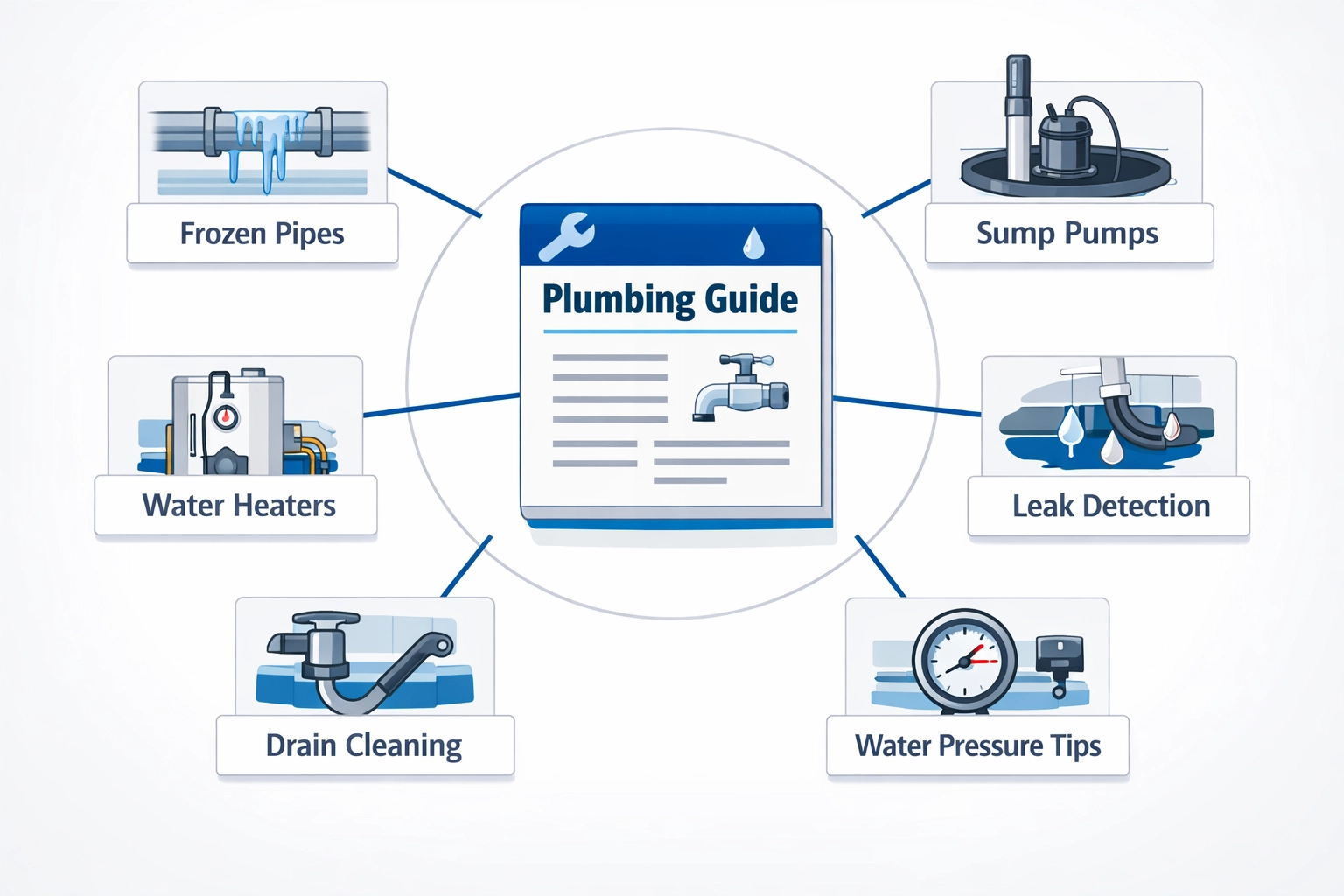
For Canadian plumbers, strong cluster topics to develop in 2026 include pipe freezing and winter plumbing protection, sump pumps and basement flooding, water heater maintenance and replacement, drain health and clog prevention, and backflow prevention and cross-connection control.
Video Content: An Underused Advantage for Canadian Plumbers
YouTube is the second-largest search engine in the world, and very few local plumbing companies compete there seriously.
Short educational videos — ‘How to Turn Off Your Home’s Main Water Shutoff,’ ‘Signs You Have a Hidden Leak,’ ‘What to Do When Your Basement Floods in Spring’ — build enormous trust and can rank on both YouTube and Google simultaneously.
Embed your videos into corresponding blog posts to increase time-on-page, improve engagement signals, and give video content a second life.
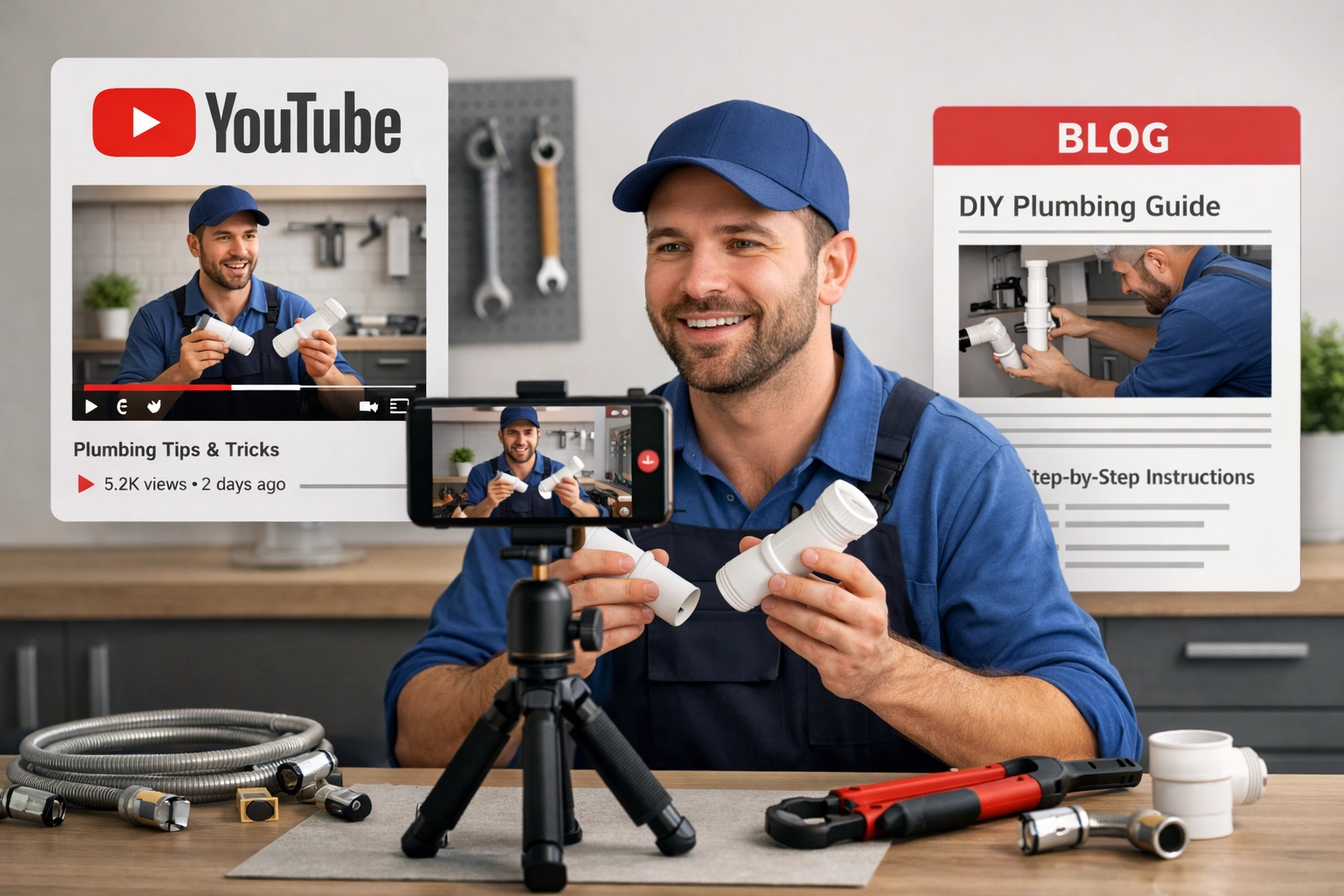
A single well-produced video can be repurposed as a blog post transcript, social media clips, an email newsletter feature, and an FAQ answer — multiplying one hour of effort across five channels.
Seasonal Content Calendar: Planning 2026
- In January 2026, publish frozen pipe emergency guides.
- In March, pivot to spring thaw and sump pump content.
- By May, shift toward outdoor plumbing and renovation season topics.
- Return to preventative maintenance and winterization content in September and October.
Plan your editorial calendar around Canadian Thanksgiving, the first major freeze warnings, and spring melt patterns in your specific region — these are the moments homeowners are most actively searching.
Measuring Content Marketing ROI
Track content performance using Google Search Console to monitor impressions, clicks, and keyword rankings for each piece. Set up Google Analytics 4 goals to measure how many blog readers contact you or request quotes.
The most successful Canadian plumbing companies treat their content library like a long-term asset — one that appreciates in value and generates qualified leads for years after publication, long after the one-time cost of creation has been recovered.
Social Media and Online Presence for Plumbers
Social media will not directly boost your Google rankings overnight, but dismissing it entirely is a costly mistake.
For Canadian plumbers in 2026, social platforms serve two essential functions: they build brand awareness that drives direct inquiries, and they generate indirect SEO benefits through increased online mentions, backlinks, and branded search volume.
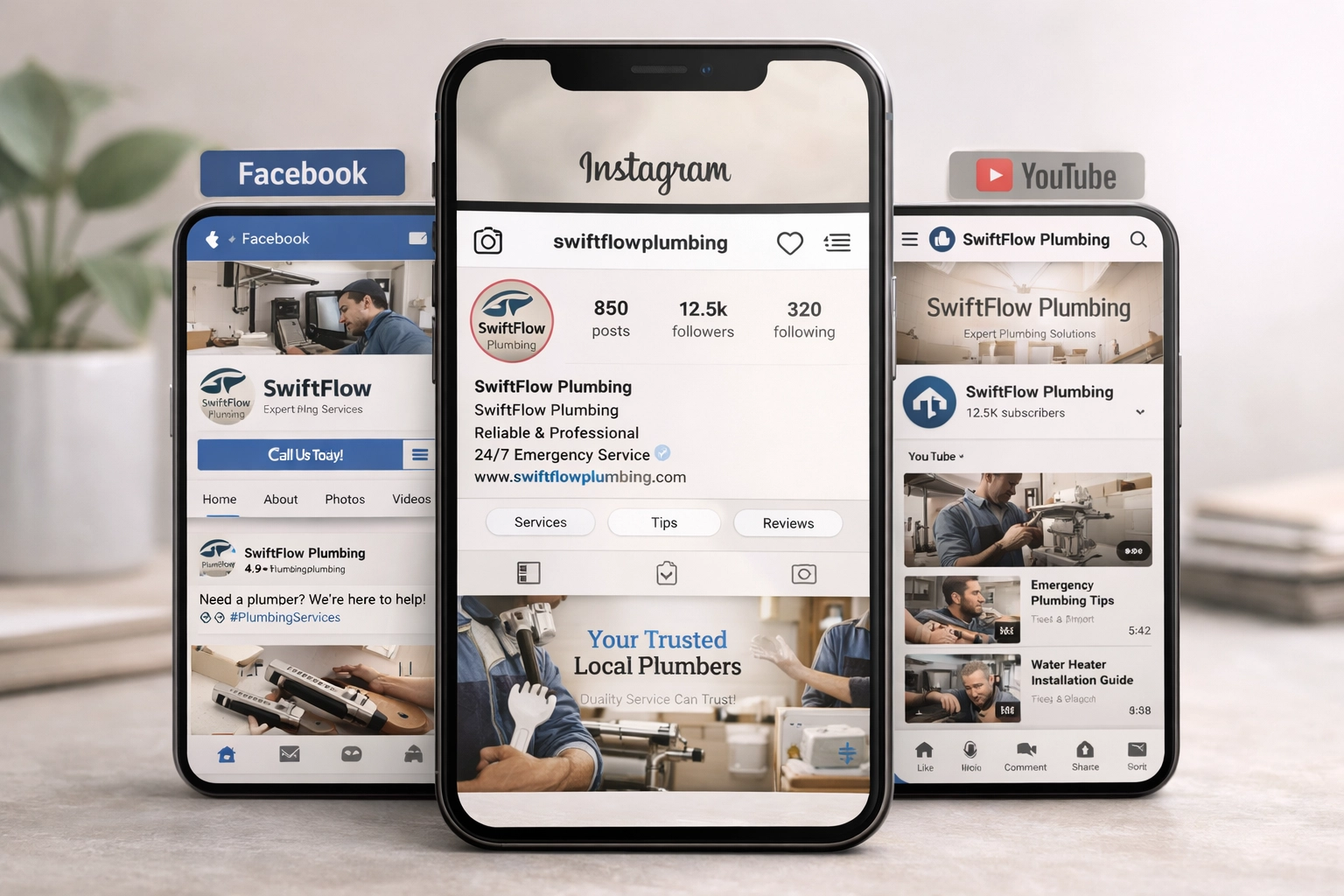
When homeowners in Mississauga or Kelowna search for a plumber and see your name across Google, Facebook, and Instagram, they are far more likely to pick up the phone. That credibility loop is what makes social media worth your time.
Facebook: Still the Workhorse for Canadian Contractors
Despite the rise of newer platforms, Facebook remains the dominant social network for Canadian adults aged 30 to 65.
As part of your broader SEO for plumbers Canada strategy, Facebook acts as a secondary business profile that ranks in Google searches and captures local intent.
Start with a fully optimized Facebook Business Page. Use your exact business name, upload a professional logo, fill in your complete service area, hours, and a keyword-rich description.
Consistency with your Google Business Profile is critical — the same NAP (name, address, phone number) signals reinforce your local authority.
Beyond your page, Canadian Facebook Groups are goldmines. Neighbourhood groups for areas like “Ottawa South Residents” or “Calgary NE Community Board” are where locals ask for trades recommendations daily.
Join these groups as your business page where permitted, or participate personally and mention your services when appropriate. Being a helpful, recognized voice in these communities generates word-of-mouth referrals that no ad budget can easily replicate.
Content ideas for Facebook: Customer testimonials with photos, completed job highlights, seasonal maintenance tips, staff introductions, community sponsorship announcements, and responses to common homeowner questions.
Instagram: Show Your Craft Visually
Instagram rewards quality visuals, and plumbing has more photogenic moments than most tradespeople realize. Before-and-after shots of bathroom renovations, gleaming new fixture installations, or a corroded pipe replaced with copper are genuinely compelling content.
In 2026, Instagram Reels continue to drive organic reach well beyond your follower count, making short 30- to 60-second videos your best tool for growth.
Document your work every day with a quick phone shot. Instagram Stories work for behind-the-scenes content: your van stocked and ready for a Monday morning, your team at a job site, or a quick poll asking followers whether they know where their home shutoff valve is.
Posting three to four times per week is a realistic target for most plumbing businesses managing their own social media for plumbers without a dedicated marketing person.
LinkedIn: Unlocking Commercial Contracts
If your plumbing business targets commercial clients, property management companies, or general contractors, LinkedIn is where those relationships live.
A polished LinkedIn company page and an active personal profile for the business owner can open doors to strata corporations in Vancouver, property managers overseeing rental portfolios in Toronto, or construction project managers across Alberta.
Share case studies of commercial projects, certifications earned, and industry news. Connect directly with property managers, facility coordinators, and building owners in your city.
In 2026, LinkedIn’s Canadian user base in the trades and real estate sector continues to grow, making it one of the higher-ROI platforms for plumbers with commercial ambitions.
YouTube: Build Authority Through Education
YouTube is the world’s second-largest search engine, and Canadian homeowners use it constantly to troubleshoot plumbing issues before calling a professional.
Creating how-to videos — “How to shut off your home’s water supply,” “Signs your hot water tank needs replacing,” or “What to do if a pipe bursts in winter” — positions your business as the trusted local expert.
These videos also embed naturally into your website and blog posts, increasing time-on-page and supporting your overall online presence.
One quality video per month is sufficient to build a meaningful library over 12 to 24 months.
Nextdoor and Hyperlocal Platforms
Nextdoor has grown significantly in Canadian suburban markets since 2024. Unlike Facebook groups, Nextdoor is organized strictly by neighbourhood, making recommendations intensely local.
Claim your business profile, respond to recommendations, and request that satisfied customers endorse you on the platform.
A handful of strong Nextdoor reviews in a specific subdivision can consistently generate calls from that area.
Integrating Social Media With SEO and Reputation Management
Every social platform where your business maintains an active profile is another place Google can find consistent signals about who you are and where you serve.
Share your blog content across social channels to drive traffic back to your website. Encourage customers who engaged with you on Facebook or Instagram to leave a Google review — this cross-platform reputation building is one of the most practical ways social media supports your broader SEO for plumbers Canada goals.
Respond to every comment, message, and review professionally and promptly.
In 2026, Canadian consumers expect replies within a few hours on social platforms. Ignored messages signal neglect and send potential customers elsewhere.
Prioritizing Your Time
For most independent plumbers or small crews, spreading across every platform simultaneously leads to inconsistent, low-quality presence.
Start with Facebook and Google Business Profile, then add Instagram once you have a content rhythm. Layer in LinkedIn if commercial work is a priority.
YouTube is a longer-term investment worth starting early. Commit to two to three platforms done well rather than six platforms done poorly.
Hiring an SEO Agency vs. DIY: What Canadian Plumbers Need to Know
For most plumbing business owners in Canada, SEO feels like a foreign language.
You understand pipe diameters, water pressure tolerances, and local building codes — but Google’s ranking algorithms? That’s a different trade entirely.
The question of whether to handle your own digital marketing or hire outside help is one of the most important business decisions you’ll make in 2026, and the wrong choice in either direction can cost you thousands of dollars and months of wasted momentum.
Let’s cut through the noise and give you an honest assessment.
When DIY SEO Actually Makes Sense
DIY SEO isn’t always a mistake.
If your plumbing business is a one-person operation serving a small market you may be able to compete effectively by learning the fundamentals yourself. The barriers to ranking in low-competition markets are significantly lower than in Vancouver, Toronto, Calgary, or Ottawa.
DIY SEO also makes sense during your startup phase when cash flow is tight and you have genuine time to invest in learning.
Platforms like Google Search Console, Google Business Profile, and tools like Semrush’s free tier are accessible enough that a motivated business owner can make meaningful progress.
If you’re disciplined enough to dedicate four to six hours per week to SEO tasks you can move the needle.
The honest caveat: most plumbing business owners don’t have four to six spare hours per week. And the learning curve is steeper than most online resources admit.
The Real Cost of DIY SEO
DIY SEO is not free. The time you spend learning technical SEO, writing content, fixing website errors, and building backlinks is time not spent on service calls, managing your crew, or growing your business in ways you’re already skilled at.
If your billable rate is $150 per hour and you’re spending five hours per week on DIY SEO, that’s $750 per week in opportunity cost — roughly $39,000 per year.
Beyond time, there’s the cost of mistakes. Plumbers who attempt DIY SEO commonly over-optimize their pages with keyword stuffing, accidentally create duplicate content across service pages, set up Google Business Profile listings incorrectly, or build low-quality backlinks from spammy directories.
These mistakes don’t just fail to help — they can actively suppress your rankings and trigger Google penalties that take months to recover from.
In 2026, Google’s algorithms are sophisticated enough to detect manipulative tactics almost immediately. A single bad decision — buying a package of 500 directory links from an overseas vendor, for example — can undo months of legitimate work.
What to Look for in an SEO Agency for Plumbers
When you’re ready to hire, specificity matters. A generalist digital marketing agency that works with restaurants, retailers, and law firms alongside your plumbing company is not the same as a specialized SEO agency for plumbers.
Industry-specific experience means the agency already understands seasonal demand patterns in Canadian markets, knows which service pages convert best, understands how emergency plumbing searches behave differently than renovation-related queries, and has existing relationships with relevant citation sources.
When evaluating agencies, look for the following:
- Proven local SEO experience in Canada. Canadian markets operate differently than American ones. An agency that only understands American SEO practices may actually hurt your local presence by building the wrong kind of citations or failing to optimize for Canadian search behaviour.
- Transparent reporting. Any reputable agency should provide you with monthly reports showing keyword ranking changes, organic traffic growth, GBP performance metrics, and leads generated. If an agency is vague about how they’ll report results, walk away.
- Realistic timelines. SEO is a long-term investment. A legitimate agency will tell you that meaningful results typically take four to six months to materialize in competitive Canadian markets. Anyone promising page-one rankings in 30 days is either lying or planning to use tactics that will eventually backfire.
Red Flags That Should Send You Running
The SEO industry, unfortunately, has more than its share of bad actors.
When evaluating a hiring SEO company, watch for these warning signs:
- Guaranteed #1 rankings. No ethical SEO professional can guarantee specific positions. Google’s algorithm is not for sale.
- Prices that seem impossibly low. A $199/month SEO package is not real SEO. It’s automated link-building and templated content that may actively harm your site.
- No Canadian market experience. If an agency can’t speak knowledgeably about local citation sources, Google Business Profile optimization for Canadian addresses, or the differences between Toronto and Calgary search landscapes, they’re not equipped to serve you.
- Ownership ambiguity over your assets. Your website, your GBP listing, your content — these must remain yours. Some agencies create assets in their own accounts, leaving you with nothing if you part ways.
- No contract or unclear deliverables. Vague agreements protect the agency, not you.
- Pressure tactics and urgency. Legitimate SEO professionals don’t cold-call with limited-time offers.
Questions to Ask Before You Sign Anything
Before hiring any SEO partner, ask these questions directly:
- Can you share case studies from other Canadian plumbing or home services clients?
- Who specifically will be working on my account — and what are their qualifications?
- What does your reporting look like, and how often will we communicate?
- Do I retain ownership of my website, content, and GBP listing if I leave?
- What’s your approach to link building, and can you show me examples of the links you’ve built for similar clients?
- How do you stay current with Google algorithm updates?
- What results can I realistically expect in the first six months?
Between full DIY and a full-service agency, there’s a middle path. Freelance SEO consultants with home services experience can provide strategic guidance at lower monthly costs.
A hybrid approach — where you handle content creation and GBP management yourself while a consultant handles technical SEO — can work well for budget-conscious operators.
For growing plumbing companies with multiple trucks and serious revenue, an in-house marketing coordinator who manages SEO day-to-day while working with an external strategist on a consulting basis can be highly effective.
The right choice depends entirely on your market, your budget, your growth ambitions, and your honest assessment of available time. In competitive urban markets in 2026, DIY SEO rarely produces the results that a well-run agency campaign can deliver — but a bad agency is worse than no agency at all.
Do your homework, ask hard questions, and remember that your SEO partner should be able to demonstrate expertise before they touch your business.
Conclusion: Your Roadmap to Dominating Local Search in 2026
If there’s one thing this guide has made clear, it’s that SEO for plumbers Canada is no longer a nice-to-have — it’s a fundamental business necessity.
Canadian homeowners are searching for plumbers online every single day, and the plumbing businesses showing up at the top of Google are the ones winning those calls, booking those jobs, and growing their revenue while competitors wonder where their next customer is coming from.
The plumbing market across Canada’s major cities is competitive, but it is absolutely winnable. The businesses investing in local SEO today are locking in the top positions that will generate leads for years to come. Waiting means handing those positions to your competitors.
At VoltStudios, we work exclusively with Canadian trades and home service businesses, and we understand the unique challenges and opportunities that come with marketing a plumbing company in cities like Vancouver, Edmonton, Ottawa, and beyond. Our team knows what it takes to move the needle in Canada’s most competitive local markets, and we have the case studies to prove it.
If you’re serious about growing your plumbing business in 2026, explore our Local SEO Services to see exactly how we approach rankings for trades businesses, or take a look at our PPC for Plumbers services if you want to combine paid and organic strategies for maximum lead volume. Our Web Design for Contractors page is also worth reviewing if your current website isn’t converting the traffic you’re already getting.
But the best first step is the simplest one.
Ready to get more plumbing leads from Google? Get your free Local SEO Audit today and see exactly how much traffic your competitors are getting — and how to beat them.
Our team will analyse your current Google presence, identify the gaps in your local SEO strategy, and give you a clear, actionable plan to outrank the competition in your service area. No pressure, no fluff — just real data and honest recommendations from a team that genuinely understands the Canadian trades market.
Reach out to VoltStudios today and let’s get your phone ringing.