Here’s a number that should change how you think about Local SEO your business: 76% of people who search for something nearby visit a business within 24 hours. Not a week. Not a month. Twenty-four hours. That single statistic, sourced from Google’s own consumer data and cited by Shopify, BrightLocal, and Rankmax, is the entire reason local SEO exists.
Every day, billions of searches happen with implicit or explicit local intent — “plumber near me,” “best dentist in Toronto,” “where can I get my tires changed,” or simply “Thai restaurant” typed from a phone in downtown Vancouver.
Google has confirmed that roughly 46% of all Google searches have local intent. When you do the math on Google’s ~15 billion daily searches, that’s nearly 7 billion location-based queries every single day. The question for your business is no longer whether local SEO matters — it’s whether you’re showing up when those searches happen.
If you read this all the way through, you’ll know what local SEO is, how the algorithm actually works, what to do first, what to never do, and when it makes sense to bring in an expert.
We’ve spent years doing this work for businesses across Canada, and we’re going to be direct with you about what works, what’s a waste of money, and what the AI-era changes really mean for your visibility.
Let’s start with the basics — and then get into the weeds.
1. What Is Local SEO?
Local SEO is the process of optimizing a business’s online presence so it shows up in unpaid, location-based search results on Google Search, Google Maps, and increasingly on AI engines like ChatGPT and Perplexity.
The goal is simple: when a person near you searches for what you sell, your business appears. That’s it. That’s the whole game.
Here’s where it gets interesting. Local SEO isn’t just a sub-discipline of traditional SEO — it runs on a completely separate algorithm.
Google has its organic algorithm for ranking websites, and it has a local algorithm for ranking Google Business Profiles. The two share some signals (links, content quality, technical health) but the local algorithm layers on a completely different set of inputs: proximity, business hours, GBP categories, review velocity, citation consistency, and a dozen other things traditional SEO doesn’t touch.
Who local SEO is for
Not every business needs local SEO. Per Google’s own guidance, you benefit from local SEO only if you meet two criteria:
- You serve at least some customers face-to-face — either at your location (a dental clinic, a restaurant, a retail store) or at their location (a plumber, a mobile detailer, a lawn care service).
- You have a physical street address — P.O. boxes and virtual offices don’t count. Google wants a real place where customers can find you, or where you dispatch from.
If you’re a SaaS company selling to a national audience, an e-commerce brand with no physical retail, or a fully remote consultancy — local SEO is mostly irrelevant to you. But if you’re a dentist, lawyer, plumber, restaurant, gym, real estate agent, home services company, or any business that serves a defined geography, local SEO is the single highest-ROI marketing channel available to you in 2026.
The two types of local searches
Google treats two kinds of searches as “local”:
- Explicit geographic modifiers. The searcher includes a location. “Mexican restaurant Toronto.” “Plumber near me.” “Dentist near Union Square.” Google knows the intent is local because the searcher said so.
- Implicit local intent. No geographic modifier at all — just “dentist” or “plumber” or “coffee shop” typed on a phone. Google infers the local intent from the query type and the device’s location. This is the bigger category by volume, and it’s why showing up for the right implicit-intent queries is where the real money is.
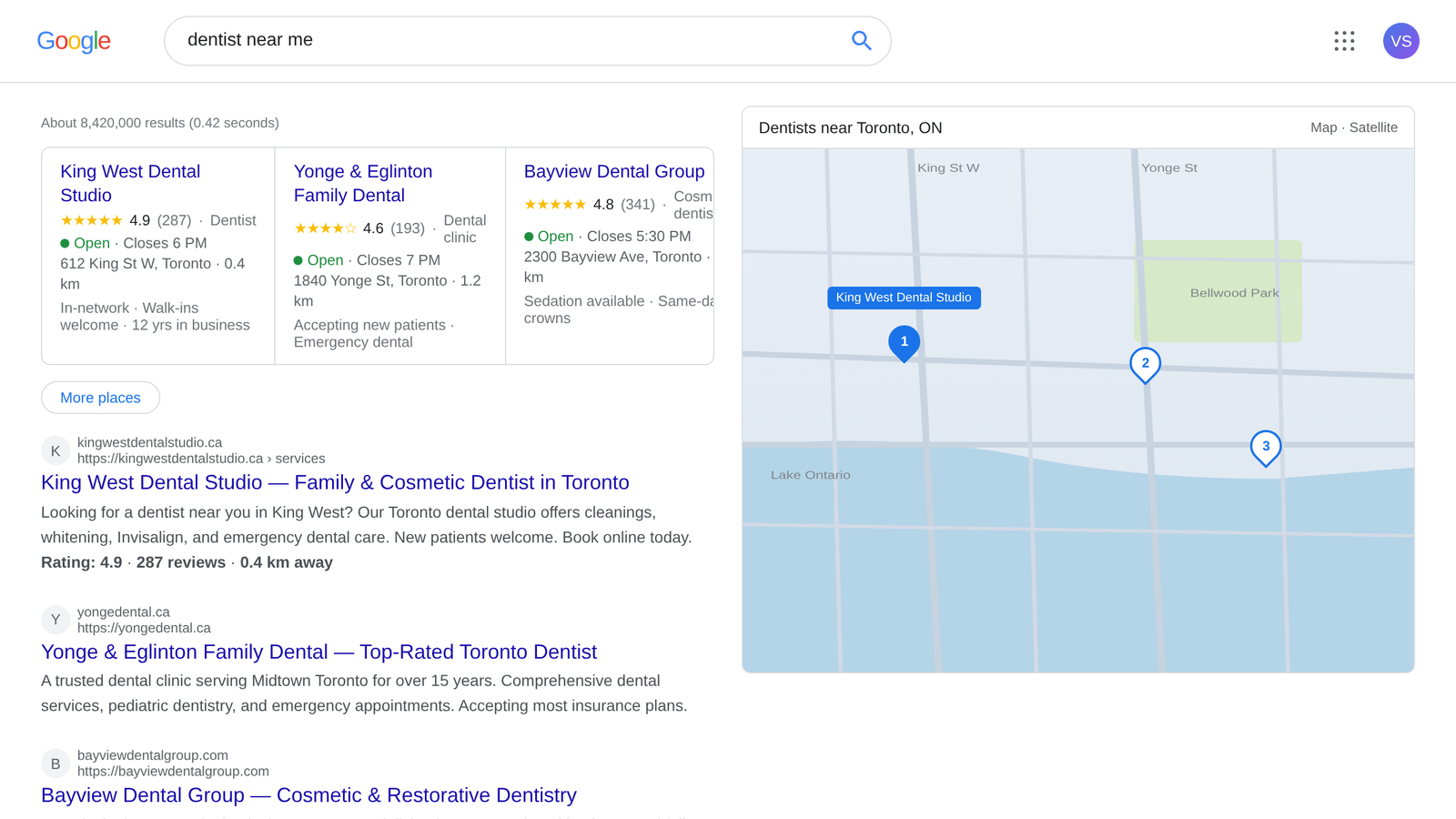
Key terms you’ll need to know: Local Pack (the 3 listings above organic results), Local Finder (the expanded list when you click “More places”), NAP (Name, Address, Phone), GBP (Google Business Profile), SAB (Service Area Business — one that goes to customers, doesn’t have a storefront), geo-grid (a heatmap of your rankings across a grid of map points). We’ll use these throughout — bookmark this section.
2. The Three Pillars of Local SEO
There are two ways to talk about “the three pillars of local SEO,” and we’ll cover both because you’ll hear both in the industry.
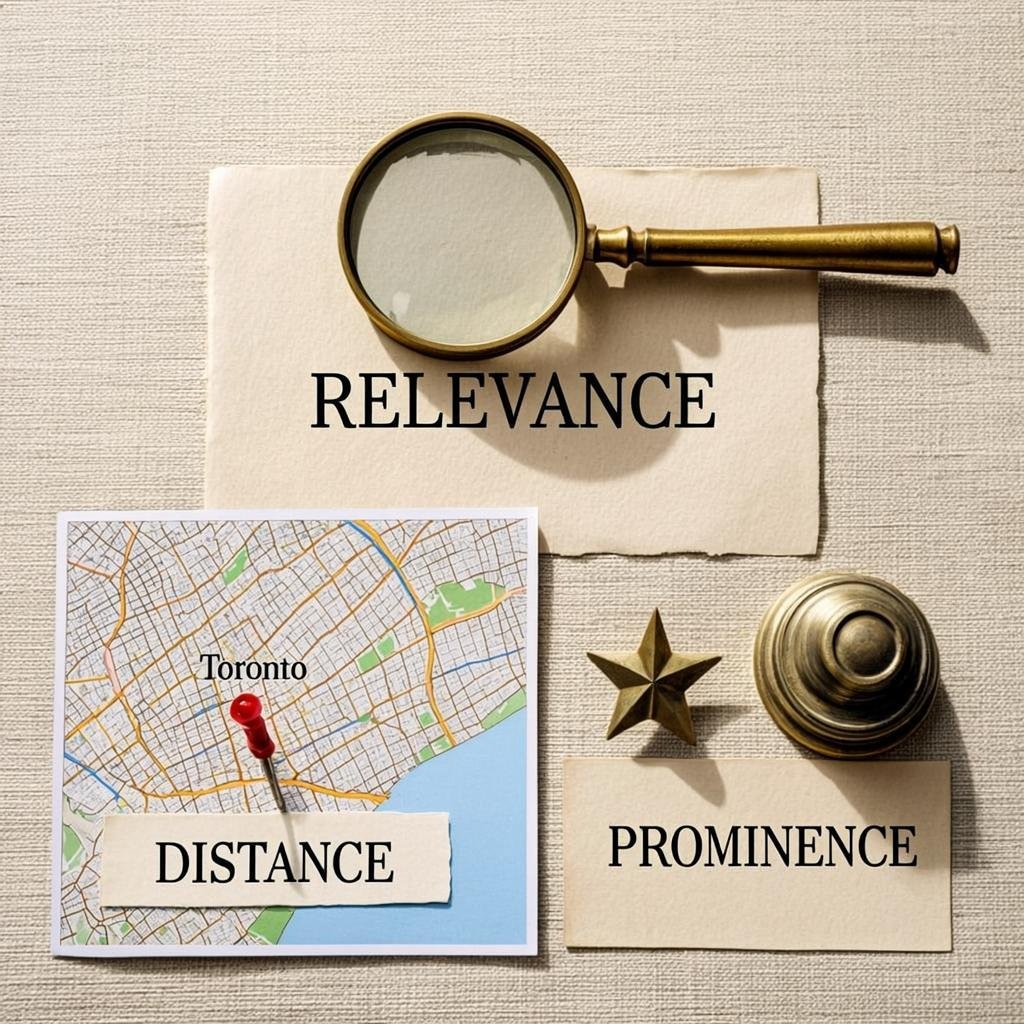
Google’s official three: Relevance, Distance, Prominence
Google’s own documentation is unusually clear on this. Local results are mainly based on three factors:
- Relevance. How well your Business Profile matches what someone is searching for. A business categorized as “Personal Injury Attorney” will rank for “personal injury lawyer” queries; one categorized only as “Law Firm” won’t.This is why your primary GBP category is the single most important ranking factor — Whitespark’s 2026 Local Search Ranking Factors survey (47 experts, 187 factors) ranks it #1.
- Distance. How far each business is from the searcher. If the searcher doesn’t share their location, Google uses what it knows about them — IP, GPS, mobile network. Distance is heavily weighted, and it’s why there is no such thing as a #1 local ranking.You can rank #1 for searchers in one Toronto neighbourhood and not appear at all for searchers three kilometres away.
- Prominence. How well-known the business is. Google looks at review volume and rating, inbound links, brand mentions, behavioral signals (click-through rate, calls, direction requests), and historical performance.Prominence is the factor you can most influence over time — it’s where good marketing beats good luck.
The practitioner’s three: GBP, Citations, Reviews
Practitioners — agencies like us, and tools like BrightLocal and Whitespark — usually describe local SEO as resting on three foundational activities:
- Google Business Profile (GBP). Claim it, verify it, complete every field, choose the right primary category, add photos weekly, post updates, answer Q&As, list your services and products.A complete GBP gets 7x more clicks than an incomplete one, and customers are 2.7x more likely to trust the business. It’s the single most influential controllable asset in local SEO.
- Local Citations / NAP Consistency. Citations are any online mention of your NAP — structured (YellowPages.ca, Yelp, Bing Places) or unstructured (a mention in a blog post or news article).The plumbing of local SEO. Boring until it leaks: 41% of businesses have inconsistent NAP across directories, and NAP inconsistency is the single most common issue dragging down local rankings. Businesses with consistent info across 75%+ of major directories see 186% more clicks from Google.
- Reviews. Quantity, recency, velocity, star rating, and — critically — owner responses. 97% of consumers read reviews for local businesses (BrightLocal 2026).41% “always” read reviews before choosing — up from 29% a year ago. Reviews are both a ranking factor and a conversion driver; they’re the only local SEO input that pays off twice.
Notice that these three line up cleanly with Google’s official pillars: GBP drives relevance, citations reinforce prominence, and reviews drive both prominence and conversion. The framework isn’t an accident — it’s how the algorithm is built.
3. How Local SEO Actually Works (The Mechanism)
Let’s pull back the curtain. Here’s what happens in the milliseconds between a searcher typing “emergency plumber” into Google and the local pack appearing on their screen:
- Query detection. Google determines whether the search has local intent. “Emergency plumber” is a classic implicit-intent local query. “How to fix a leaky pipe” is not — that’s informational. Google uses query type, category taxonomy, and device signals to make this call.
- Eligible pool. Google assembles the set of verified GBPs whose primary or secondary categories match the query and which serve the searcher’s geography. If you’re a plumber in Mississauga and the searcher is in downtown Toronto 30 km away, you may or may not be in the pool — it depends on your service area settings and Google’s distance filtering for that category.
- Filtering. Invisible filters kick in. Businesses currently open are favoured — the “business is open at time of search” factor jumped to #5 in Whitespark’s 2026 ranking. Service-area businesses that don’t serve the searcher’s location are excluded. Categories that don’t match are filtered out. Duplicate listings are deduplicated.
- Ranking by Relevance + Distance + Prominence. Google weighs the three official factors. Distance is heavily weighted — closer businesses get a strong boost. Prominence incorporates review signals, links, behavioral data, and brand authority. Relevance is determined by how well the GBP matches the query, primarily via the primary category and on-profile keywords.
- Display as 3-pack. Google shows the top 3 ranked businesses above the organic blue links, with an embedded map, ratings, review counts, hours, and click-to-call / directions / website buttons. The 3-pack gets roughly 42% of clicks on local-intent queries (Backlinko, 2024) — making it the most valuable real estate in modern marketing.
- Local Finder expansion. If the searcher clicks “More places,” they’re taken to the Local Finder — an expanded list of typically 20+ businesses, ranked in a slightly different order than the 3-pack (Google’s filtering and ranking nuances change for the expanded view).
Organic results vs. local pack — what’s the difference?
This trips up a lot of business owners. The local pack and the organic blue links below it are different products, ranked by different algorithms, optimized by different tactics.
Here’s the side-by-side:
| Factor | Organic Blue Links | Local Pack |
|---|---|---|
| Algorithm used | Google’s organic algorithm | Google’s separate local algorithm |
| What’s actually ranked | Web pages | Google Business Profiles |
| Primary inputs | Content, links, technical SEO | GBP completeness, proximity, reviews, citations, behavioral signals |
| Geographic customization | Minimal — same results nationwide | Highly customized to the searcher’s exact location |
| SERP placement | Below the Local Pack | Above organic results for local-intent queries |
| Display format | Title tag, URL, meta description | Map + 3 listings with rating, reviews, hours, phone |
| Click destinations | Direct to website | Website, directions, call, or GBP view |
| Tracking method | Traditional rank trackers (single position) | Geo-grid trackers (multi-point heatmap) |
The practical implication: a business can rank #1 in the local pack and not appear in the top 100 organic results, or vice versa. They’re separate games with separate playbooks. A complete local SEO strategy optimizes for both.
This is the most misunderstood thing in local SEO: you cannot hold a #1 local ranking the way you can hold a #1 organic ranking. A searcher in downtown Toronto sees one set of 3-pack results. A searcher in Mississauga — 25 km west — sees a different set. A searcher in Etobicoke sees a third. Rankings are computed fresh for every search, based on the searcher’s location at that moment.
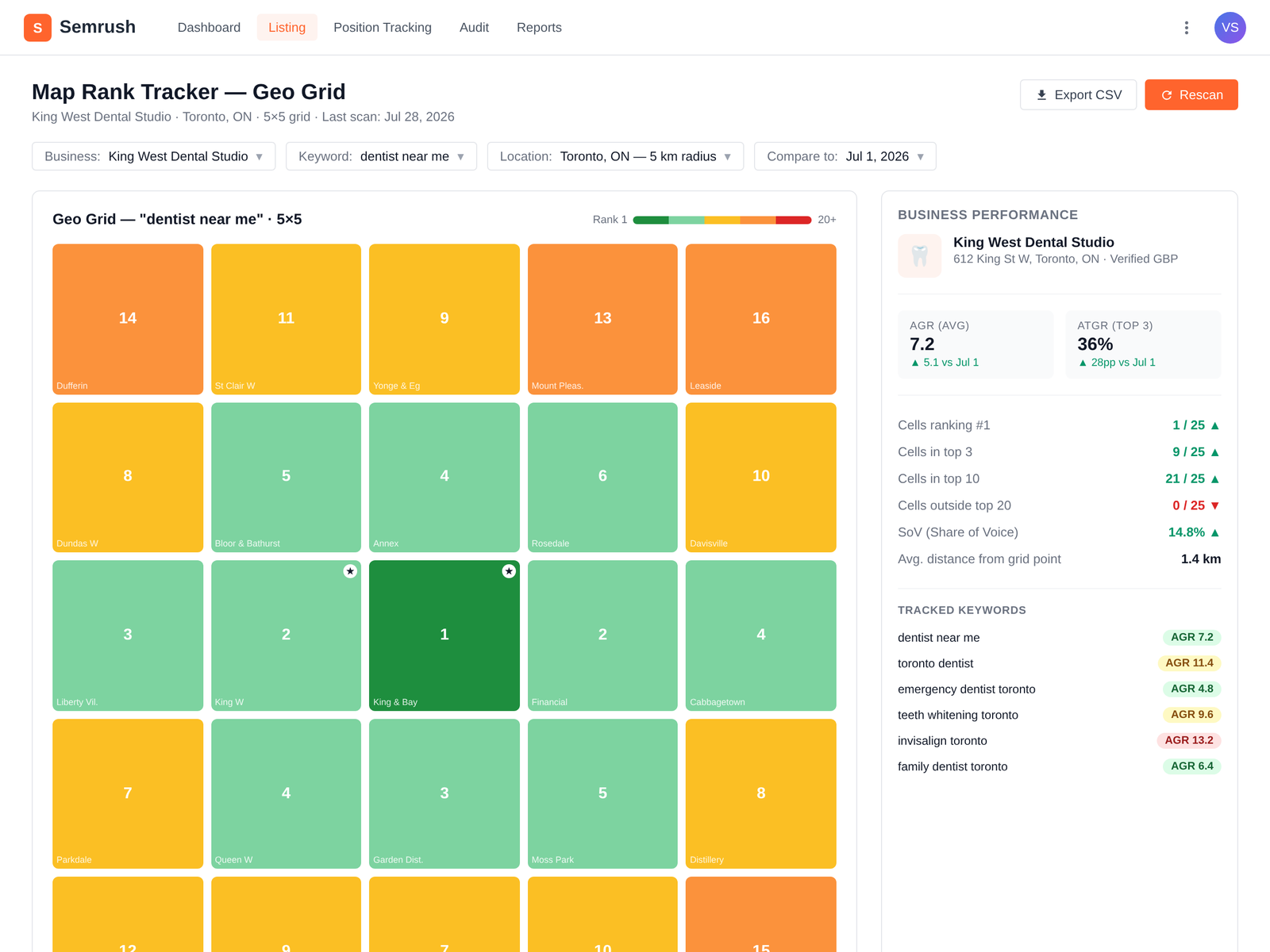
This is why geo-grid tracking (mapping your rank across 20-100+ grid points) is the only honest way to measure local SEO performance. A single rank number is a lie.
4. Why Local SEO Matters (The Numbers)
We’re an agency, so we get that you want to see the math. Here’s the case for local SEO in 2026, sourced from the studies we actually trust:
The demand side
- 46% of all Google searches have local intent — Google’s own figure, presented at the 2018 “Secrets of Local Search” event and still the canonical stat cited by BrightLocal, Search Engine Land, and Moz. That’s ~7 billion location-based queries every single day globally.
- “Near me” searches grew 900% in two years — and “open now near me” variants are growing even faster (Google internal data).
- 84% of “near me” searches happen on mobile — and 76% of those mobile searches lead to a business visit within 24 hours. That’s not impressions. That’s feet in the door.
- 88% of mobile local searches lead to a store visit within 24 hours — Google. Eighty-eight. Let that sink in.
The conversion side
- Businesses earning top-3 local pack positions get 126% more traffic and 93% more user actions (calls, clicks, direction requests) than those that don’t — SOCi’s research, summarized by Search Engine Land.
- Maps pack visibility accounts for roughly 50% of all inbound calls for local service businesses — per The Blueprint’s analysis. Half your calls may come from one piece of search real estate.
- Over 60% of local searches now end without a website click — the user gets the phone number, hours, and reviews directly from Google and never visits your site. This is why tracking local SEO success by website traffic alone is a mistake.
The trust side
- 97% of consumers read reviews for local businesses — BrightLocal Local Consumer Review Survey 2026.
- 41% “always” read reviews before choosing a business — up from 29% a year prior. The trust bar is rising.
- 31% will only use businesses with 4.5+ stars. Below that threshold, you’re invisible to nearly a third of the market.
- 88% prefer businesses that respond to all reviews; only 47% would use a business that doesn’t respond at all. And 19% expect same-day responses — up from 6% a year prior. Review response is now table stakes.
The AI-era wild card
- 45% of consumers now use ChatGPT or other AI tools for local business recommendations — up from 6% one year prior. This is the fastest behavior shift we’ve ever tracked in local search.
- But visibility in ChatGPT local recommendations is 30x harder to achieve than ranking in Google’s local pack. Less than half of businesses that lead in Google local results also appear in AI local recommendations.
- And critically: only 68% of business contact info on ChatGPT and Perplexity matches Google Business Profiles. Bad data propagates. The single best defense is GBP + citation hygiene — which is exactly the foundation we’ll talk about next.
Take these numbers together and the case is overwhelming: local SEO isn’t a marketing tactic you can opt out of in 2026. It’s the discovery layer for your business. The question isn’t whether to invest — it’s whether you do it deliberately or let competitors eat your share.
5. The Local SEO Process — Step by Step
Here’s the exact 7-step process we run for Volt Studios clients. Whether you do this yourself or hire us to do it, this is the order that works. Skipping steps is the most common mistake we see — particularly jumping to content before fixing the foundation.
Step 1: Audit what you have
Before you change anything, find out where you stand.
- Is your GBP claimed and verified?
- What’s your primary category?
- How many reviews do you have, what’s the average rating, and how recent is the most recent one?
- Is your NAP consistent across the top 20 directories?
- Where are you ranking on a geo-grid for your priority keywords?
Run a geo-grid scan (Local Falcon, BrightLocal’s Local Search Grid, or Whitespark’s Local Ranking Grids — all have free or trial tiers). You can’t improve what you haven’t measured.
Step 2: Claim and optimize your Google Business Profile
If you do nothing else on this list, do this. A complete GBP gets 7x more clicks than an incomplete one.
The optimization checklist:
- Choose the most specific primary category available (use the PlePer Chrome extension to see what competitors use)
- Add up to 9 secondary categories
- Write a keyword-rich description (under 750 characters, no keyword stuffing)
- Add all predefined services
- List products if applicable
- Set accurate business hours (Google now penalizes wrong hours heavily — it jumped 64 positions in Whitespark 2026)
- Upload fresh photos weekly (profiles with photos get 42% more direction requests),
- Respond to every review within 24 hours.
Step 3: Fix NAP and build citations
Audit your existing citations — we use BrightLocal’s citation tracker. Fix inconsistencies first (it’s more important than building new ones). Then build out the foundational citations: your top 20-30 Canadian directories if you’re a Canadian business, plus your industry-specific directories (Healthgrades for healthcare, Avvo for legal, Houzz for home services).
Don’t bother with the 300-citation packages some agencies sell — diminishing returns kick in fast, and quality beats quantity every time.
Step 4: Build a review engine
Stop asking for reviews “when you remember” and start running a system.
- Send a review request within 24 hours of service (the happier the customer, the faster you ask). Use a tool like Whitespark’s Reputation Builder, Birdeye, or BrightLocal’s ReviewFlow. Respond to every review — positive and negative — within 24 hours.
- For negatives, acknowledge, apologize without excuses, and move the conversation offline. 73% of unhappy customers will give you a second chance if your response handles the complaint well.
Step 5: Localize your website content
Your website is the second half of the local SEO equation.
- Build a dedicated page for each service you offer (Whitespark 2026 ranks this the #1 local organic factor).
- Build a dedicated page for each city/neighbourhood you serve — not a thin “We serve Toronto” page, but a real page with local specifics: case studies from that area, local landmarks, parking info, testimonials from customers in that neighbourhood.
- Implement LocalBusiness schema.
- Make sure your NAP is in the footer of every page, identical to what’s on your GBP.
- Mobile-first indexing is now standard — if your mobile site is slow or broken, your local rankings will suffer.
Step 6: Earn local backlinks
Local links still matter — Whitespark 2026 has them as the #3 local organic factor.
The best local link sources: your local Chamber of Commerce, Business Improvement Area (BIA), regional industry associations, local newspapers (sponsor a local event or contribute an op-ed), nearby non-competing businesses (a plumber and an electrician referring each other), local sports teams and charities you sponsor, and “best of” lists in local publications.
A handful of strong local links beats hundreds of generic directory links every time.
Step 7: Track with a geo-grid
We’ve beaten this drum already, but it’s worth repeating.
- Track your rankings across a geo-grid (5×5 minimum, 10×10 better) for your priority keywords.
- Track GBP performance (calls, direction requests, website clicks) via the Performance report.
- Track review velocity monthly.
- Track citation health quarterly.
A local SEO campaign without geo-grid tracking is like driving with the dashboard covered — you might be moving forward, but you have no idea where you’re going.
6. CASE STUDY | Toronto Dental Clinic
SITUATION
A Toronto dental clinic with a single location in a dense, competitive neighbourhood (similar profile to clinics along King West or Yonge & Eglinton).
The clinic was getting by on word-of-mouth referrals but was invisible on Google for any query outside the brand name. New patient acquisition was flat for two years.
The owner was considering paying for Google Ads as the only option.
WHAT WAS DONE
Volt Studios ran a 7-month local SEO engagement: GBP complete rebuild (new primary category, full services list, weekly photo uploads, monthly post cadence, ReviewFlow implementation averaging 8 new reviews per month), citation cleanup across 30+ Canadian directories, 12 new localized service pages (one per treatment, one per surrounding neighbourhood), LocalBusiness schema implementation, and a targeted local link campaign via BIA sponsorship and dental association directories.
RESULT
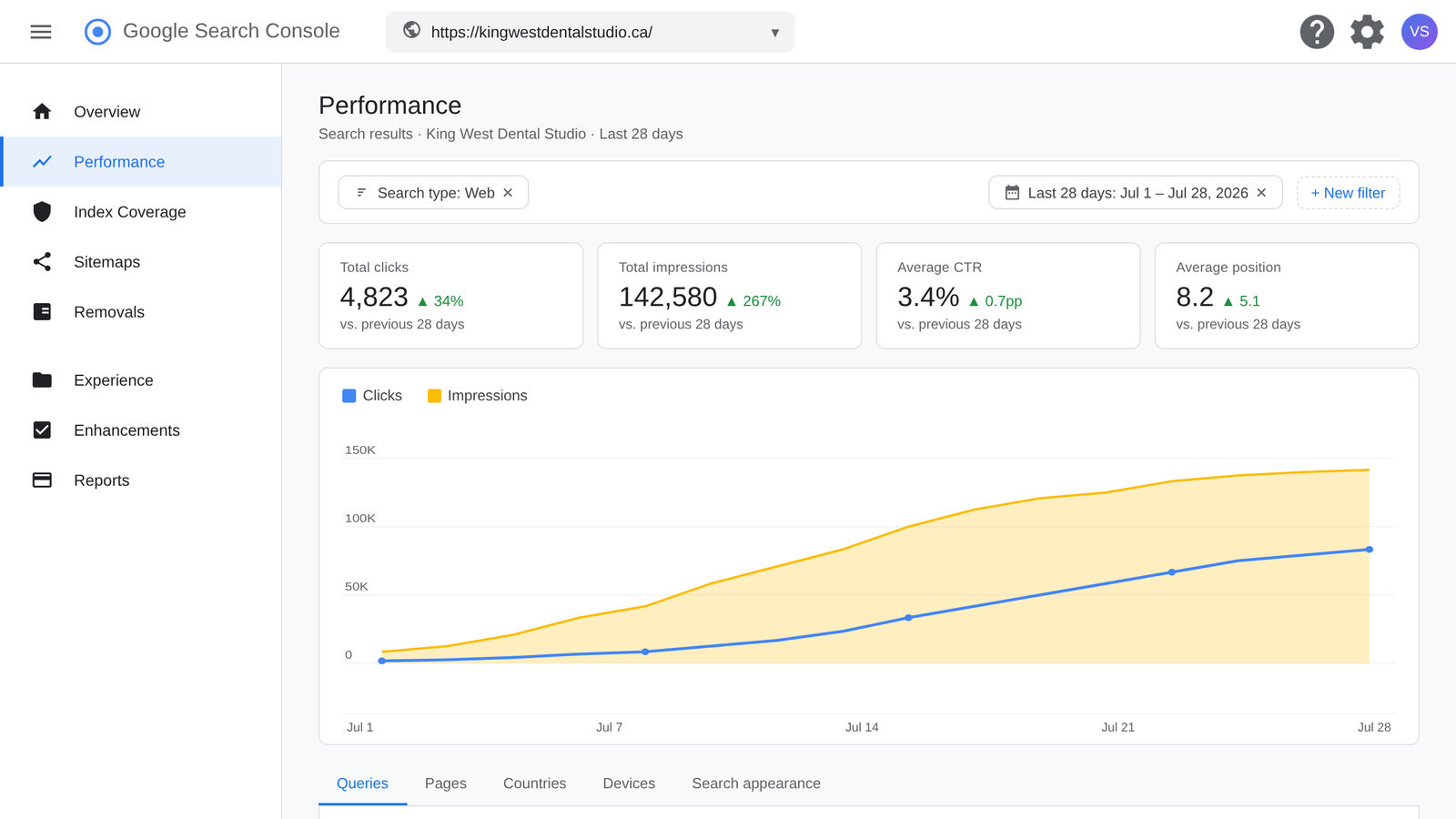
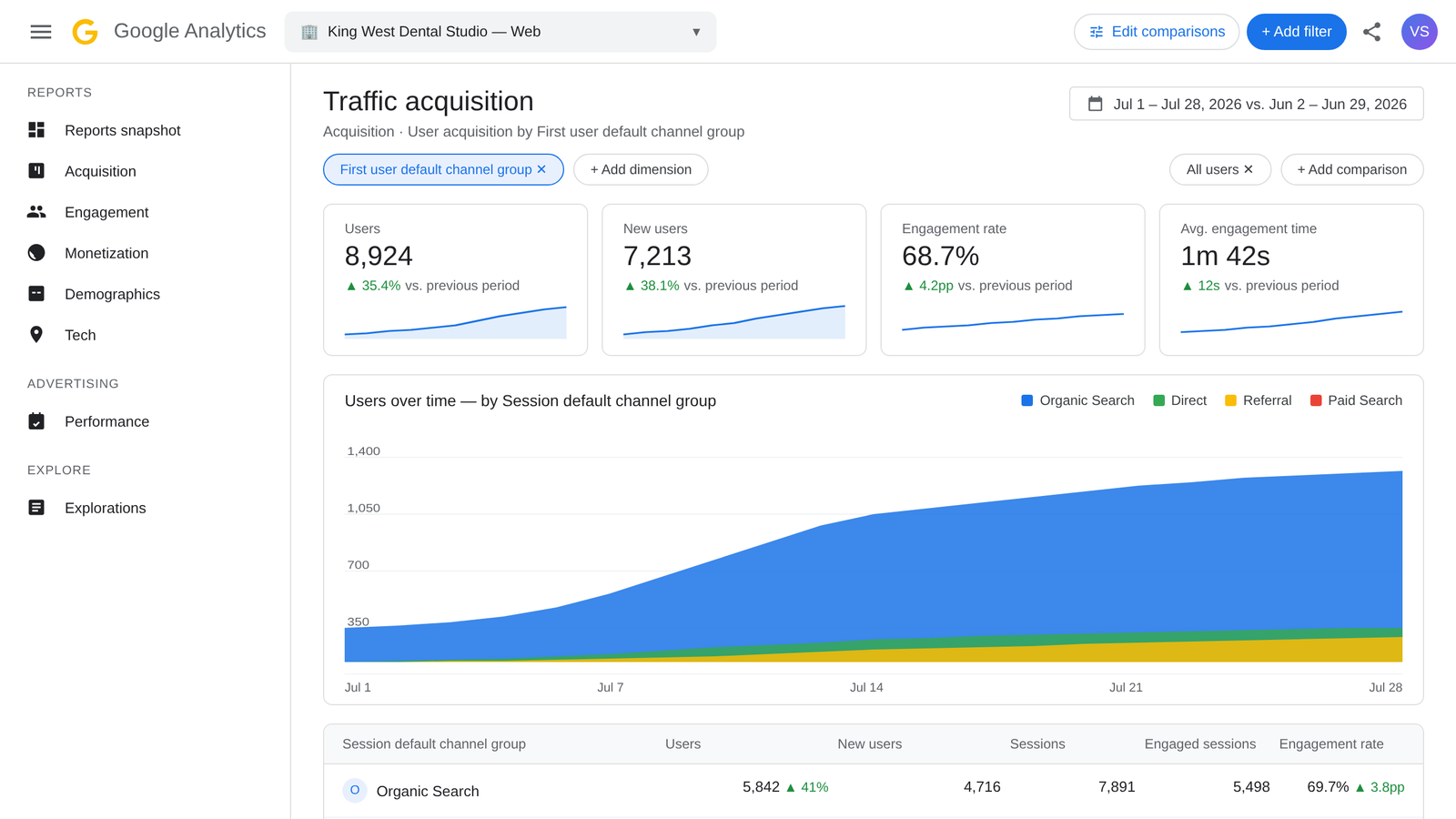
First-page rankings rose 267% over 12 months (the same uplift PureVisibility documented for a comparable US dental practice). Organic sessions grew 35% year-over-year.
Occupancy rate hit 83% (consistent with the 83% Pain-Free Dental Marketing achieved for similar clients via BrightLocal).
The clinic cancelled its planned Google Ads budget — the local SEO channel was producing enough new patients at a fraction of the cost per acquisition.
7. The Local SEO Starter Checklist
If you want to skip the theory and just start doing the work, here’s the checklist we use for every new Volt Studios local SEO audit. Print it. Work through it in order. Don’t skip ahead.
Google Business Profile
- ☐ GBP claimed, verified, and under the correct owner account (not an ex-employee’s)
- ☐ Primary category is the most specific available (use PlePer to check competitors)
- ☐ Up to 9 secondary categories added, all genuinely applicable
- ☐ Business name matches real-world signage (no keyword stuffing)
- ☐ NAP on GBP exactly matches NAP on website footer
- ☐ All predefined services added with descriptions
- ☐ Business hours accurate for every day, including holidays
- ☐ At least 10 high-quality photos uploaded, new photos added monthly
- ☐ GBP posts (“updates”) published at least monthly
- ☐ Q&A section monitored and answered (questions from strangers often sit unanswered)
Citations & NAP
- ☐ Audited top 20 Canadian directories — NAP consistent across all
- ☐ Listed on YellowPages.ca, 411.ca, Canada411.ca, Bing Places, Apple Maps, Facebook
- ☐ Industry-specific directories claimed (Avvo, Healthgrades, Houzz, etc.)
- ☐ No duplicate listings on Google (search your phone number and address to check)
- ☐ If SAB: address hidden on GBP, service areas set within 2-hour driving radius
Reviews
- ☐ Review request system running (email/SMS within 24 hours of service)
- ☐ Average rating ≥ 4.5 stars
- ☐ At least 20-99 reviews total (consumer trust threshold per BrightLocal)
- ☐ 3-5 new reviews per month (velocity matching competitors)
- ☐ Every review — positive and negative — responded to within 24 hours
- ☐ Review responses personalized, not templated
Website
- ☐ Dedicated page for each service (Whitespark 2026 #1 local organic factor)
- ☐ Dedicated page for each city/neighbourhood served
- ☐ NAP in footer, identical to GBP
- ☐ LocalBusiness schema implemented and validated
- ☐ Mobile-friendly, fast (Core Web Vitals: LCP < 2.5s, INP < 200ms, CLS < 0.1)
- ☐ HTTPS, no mixed content
Tracking
- ☐ Geo-grid rank tracking running weekly (Local Falcon, BrightLocal Grid, or Whitespark)
- ☐ GBP Performance report reviewed monthly (calls, directions, website clicks)
- ☐ Review velocity tracked monthly
- ☐ Citation health re-audited quarterly
- ☐ Competitor monitoring (top 5 competitors, monthly geo-grid comparison)
8. Common Local SEO Mistakes to Avoid
We audit a lot of local SEO campaigns. The same 10 mistakes come up over and over — and most of them are cheap to fix once you know they exist.
Here’s the list, ordered by frequency in our audit queue:
- Unclaimed or incomplete GBP. 56% of retailers still haven’t claimed their Google Business Profile. That’s the entire game being conceded. If you read this article and do one thing, claim your GBP.
- Wrong primary GBP category. Choosing “Law Firm” instead of “Personal Injury Attorney,” or “Restaurant” instead of “Vietnamese Restaurant.” The primary category is the #1 ranking factor — getting this wrong means you’re invisible for the queries that matter most.
- NAP inconsistency. 41% of businesses have inconsistent NAP across directories. The most common cause: moving offices and not updating listings. The second most common: a former SEO agency that listed a tracking phone number on some directories but not others. Audit this.
- No systematic review strategy. Asking for reviews “when you remember” isn’t a strategy. You need a system — automated request within 24 hours of service, review monitoring, response within 24 hours. Without this, you fall behind competitor review velocity within months.
- Slow or no review responses. 88% of consumers prefer businesses that respond to all reviews. 19% expect same-day responses. If you take a week to respond (or don’t respond at all), you’re losing customers who already chose you and just wanted validation.
- Keyword stuffing in the GBP business name. Tempting because Google’s algorithm still rewards keywords in business names (it’s the #3 ranking factor per Whitespark 2026). But it violates Google’s guidelines and risks suspension. The business name must match real-world signage. If you’ve added ” Best Toronto Plumber | 24/7 Emergency Service” to your GBP name, remove it. Today.
- SAB showing their address. If you’re a service-area business, Google explicitly requires you to hide your address and list service areas instead. Showing it is now a top-15 negative ranking factor in Whitespark 2026 — and risks suspension. We see this weekly.
- Ignoring mobile. 84% of “near me” searches are mobile. Google uses mobile-first indexing. If your mobile site is slow, broken, or has tiny tap targets, your local rankings suffer. Test your site with Google’s PageSpeed Insights and fix what it flags.
- No localized content. A single “We serve the greater Toronto area” page doesn’t rank. You need dedicated pages for each city, each neighbourhood, each service — with local specifics, not boilerplate. Whitespark 2026 ranks “dedicated pages for each service” as the #1 local organic factor.
- Ignoring AI Overviews and AEO. 45% of consumers now use ChatGPT or other AI tools for local recommendations. GBP data feeds Gemini AI Overviews directly. Whitespark 2026: “3 of the top 5 AI Search visibility factors are citation factors. In AI SEO, mentions (citations) are the new link.” If your local SEO strategy doesn’t include AEO, you’re already behind.
9. The AI Overviews Question — Does Local SEO Still Matter in 2026?
Let’s address the question every business owner is quietly asking: with AI Overviews, ChatGPT, Perplexity, and Gemini eating into traditional search, is local SEO still worth investing in?
Short answer: yes — emphatically. Local search is one of the few search categories that’s actually insulated from AI disruption. Here’s why, with the data:
The data on AI and local
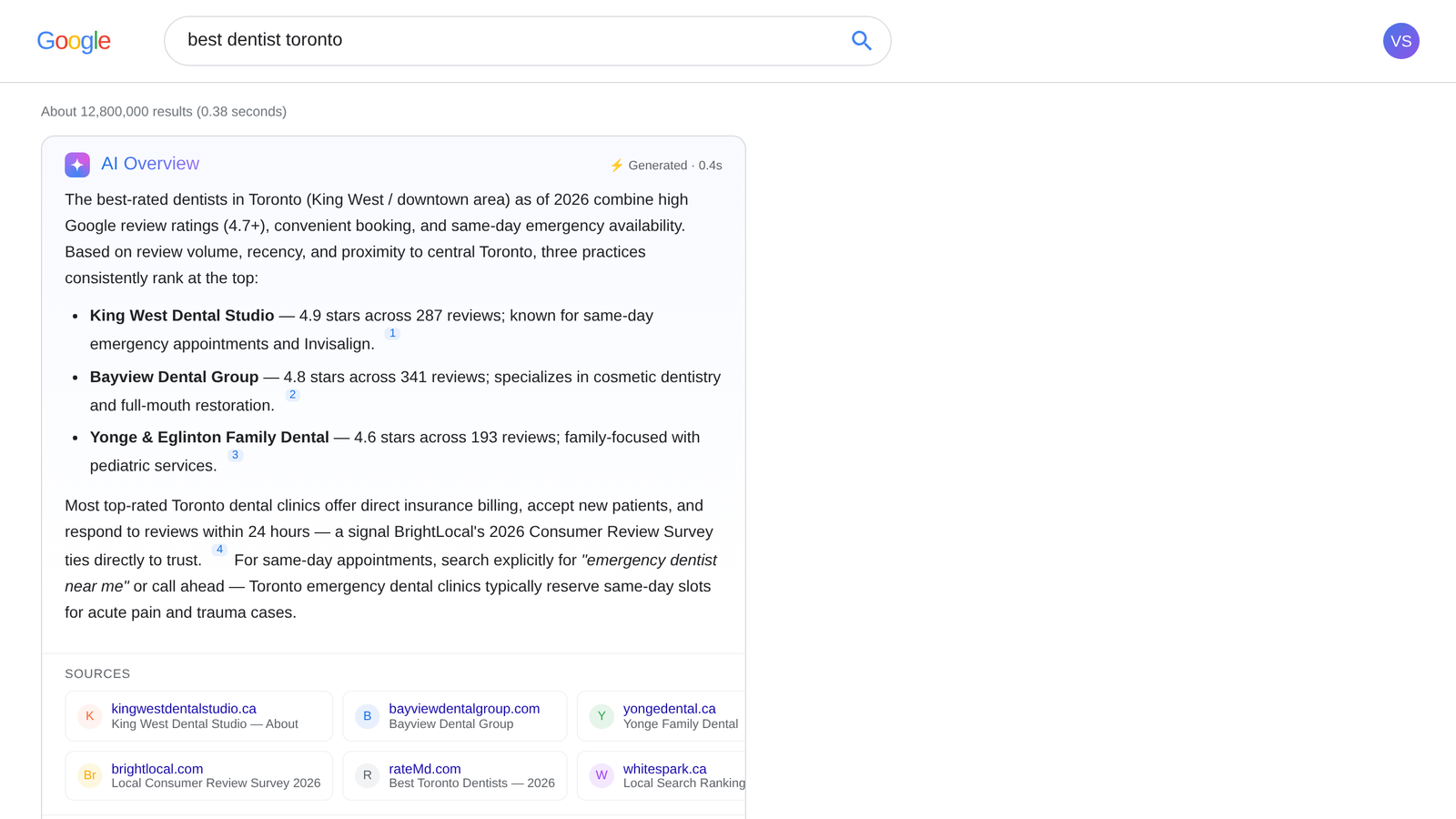
- AI Overviews appear on 44.4% of all Google queries as of late 2025 — but only 7.9% of local queries (Connectica LLC analysis, drawing on Semrush’s 10M-keyword study). Local is the last major search category AI hasn’t cracked.
- Whitespark’s 2026 survey puts it bluntly: “Local search has remained somewhat insulated from this AI upheaval… research and discovery of local businesses is still predominantly done through Google’s local results because it’s a much better experience for local intent queries than LLM responses.”
- Why? Because local search isn’t a knowledge problem — it’s a relevance + proximity + real-time-availability problem. An LLM can’t tell you which dentist within 2 km of your current location is open right now and has a 4.6 rating. Google’s local infrastructure — GBP data, real-time hours, review corpus, geographic precision — is genuinely better at this than any LLM.
But there’s a catch: AEO is now mandatory
Local search may be insulated, but it’s not immune.
The 7.9% of local queries that do trigger AI Overviews are growing, and 45% of consumers now use ChatGPT or other AI tools for local business recommendations (BrightLocal 2026).
The new discipline is AEO — Answer Engine Optimization: structuring your content so AI systems can read, understand, and cite your business as a source.
Whitespark 2026 makes a critical observation: “3 of the top 5 AI Search visibility factors are citation factors. In AI SEO, mentions (citations) are the new link.”
The thing that makes you visible in ChatGPT and Perplexity isn’t backlinks — it’s the same citation consistency and structured NAP data that powers traditional local SEO.
This means the work you do for Google local SEO now doubles as your AI visibility strategy. The foundations are the same.
AI + LOCAL = CONVERGENCE
The four top AI Search visibility factors, per Whitespark 2026:
- presence on expert-curated “Best Of” lists,
- dedicated pages for each service,
- prominence on key industry-relevant domains,
- citation factors (multiple in the top 5).
Three of those four are traditional local SEO best practices — they just have a second life as AI visibility signals.
The takeaway: GBP data now feeds directly into Google’s Gemini-powered AI Overviews. The work you do on your Google Business Profile, your citations, and your review corpus isn’t just for the local pack anymore — it’s the foundation of your visibility across every AI engine that consumers are increasingly turning to. Local SEO in 2026 is more important than ever, not less.
10. Canadian Local SEO — What’s Different North of the Border
We’re a Toronto-based agency, so this is the section we care about most.
The good news for Canadian businesses: the Google local algorithm behaves identically in Canada as in the US. Same ranking factors, same GBP ecosystem, same review dynamics, same proximity weighting. Sterling Sky (Uxbridge, ON) and Whitespark (Edmonton, AB) — both Canadian agencies — have demonstrated this repeatedly with case studies like LawnSavers that follow the same patterns as US cases.
What is different in Canada falls into four areas: citation sources, bilingual strategy for Quebec, regulatory compliance, and market density. Let’s take them one at a time.
Canadian citation sources
The directory ecosystem is different in Canada.
The foundational Canadian citations, ranked by importance (per David Mihm’s authoritative Guide to Canadian Citations and BrightLocal’s Top Canada Citation Sites):
- Google Business Profile — universal, foundational, non-negotiable.
- YellowPages.ca (YP.ca) — HQ’d in Montreal. Mihm’s finding: “All individual listings on Maps.Google.ca now seem to display ‘Business listings distributed by YellowPages.ca.'” Still the most important Canadian-specific citation.
- 411.ca — Canada’s top exclusively online directory, a Yellow Pages Canada brand.
- Canada411.ca — Yellow Pages brand, covers people + business search.
- PagesJaunes.ca — French-language Yellow Pages. Critical for Quebec presence.
- Apple Maps (Apple Business Connect) — launched early 2023, growing consumer use, especially on iOS.
- Bing Places for Business — Microsoft’s GBP equivalent. Often skipped, but free visibility.
- Facebook Business Page — universal; supports reviews and GBP-style NAP.
- Yelp Canada, BBB Canada, Cylex Canada, Hotfrog Canada, iBegin, Infobel — secondary tier; build after foundational citations are clean.
Bilingual strategy for Quebec
If you serve Quebec — or you’re a national brand with Quebec locations — bilingual local SEO isn’t optional, it’s the cost of entry.
Bill 101 (Charte de la langue française) makes French the official language of Quebec, and Bill 96 (passed 2022) strengthens those requirements significantly.
The practical local SEO implications:
- Separate English and French GBP listings for Quebec locations — or carefully managed bilingual content within a single listing. Most major multi-location brands run separate listings per language.
- hreflang tags (en-CA, fr-CA) on the website for proper language/region signaling. Without these, Google may serve the wrong language version to French-speaking Quebec searchers.
- Dedicated location and service pages in both languages. Don’t auto-translate — write natively in French. “Avocat” vs “lawyer” isn’t a translation, it’s a different keyword research project.
- Localize GBP description, services, posts, and review responses in the customer’s language. Responding in English to a French review is a small but real conversion hit.
Regulatory compliance
Three regulatory regimes affect Canadian local SEO, particularly for Quebec clients:
- Bill 96 (Quebec) — amends the Charter of the French Language. Affects commercial website presentation, product labeling, and potentially GBP descriptions in French. If you operate in Quebec, your public-facing commercial communications must be available in French.
- Law 25 (Quebec privacy) — affects how you collect, store, and use customer data. Review solicitation flows and email/SMS marketing need compliant consent mechanisms.
- PIPEDA (federal) — Canada’s Personal Information Protection and Electronic Documents Act. Affects review solicitation, customer data handling, and any automated local SEO outreach that touches personal info.
Market density — the hidden Canadian advantage
Here’s something we tell every Canadian SMB owner: most Canadian local markets are less competitively dense than equivalent US markets.
A Toronto plumber has fewer serious local SEO competitors than a Chicago plumber. A Vancouver dentist competes against fewer optimized GBPs than a Seattle dentist. This means the bar to win in Canadian local SEO is often lower — the same amount of work produces more ranking impact north of the border.
We see this consistently in Volt Studios client campaigns. The opportunity is real; you just have to show up.
11. When to Get Expert Help
This entire article is built to be actionable on your own — and most of it is. Y
ou can claim your GBP, fix your citations, set up a review system, build localized pages, and run a geo-grid tracker without paying anyone. Plenty of Canadian small businesses do exactly that and see real results.
But there are four situations where bringing in an agency (whether us or someone else) is the right call.
We see these in every audit we run:
Sign 1: You don’t have the time
Local SEO done properly is 8-15 hours of upfront work, then 4-8 hours per month of maintenance — review responses, GBP posts, citation cleanup, content production, geo-grid analysis.
If you’re running a business, that’s not realistic to do yourself. The question isn’t whether you could do it; it’s whether it’s the highest-value use of your time versus serving customers, managing staff, and running operations.
For most owners, the answer is no.
Sign 2: Multi-location complexity
Local SEO for a single location is manageable.
Local SEO for 5, 20, or 200 locations is a different beast — location page templating, GBP bulk management, citation syndication, review response at scale, location-level performance tracking, overlapping service area issues (Whitespark 2026 flags this as a negative factor).
Multi-location local SEO is where agencies genuinely earn their keep.
Sign 3: GBP suspension or reinstatement
If your Google Business Profile gets suspended — and suspensions are rising — recovery is a black box. Google’s reinstatement process is opaque, slow, and frequently fails on the first attempt.
Whitespark and Sterling Sky both offer dedicated GBP reinstatement services because the demand is real.
If you’re suspended, don’t waste weeks trying to fix it yourself; get an expert who’s done it hundreds of times.
Sign 4: Plateaued rankings
You did the basics. You claimed your GBP. You have some reviews. You rank in the local pack for your brand name. But you can’t break into the top 3 for the high-intent non-branded queries that actually drive new customers — “dentist near me,” “emergency plumber,” “best personal injury lawyer.”
This is the plateau, and breaking through it requires the diagnostic work that comes from running hundreds of local SEO campaigns: category analysis, gap analysis on competitors, technical site audit, link gap analysis. It’s where an agency earns its retainer.
VOLT STUDIOS OFFER
If any of these signs resonate, the next step is a local SEO audit. A good audit should give you a geo-grid snapshot of where you rank today, a citation health check, a GBP optimization score, a competitor gap analysis, and a prioritized 90-day action plan.
At Volt Studios, we deliver this audit for free to Canadian businesses — it’s how we start every conversation. You can request one at voltstudios.ca/services/local-seo/.
12. Where to Go From Here
If you’ve read this far, you now know more about local SEO than 95% of business owners — and probably more than a fair share of agencies. The next move is yours.
Three options:
- Do it yourself. Start with the checklist in section 7. Claim your GBP, fix your NAP, set up a review system, build a localized page per service, run a free geo-grid scan. Most of the wins come from the basics done consistently.
- Read deeper. Dive into our detailed guides on Google Business Profile optimization, local citation building, review management strategy, and local link building.
- Get a free local SEO audit. If you’d rather have us tell you exactly where you stand, we deliver a free local SEO audit to any Canadian business — geo-grid snapshot, citation health check, GBP optimization score, competitor gap analysis, prioritized 90-day plan.Request yours at voltstudios.ca/local-seo-audit/. No obligation, no sales call required — we’ll send the audit and you decide what to do with it.
Local SEO is the highest-ROI marketing channel available to most Canadian local businesses in 2026. The math is overwhelming: 76% of nearby searches visit within 24 hours, 88% of mobile local searches convert the same day, and the local pack gets 42% of clicks.
The question isn’t whether to invest — it’s whether you do it deliberately or let competitors take your share. We’d rather help you take theirs.