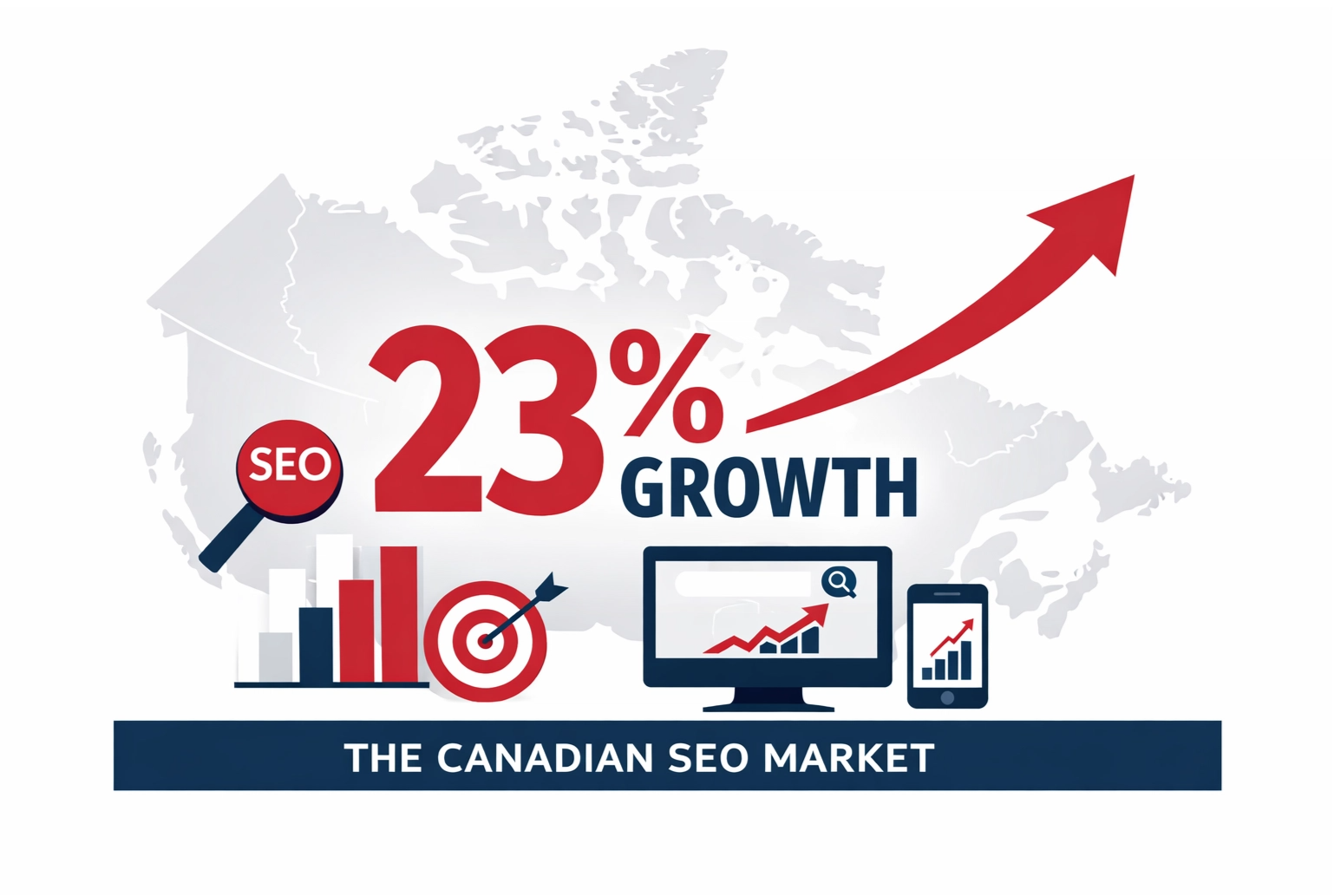
In 2026, the Canadian digital economy continues to accelerate at a remarkable pace, with overall SEO investment in Canada reaching $2.4 billion — representing a 23% year-over-year growth rate. This growth signals just how seriously businesses are taking search visibility.
Yet despite this explosion of interest, thousands of Canadian service businesses remain invisible online, losing high-value leads every single day to competitors who understood the rules of local search just a little earlier.
This guide is designed to change that.
Whether you are a solo electrician in Montreal, a multi-crew roofing company in Edmonton, or a regional property management firm operating across multiple Ontario cities, the SEO strategies in this guide will give you a complete, actionable framework for dominating local search results in every market you serve.
What Is Local Services SEO and Why It Matters for Canadian Businesses
Local services SEO is the practice of optimizing your online presence so that your business appears prominently in Google search results when people in your geographic area search for the services you provide.
According to 2026 research data, 89% of Canadians conduct local searches on a weekly basis, with 68% of those searches happening on mobile devices.
Research shows that 78% of mobile local searches result in a conversion within 24 hours. That means someone called a business, booked an appointment, or visited a location within one day of doing a local search on their phone.
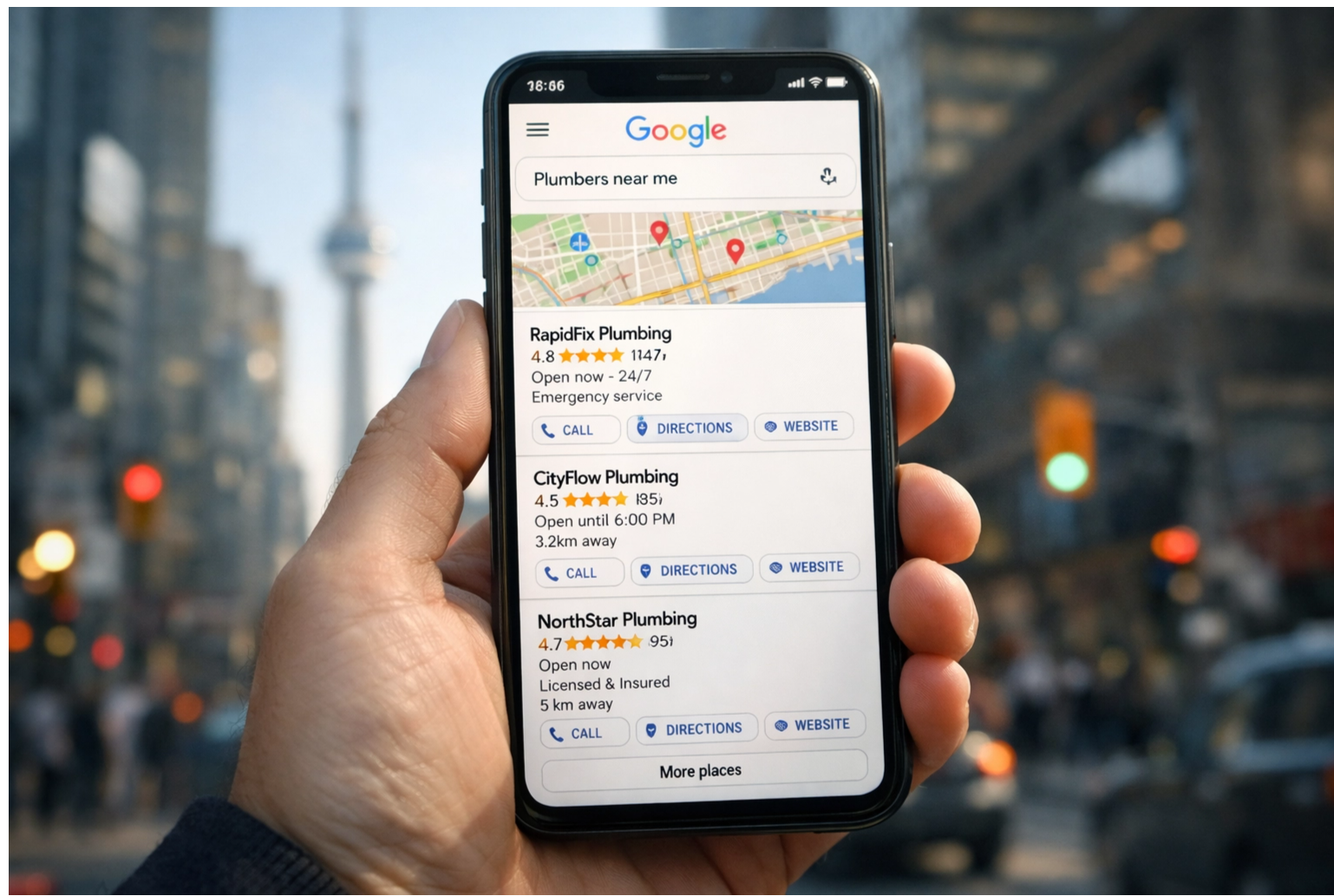
For a plumber, an electrician, a cleaning company, or a landscaper, this represents enormous revenue potential sitting right at the top of the search results page.
Local services SEO captures that intent at the exact moment it exists. It puts your business in front of Canadians who are actively searching for what you do, in the area where you operate, at the precise moment they are ready to make a hiring decision.
How Google Ranks Local Service Businesses in Canada
Understanding how Google decides which businesses appear in local search results is the foundation of any effective local SEO strategy.
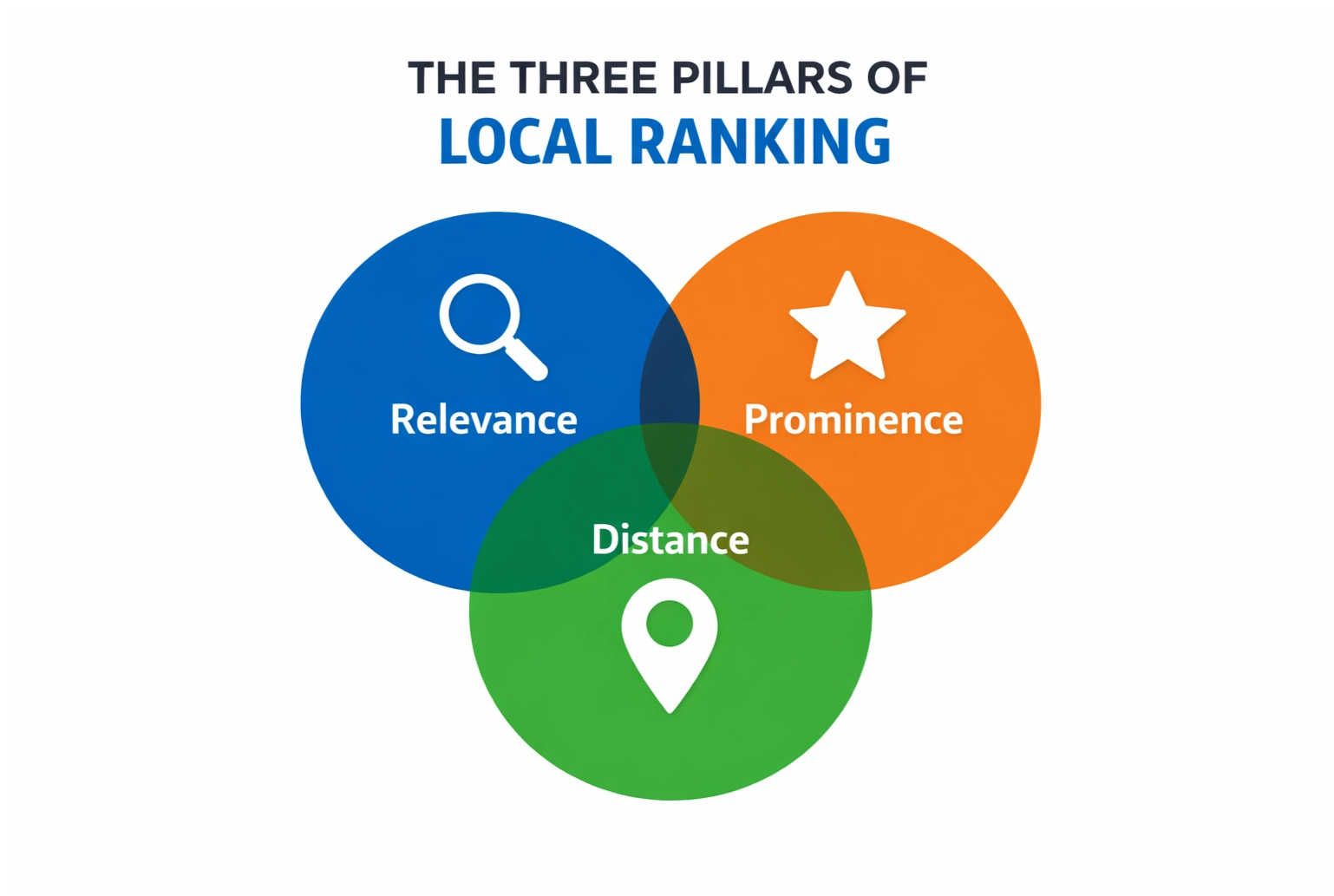
Google uses three primary ranking factors for local results: relevance, distance, and prominence. Each of these factors plays a distinct role, and understanding how they interact will help you make better decisions about where to invest your SEO efforts.
1. Relevance
Relevance refers to how closely your Google Business Profile and website content match what the searcher is looking for. If someone in Toronto searches for “emergency furnace repair,” Google will prioritize businesses whose profiles and websites clearly indicate they offer furnace repair services, ideally with specific language that matches the searcher’s query.
2. Distance
Distance is straightforward: Google considers how far your business is from the searcher or from the location specified in the search query. A Calgary homeowner searching for “fence installation Calgary” will see businesses that are geographically near Calgary.
3. Prominence
Prominence refers to how well-known and well-regarded your business is, both online and offline. Google interprets prominence through signals like the quantity and quality of online reviews, the number of links pointing to your website from other authoritative sites, your presence in online directories, your social media presence, and the overall authority of your website.
In 2026, Google has also become increasingly sophisticated at detecting and rewarding businesses that demonstrate what SEO professionals call E-E-A-T: Experience, Expertise, Authoritativeness, and Trustworthiness.
For Canadian service businesses, this means demonstrating your qualifications, showcasing completed projects, highlighting industry certifications, and building a digital footprint that signals you are a legitimate, established business in your community.
The Role of Google Business Profile in Canadian Local Search
Your Google Business Profile (GBP) is the most important single asset in your local SEO toolkit.
When Canadians search for a local service, the first thing most of them see is the Google Map Pack. The three positions in Map Pack represent the most valuable real estate in local search, and the 2026 data makes their importance crystal clear: businesses that appear in the top three map pack positions receive 93% more conversions than those that appear only in the organic results below.
A fully optimized GBP includes a complete and accurate business name, address, phone number, correct primary and secondary categories, business description written with relevant keywords, comprehensive list of your services with descriptions and pricing, regularly updated photos and videos showing your team, equipment, completed work, and service vehicles, Google Posts highlighting promotions, seasonal services, and company news, and a collection of genuine customer reviews with thoughtful, keyword-rich responses from the business owner.
For service-area businesses that operate across multiple Canadian cities, the GBP service-area settings allow you to specify all the regions you serve without necessarily having a physical address in each location. This is a critical setting that many Canadian service businesses either miss entirely or configure incorrectly, resulting in lost visibility in markets they actively serve.

In 2026, Google has expanded the features available within GBP, including enhanced booking integrations, messaging capabilities, and product and service showcases.
The Canadian Local Services SEO Landscape in 2026
Unlike the United States, where the sheer volume of competing businesses and the depth of digital marketing investment has created hyper-competitive search landscapes in almost every vertical, many Canadian markets still have significant local SEO opportunity gaps.
The $2.4 billion Canadian SEO market in 2026 reflects growing awareness among business owners that search visibility drives revenue. But this investment is not evenly distributed.

Large enterprises and franchise networks account for a disproportionate share of SEO spending, leaving independent local service businesses in search results and underserved by agencies that understand their specific needs. This is precisely the gap that a focused local services SEO strategy is designed to fill.
Companies that commit to a consistent local SEO program see an average 35% increase in leads within six months. For a service business generating $400,000 in annual revenue, a 35% lead increase at even a modest conversion rate represents tens of thousands of dollars in new business.
Why Canadian Service Businesses Struggle to Rank
-
- The first and most pervasive problem is an incomplete or inconsistent online presence. Many Canadian service businesses have a Google Business Profile that is 40% complete — missing service descriptions, lacking photos, devoid of reviews, and configured with incorrect service-area settings. At the same time, their business information may appear differently across various online directories — the phone number on Yellow Pages Canada might differ from the one on Yelp Canada, and the address format on Canada411 might not match the GBP. These inconsistencies send confusing signals to Google and erode the trust signals that local ranking depends on.
-
- The second major issue is weak or absent website content. A service business website that consists of a homepage, an “about us” page, and a contact form is not equipped to rank in competitive local searches. Google needs content to understand what you do, where you do it, and why you are the best option. Without dedicated service pages, location-specific landing pages, and genuinely useful content that answers the questions your target customers are asking, your website is simply invisible to the algorithm.
-
- Third, many Canadian service businesses have no systematic approach to generating reviews. In a city like Montreal or Edmonton, where five or ten competitors might be vying for the same map pack position, the business with 150 Google reviews will almost always outperform the one with 12. Reviews are both a ranking signal and a conversion driver, and businesses that leave review generation to chance are leaving both rankings and revenue on the table.
-
- Finally, there is the widespread problem of technical SEO neglect. Slow-loading websites, non-mobile-friendly designs, missing local business schema markup, broken internal links, and pages that fail basic Core Web Vitals standards all create barriers between your business and the top of the local search results. In 2026, Google’s technical standards are higher than ever, and a website that does not meet them will be penalized in rankings regardless of how strong other signals might be.
HomeStars, Houzz, and Third-Party Directories vs. Your Own Website
A question VoltStudios frequently hears from Canadian service business owners is: “Should I just focus on HomeStars and Houzz rather than building up my own website?”
It is a fair question, particularly given that HomeStars attracts 8 million visits per year and has established itself as Canada’s most recognized platform for hiring home service professionals. Houzz Canada, with its global design focus and portfolio showcase features, similarly offers real visibility for renovation contractors, interior designers, and landscapers.
The honest answer is: you need both, but your own website must be the foundation. Third-party platforms like HomeStars, Houzz Canada, Yellow Pages Canada, Canada411, and Yelp Canada are enormously valuable but not primarily because they generate direct leads on their own. Their true SEO value lies in the citations they create. These citations reinforce your business’s legitimacy and local relevance in the eyes of Google’s algorithm. However, you do not own these platforms. These can change their algorithm, increase fees, or modify their ranking criteria at any time.
Your own website, by contrast, is a permanent digital asset that you control completely. A well-optimized website with strong content, technical SEO, and a strong backlink profile will compound in value over time, becoming more authoritative and more competitive with every passing month.
The winning strategy in 2026 is to use third-party directories strategically while simultaneously investing in a website that is built to dominate local search independently. This dual approach creates multiple pathways through which potential customers can find your business, and it builds long-term digital equity that no platform change can take away.
Core Pillars of Local Services SEO in Canada
Successful local services SEO rests on three interconnected pillars: on-page optimization, citation building, and reputation management. When all three are working together consistently, the cumulative effect on local rankings and lead generation is dramatically greater than any single element alone.
1. On-Page SEO for Service-Area Businesses
On-page SEO refers to all the optimization work done directly on your website to make it more relevant, authoritative, and technically sound in the eyes of search engines. For Canadian service businesses, on-page SEO has unique characteristics that differ from e-commerce or content-driven websites, and getting these details right is what separates businesses that rank consistently from those that struggle.
The main on-page SEO factor for any service business is the structure of your service pages. Each core service you offer deserves its own dedicated page which explains what customers can expect, addresses common questions, showcases relevant photos or videos, and includes a clear call to action.
A Toronto plumbing company should have individual pages for emergency plumbing, drain cleaning, water heater installation, pipe repair, bathroom renovation plumbing, and any other service it provides. Each page should be optimized with a primary keyword (such as “drain cleaning Toronto”) in the title tag, H1, first paragraph, and throughout the body content in a natural, readable way.
Title tags and meta descriptions are the first things potential customers see in search results, and they play a direct role in both rankings and click-through rates. A well-optimized title tag for a Calgary HVAC company’s furnace installation page can be: “Furnace Installation Calgary | Licensed HVAC Technicians | Free Estimates” — incorporating the primary keyword, a trust signal, and a value proposition all in under 60 characters. Meta descriptions should expand on this promise, clearly articulating what the customer will find on the page and why they should choose this business over competitors.
Local business schema markup is a technical on-page element that many Canadian service businesses overlook entirely, yet it provides a significant ranking advantage. Schema markup is structured data code added to your website that explicitly tells Google what your business is, where it is located, what services it offers, its operating hours, and how customers can contact you. Implementing LocalBusiness schema, Service schema, and Review schema correctly can improve your chances of appearing in rich search results and helps Google understand your business context with greater confidence.
Page speed and mobile optimization are non-negotiable in 2026. With 68% of Canadian local searches happening on mobile devices, a website that loads slowly or displays poorly on a smartphone is actively losing leads every single day. Google’s Core Web Vitals standards have a direct impact on both organic and local search rankings.
2. Building Local Citations in Canadian Directories
Citations are online mentions of your business’s name, address, and phone number. They appear on directory websites, review platforms, local business associations, industry-specific sites, and news publications, among many other places. For local SEO purposes, citations serve as trust signals — they confirm to Google that your business is real, established, and consistent in how it presents its information across the web.
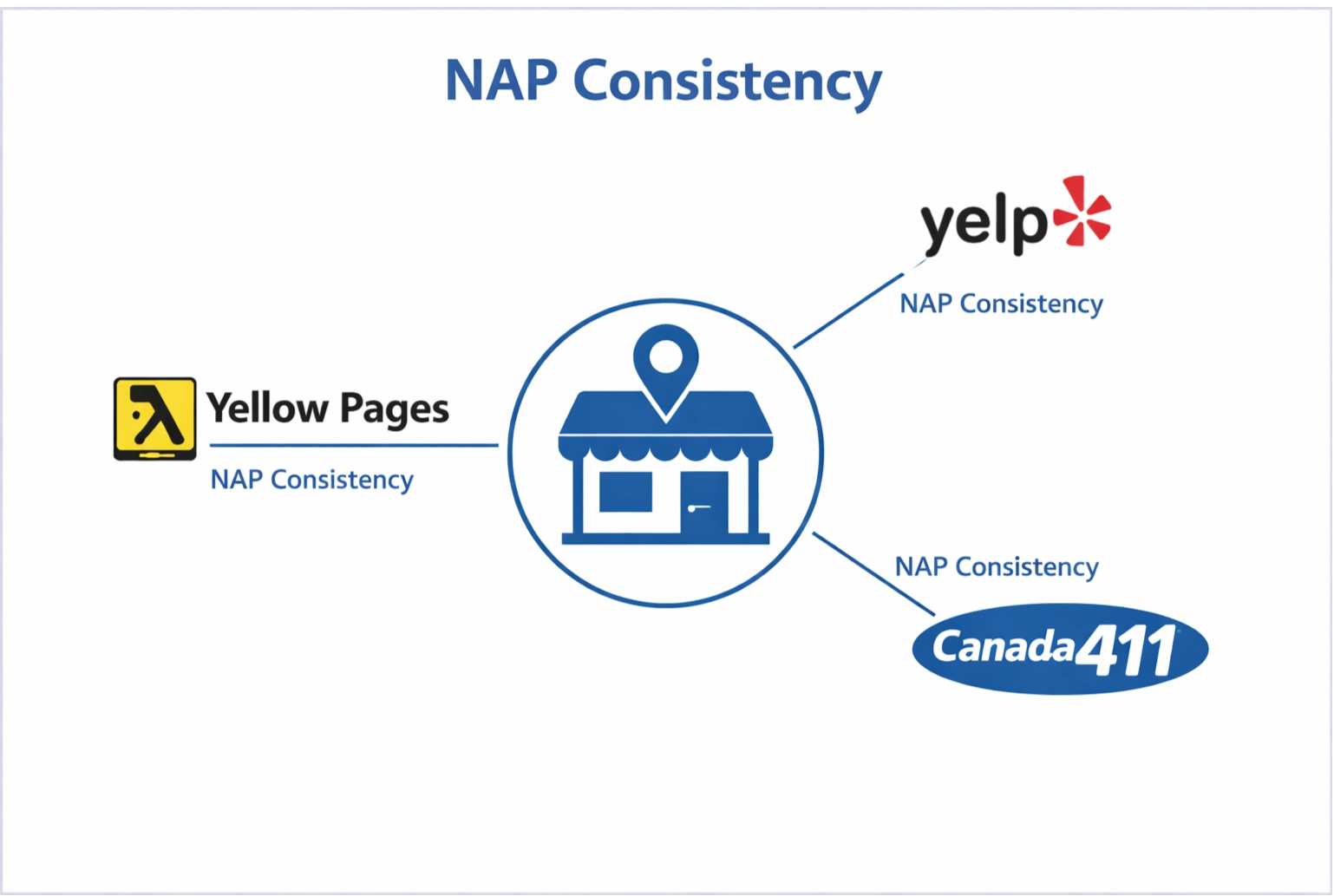
For Canadian service businesses, the priority citation sources include both national and regional directories. At the national level, Yellow Pages Canada (yp.ca), Canada411, Yelp Canada, BBB Canada (Better Business Bureau), and the Canadian Business Directory are essential starting points. Regional and local directories provide valuable citation signals that national directories cannot replicate. A Montreal cleaning company should appear in Quebec-specific business listings and French-language directories. These locally specific citations carry geographic relevance signals that reinforce your business’s connection to the communities you serve.
The critical requirement for citation building is NAP consistency. Your business name, address, and phone number must be formatted identically across every single directory and platform where your business appears. Even small variations like “St.” versus “Street,” a missing suite number, an old phone number that was never updated can create conflicting signals that confuse Google and erode the trust value of your citations. Before building new citations, Canadian service businesses should conduct a thorough audit of all existing listings and correct any inconsistencies they find.
In 2026, citation management has become increasingly important not just for raw ranking signals but for voice search and Google Maps accuracy. When someone uses voice search to ask their smartphone for “plumbers near me” while standing in their Mississauga kitchen, Google draws on citation data to serve the most relevant local results. A business with clean, consistent, comprehensive citations will appear more reliably in these zero-click and voice-driven search experiences.
3. Review Generation and Reputation Management
Online reviews are local ranking factor, conversion driver, and brand reputation asset. A roofing company in Edmonton with 180 genuine Google reviews and an average rating of 4.8 stars occupies a fundamentally different competitive position than a competitor with 15 reviews and a 3.9 average.
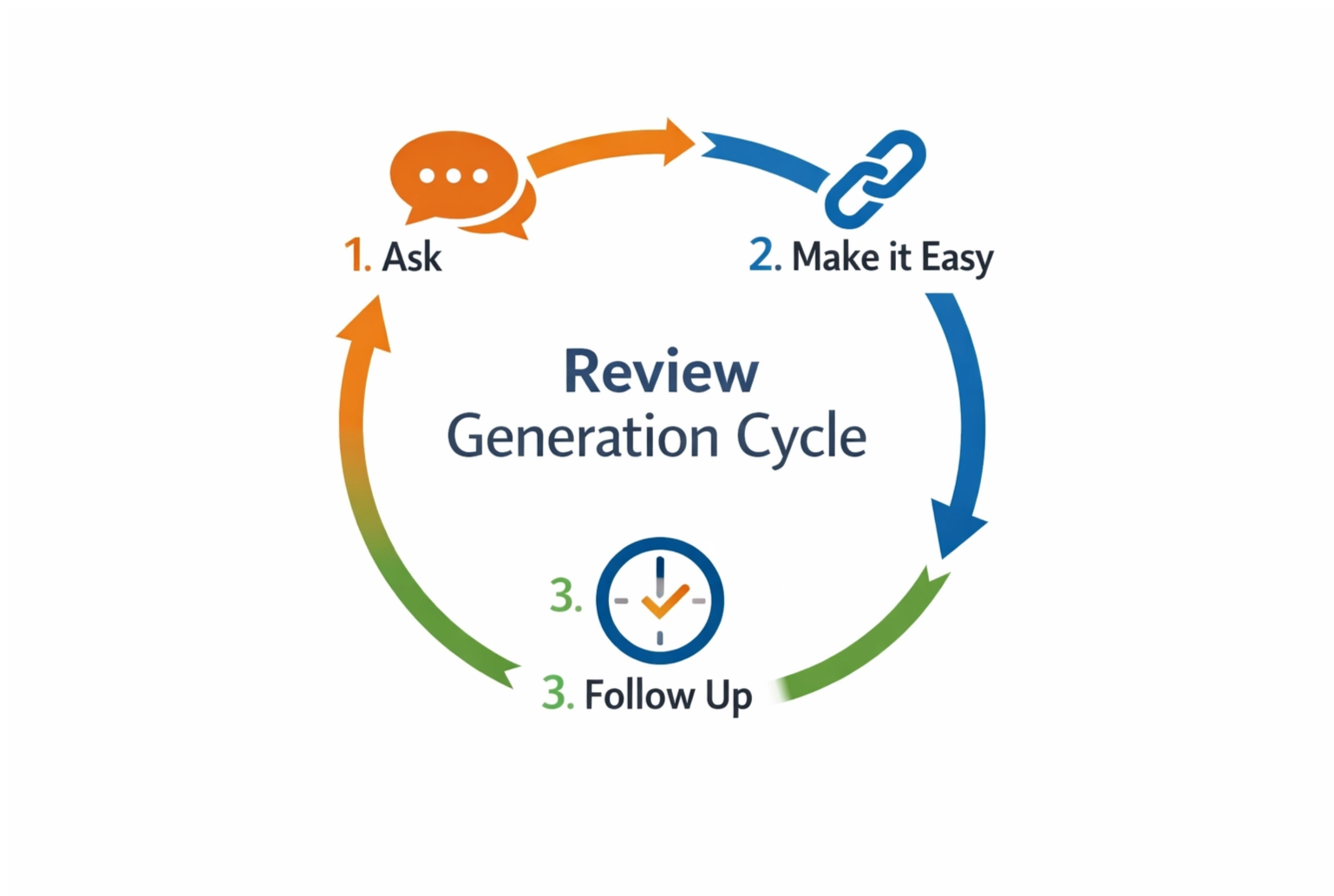
Generating reviews requires a systematic, proactive approach rather than hoping satisfied customers will find their way to Google on their own. The most effective review generation strategy for Canadian service businesses involves a three-step process: asking at the right moment, making it easy, and following up thoughtfully.
- The right moment to ask for a review is immediately after the service is completed and the customer has expressed satisfaction.
- Making it easy means providing a direct link to your Google review form, typically via text message or email, so the customer does not have to navigate through multiple screens to leave feedback.
- Following up with a gentle reminder a few days later can significantly increase the response rate among customers who intended to leave a review but forgot.
Responding to reviews, both positive and negative, is equally important. Google views review responses as evidence of an active, engaged business owner who values customer feedback, which contributes positively to prominence scores.
Service-Area Pages: How to Target Every City You Serve
For Canadian service businesses that operate across multiple cities or regions, service-area pages are one of the most powerful and underutilized local SEO strategies available. A service-area page is a dedicated page on your website that targets a specific city or neighbourhood, combining your service offerings with location-specific content to rank in searches from that geographic area even if your physical address is located elsewhere.
Consider a window and door installation company based in Burlington, Ontario, that serves customers across the Greater Toronto Area. Without service-area pages, this company’s website will struggle to appear in searches from Toronto, Oakville, Mississauga, Brampton, and Hamilton.
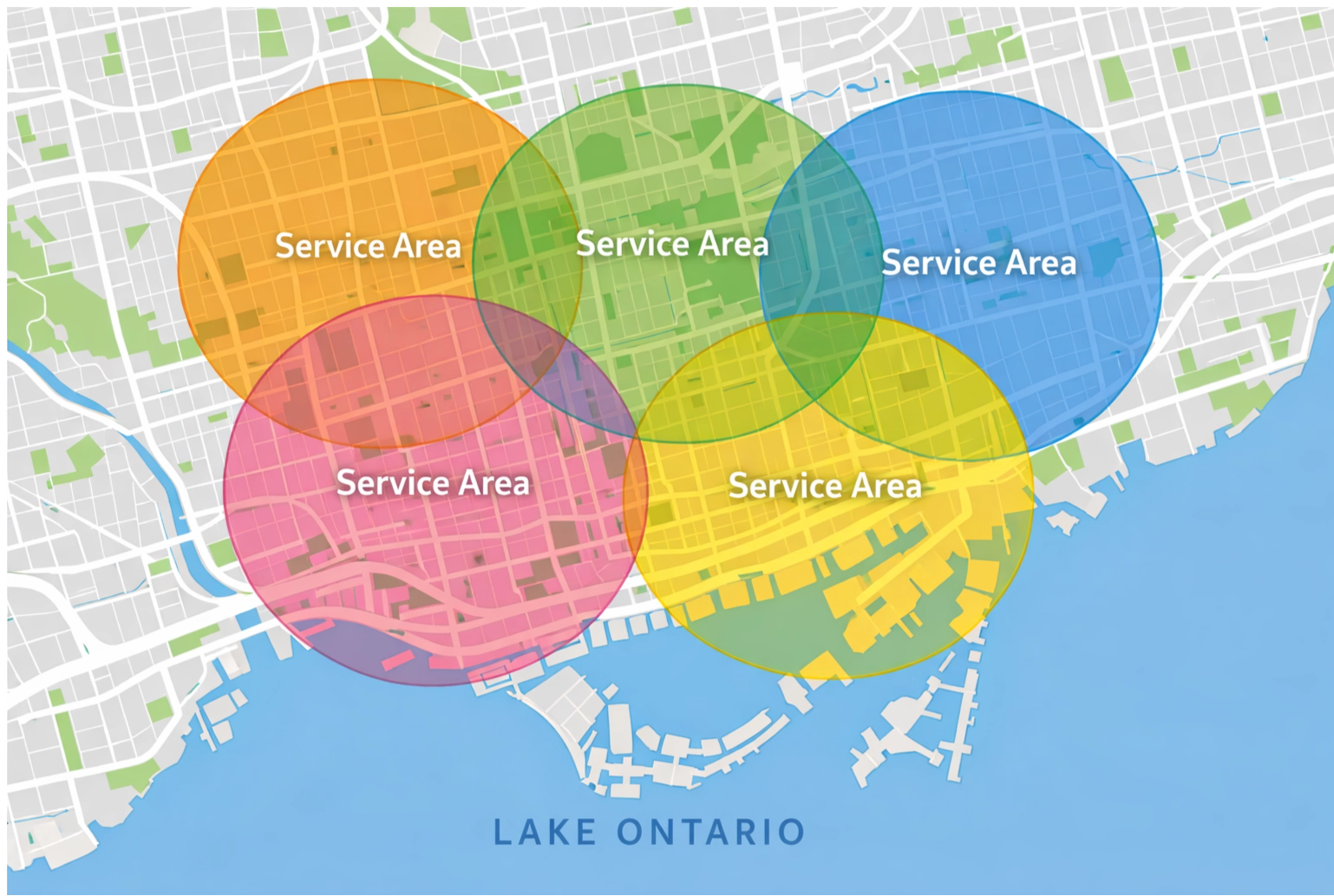
Effective service-area pages are not thin, templated content with only the city name swapped in. Instead, each service-area page should include genuinely useful, locally relevant content: references to specific neighbourhoods, local landmarks, or regional characteristics, testimonials from actual customers in that city, photos of completed projects in that location, relevant local regulations or considerations and a clear description of how the business serves customers in that area.
Each service-area page should be optimized with the city name in the title tag, H1, URL slug, first paragraph, and naturally throughout the content. The page should include the company’s service-area business information, a local phone number if available, an embedded Google Map, and a clear call to action that makes it easy for the visitor to request a quote or call the business directly. Internal linking between service-area pages and core service pages strengthens the overall site architecture and helps Google understand the relationships between your geographic coverage and your service offerings.
Content Marketing for Local Services
Content marketing plays a critical supporting role in a comprehensive local services SEO strategy. While service pages and service-area pages form the commercial core of your website’s search presence, a well-executed content marketing builds topical authority, attracts backlinks, generates organic traffic from informational searches, and nurtures potential customers who are in the research phase of their buying journey before they are ready to request a quote.
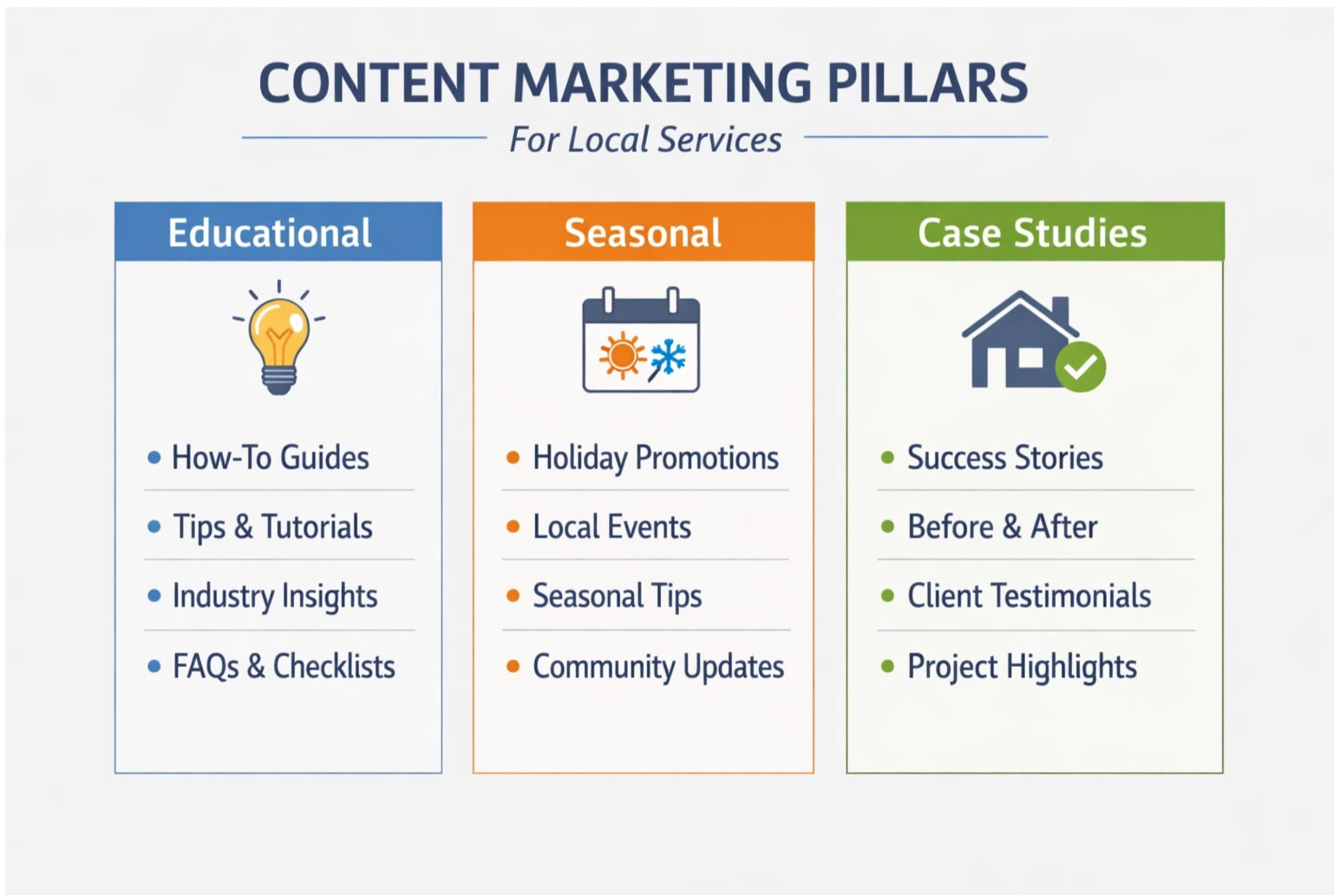
For Canadian service businesses, the most effective content marketing focuses on answering the specific questions that local customers ask at every stage of the decision-making process. A Montreal HVAC company might create blog posts addressing questions like: “How often should I service my furnace in Quebec?”, “What size heat pump do I need for a Montreal winter?”, and “What are Quebec’s regulations for HVAC installation in rental properties?”.
These articles attract organic traffic from Canadians who are researching their HVAC needs, position the company as a knowledgeable authority, and create opportunities to convert readers into leads through well-placed calls to action.
Seasonal content is valuable for Canadian service businesses. A Vancouver roofing company should publish pre-winter inspection guides every autumn, addressing the specific concerns of Lower Mainland homeowners facing the wet season. A Halifax deck and fence company should create spring-focused content that targets homeowners planning renovation projects as the weather improves.
Aligning your content calendar with the seasonal changes of your Canadian market keeps your website consistently active and ensures you are capturing search traffic at the moments when demand is highest.
Case studies and project showcases are powerful form of content for service businesses because they combine social proof with genuinely informative content and location-specific signals. A before-and-after case study of a basement waterproofing project completed in a Toronto home provides multiple SEO benefits.
Video content has become important for local services SEO in 2026. Short videos embedded on service pages and hosted on YouTube increase page engagement time, reduce bounce rates, and contribute to the overall authority and richness of your content.
Measuring ROI: What Metrics Actually Matter
One of the most common frustrations Canadian service business owners express about SEO is the difficulty of measuring whether it is actually working. Unlike pay-per-click advertising, where you can draw a relatively direct line between ad spend and leads generated, SEO operates over longer timeframes and involves multiple interacting variables.
The metrics that matter most for a Canadian service business investing in local SEO fall into four categories: visibility metrics, traffic metrics, lead metrics, and revenue metrics.
-
- Visibility metrics include your Google Business Profile ranking position for key search terms in each of your target markets, your appearance rate in the map pack for primary keywords, and your organic ranking positions for service and location-specific pages. These metrics tell you whether your SEO work is producing the search visibility improvements that everything else depends on.
-
- Traffic metrics measure what happens as a result of that visibility including how many people are visiting your website each month from organic search, which pages they are landing on, how long they are spending on those pages, and whether they are engaging with your content or leaving immediately. Tools like Google Search Console and Google Analytics 4 provide this data for free.
-
- Lead metrics are where local SEO’s business impact becomes concrete. Tracking the number of phone calls that originate from organic search, the number of contact form submissions from organic visitors, and the number of quote requests attributed to local search gives you a direct count of leads generated by your SEO investment.
-
- Revenue metrics connect those leads to actual business outcomes like how many of those SEO-generated leads converted into paying customers, what their average job value was, and what lifetime customer value looks like for clients who found you through local search.
In 2026, businesses that commit to local SEO see that average 35% increase in leads within six months but the businesses that see the most dramatic results are those that measure consistently, adjust their strategies based on data, and treat SEO as an ongoing investment rather than a one-time project.
How to choose a Local SEO Agency in Canada?
Choosing the right agency is critical. The Canadian digital marketing industry includes genuinely excellent agencies with deep local SEO expertise.
Agencies to Avoid
- The first and most important red flag is any agency that guarantees specific ranking positions for example, “we guarantee you’ll rank #1 for your top keyword within 90 days.” No legitimate SEO professional can make this guarantee because Google’s algorithm is not under anyone’s direct control.
- A second red flag is a complete lack of transparency about strategy and tactics. A reputable SEO agency should be able to explain clearly what they are doing, why they are doing it, and how it will benefit your business. If an agency is vague or evasive when you ask about their specific approach, that is a serious concern. You are the business owner; you deserve to understand where your investment is going.
- Agencies that offer unrealistically low pricing. Local SEO packages at $99 or $149 per month are almost certainly providing negligible value. Effective local SEO requires real human effort for content writing, technical auditing, citation building, review strategy, competitor analysis, and ongoing optimization. That work cannot be done profitably at rock-bottom price points, and services marketed at those prices are typically automated reports and minimal actual optimization activity.
- Agencies Focusing exclusively on vanity metrics like impressions, keyword rankings without connecting them to business outcomes, or social media followers, is another warning sign. A results-oriented SEO agency should be talking to you about leads, calls, and revenue from day one, not abstract visibility numbers that do not connect to your bottom line.
Questions to Ask Before Hiring
- Have they worked with plumbers, electricians, landscapers, HVAC companies, or other trade businesses in Canadian markets?
- Can they provide case studies or references from clients in similar industries?
- Ask specifically about their approach to Google Business Profile optimization, service-area page strategy, and citation management.
- How often will they provide performance reports?
- What metrics will they track and report on?
- Will you have a dedicated account manager, and how will you communicate if questions or concerns arise?
- Finally, ask about the length and terms of their contracts.
Conclusion and Next Steps
Local services SEO in Canada is not a mystery, and it is not reserved for large corporations with massive marketing budgets. It is a systematic, learnable discipline that any Canadian service business can implement to generate more visibility, more calls, and more revenue from the customers who are already searching for exactly what they offer.
The fundamentals we have covered in this guide including optimizing your Google Business Profile, building consistent citations, developing authoritative service and service-area pages, generating genuine customer reviews, creating locally relevant content, and measuring your results with discipline form a complete framework for local search dominance in any Canadian market. The businesses that commit to these fundamentals, execute them consistently, and treat local SEO as a long-term growth investment rather than a one-time project are the ones that own the top of the local map pack, capture the majority of local search leads, and build a digital presence that compounds in value year after year.
The 2026 Canadian local services landscape rewards action. With 89% of Canadians conducting local searches weekly, 78% of mobile searchers converting within 24 hours, and the top three map pack positions capturing 93% more conversions than those below them, the opportunity cost of inaction is real and measurable.
Every month your business is not ranking in the top positions for your key local searches is a month of leads, revenue, and market share being captured by competitors who moved first.
VoltStudios specializes in local services SEO for Canadian businesses. We have helped service companies across Toronto, Vancouver, Calgary, Montreal, Halifax, and dozens of other Canadian markets achieve improvements in local search visibility and lead generation. Our approach is transparent, data-driven, and built entirely around the metrics that matter to your business: calls, quote requests, and revenue.
If you are ready to find out exactly where your local SEO stands today, we invite you to claim your free Local SEO Audit. Our team will conduct a comprehensive analysis of your Google Business Profile, website, citation consistency, competitive landscape, and content gaps, and deliver a clear, actionable report with prioritized recommendations you can begin implementing immediately.
Stop losing leads to competitors who rank above you. Let VoltStudios show you exactly how to take those positions back and keep them.
Questions Mostly Local Service Businesses Ask
1. Why is Local SEO important for Canadian service businesses in 2026?
Because 89% of Canadians perform local searches weekly, and 78% of mobile local searches convert within 24 hours. If you are not visible, your competitors are getting your calls.
2. How long does Local SEO take to work?
Most Canadian service businesses begin seeing measurable ranking improvements within 3–4 months, with significant lead growth typically occurring within 6 months.
3. Do service-area businesses need physical offices in every city?
No. With properly structured service-area pages and Google Business Profile configuration, you can rank in multiple cities without physical locations in each one.
4. How many Google reviews do I need to rank?
There is no fixed number, but businesses with consistent review growth and strong ratings outperform competitors with minimal reviews.
5. Should I rely on HomeStars or build my own website?
You need both. Directories support citation authority, but your website is your long-term digital asset that builds equity and rankings.