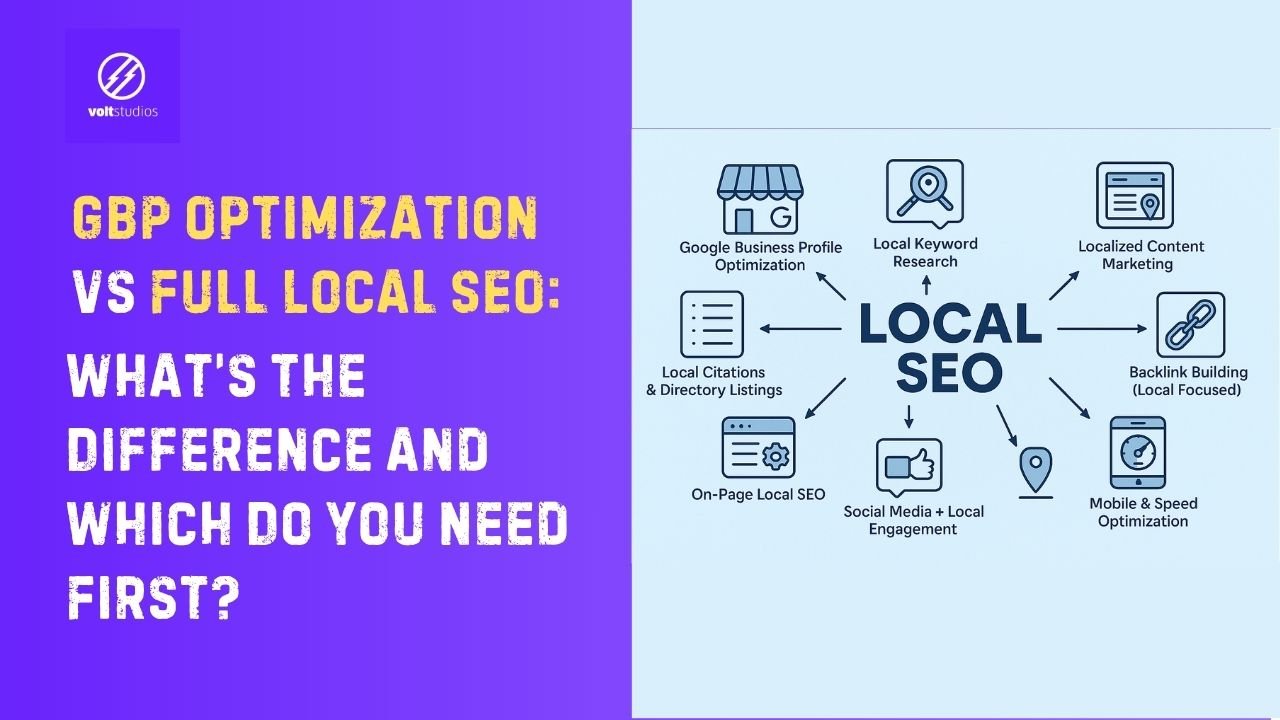
The Toronto Plumber SEO Landscape: How Competitive Is It Really?
If you’re a plumber operating anywhere in Toronto or the Greater Toronto Area, you already know that competition for new customers is fierce.
But the scale of that competition in the digital search landscape is something most plumbing business owners dramatically underestimate.
Understanding the true nature of the plumber SEO in toronto environment in 2026 is the essential first step before investing a single dollar in any digital marketing strategy.
Without this foundational knowledge, you’re essentially driving blind on the 401 at rush hour.
How Many Plumbers Are Competing for Google’s Top 3 in Toronto
Here is the number that should sharpen your focus immediately: across Toronto’s 416 and 647 area codes, more than 500 plumbing companies are actively competing for visibility on Google.
This figure encompasses everything from one-truck independent operators working out of Scarborough and Etobicoke, to large national franchise operations with dedicated marketing departments and six-figure annual SEO budgets.
Companies like Drain King Plumbers, Priority Plumbing, Mr. Rooter, and DrainWorks have invested years into building the domain authority, review profiles, and local citation networks that now anchor their positions at the top of Google search results.
Reliance Home Comfort, with its massive brand recognition across Ontario, further complicates the competitive landscape by dominating both paid and organic visibility for high-intent plumbing searches.
The density of competition varies significantly by service type.
Emergency plumbing searches — queries like “emergency plumber Toronto” or “24 hour plumber downtown Toronto”, carry the highest commercial intent because the searcher has an immediate, often urgent need, and they’re willing to pay premium rates for fast service.
In 2026, ranking in the top three positions for emergency plumbing keywords in Toronto can mean the difference between a booked-solid schedule and trucks sitting idle.
The businesses occupying those top spots aren’t there by accident; they’ve executed sophisticated local SEO strategies that combine technical website optimization, aggressive Google Business Profile management, and systematic review generation.
The Map Pack vs. Organic Results: Where Leads Actually Come From
To understand where your SEO investment should flow, you need to understand how Toronto customers actually find plumbers when they search.
Google presents local service searches in two distinct formats, and each carries dramatically different value for your business.
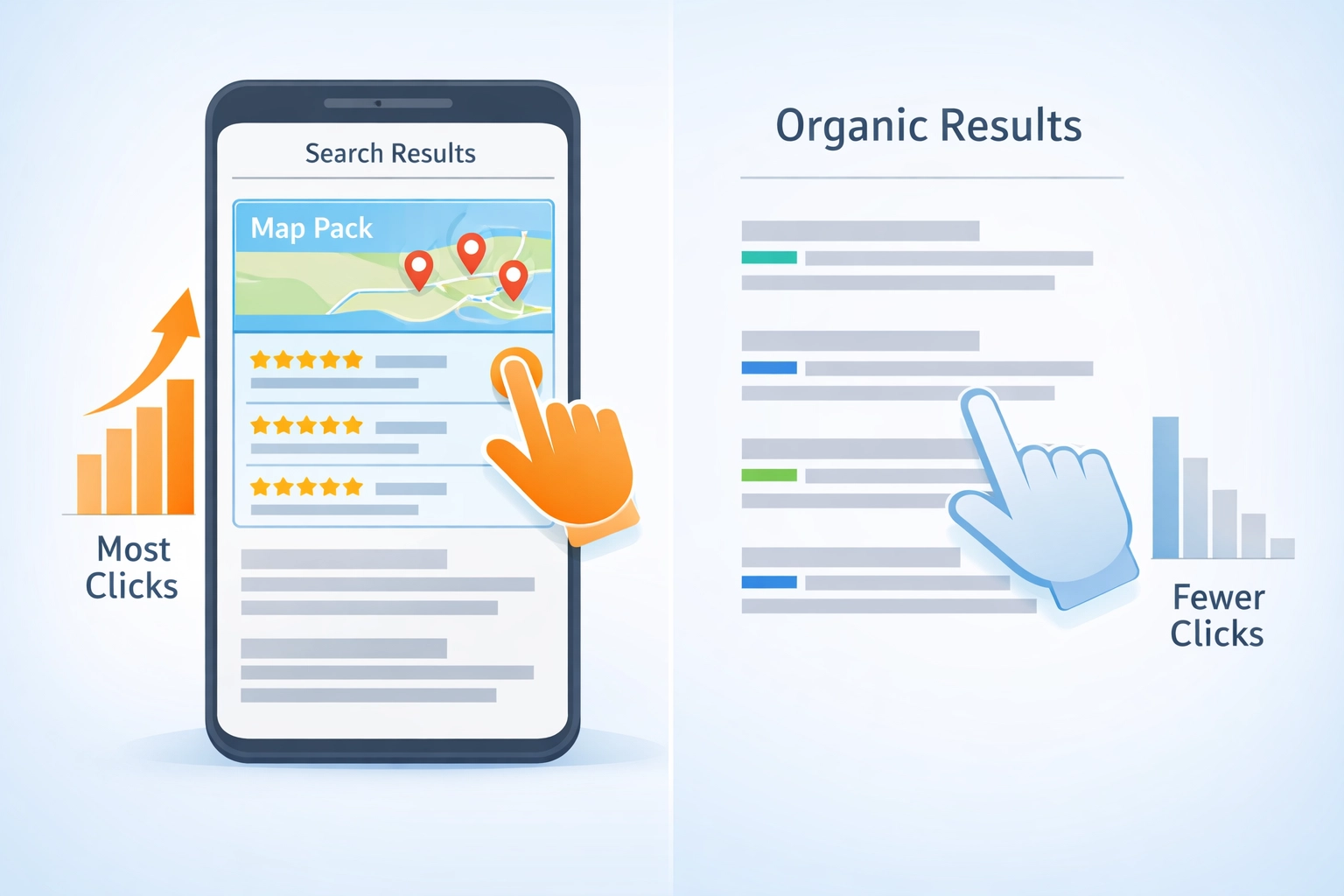
The Google Map Pack is the map-based listing that appears at the very top of search results for local queries. When a Toronto homeowner types “plumber near me” or “drain cleaning Etobicoke” into Google, the Map Pack displays three business listings complete with star ratings, review counts, business hours, and a map pin showing their location.
For plumbing searches in Toronto, the Map Pack captures between 40% and 60% of all clicks, depending on the specific query and device. Mobile searches skew even more heavily toward the Map Pack because the format is optimized for smartphone screens and one-tap calling.
Here’s what makes the Map Pack so valuable for Toronto plumbers: when a pipe bursts in a North York basement at 2 AM, the homeowner isn’t scrolling through organic search results to read blog posts about plumbing maintenance. They’re looking at the Map Pack, checking which businesses are open 24/7, comparing star ratings, and tapping the call button.
The top three positions in the Map Pack generate an estimated 70-80% of all leads from Google for emergency plumbing searches in the GTA.
Organic search results still matter, but their role has shifted. For informational queries like “how to fix a clogged drain” or “cost to replace water heater Toronto,” organic results capture significant traffic. These searches represent earlier-stage prospects who are researching before they buy.
Ranking well in organic results builds long-term authority and captures customers who are comparison shopping.
However, for high-intent transactional searches like “emergency plumber Toronto” or “burst pipe repair Scarborough,” organic rankings generate substantially fewer immediate leads than Map Pack placements.
Understanding this competitive landscape is essential because it shapes every decision that follows. Toronto’s plumbing market demands a comprehensive, sustained strategy that accounts for the specific dynamics of the GTA market, the behaviours of Toronto consumers, and the sophisticated tactics your competitors are already deploying.
Strategies for plumbing SEO in Toronto differ significantly from those used for Canada-wide targeting. To understand the broader approach, read more here: How Plumbers in Canada Rank Higher on Google and Get More Calls in 2026.
Google Business Profile Optimization for Toronto Plumbers
In 2026, Google Business Profile (GBP) remains the single most powerful digital asset a Toronto plumbing company can control.
With over 78% of local service searches resulting in a phone call within five minutes of the search, your GBP listing is often the first and only impression you get to make on a homeowner whose basement is flooding at 2 a.m.
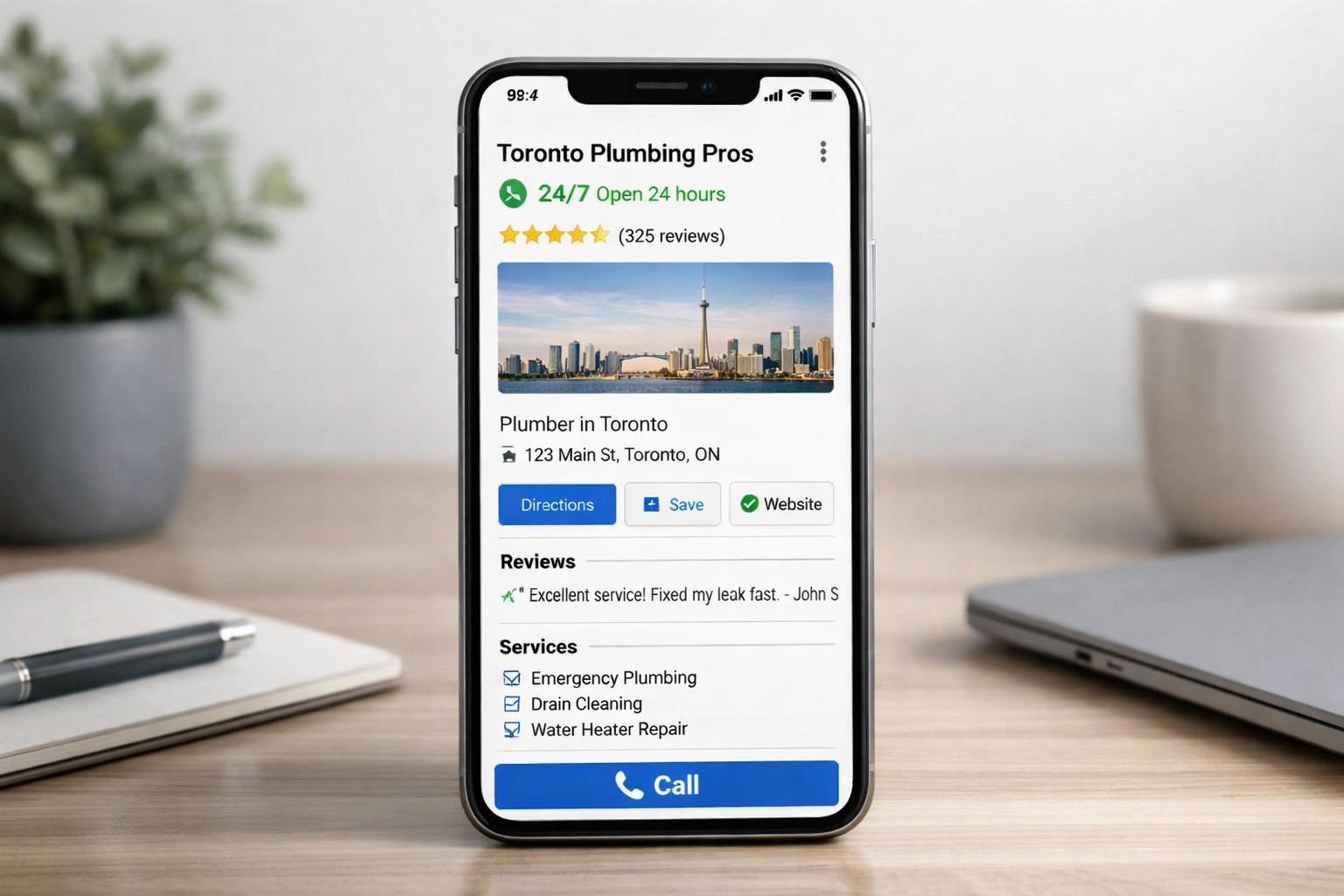
For plumbers operating across the GTA mastering GBP optimization is not optional. It is the difference between owning the Map Pack and watching Drain King, Priority Plumbing, and Mr. Rooter collect calls you should be receiving.
How to Optimize for ‘Emergency Plumber Toronto’ Searches
Emergency plumbing searches are fundamentally different from standard service searches.
When a homeowner in North York types “emergency plumber Toronto” at midnight, Google’s algorithm is not just looking for relevance — it is looking for signals of availability, proximity, and trust under time pressure. Your GBP listing must communicate all three immediately, and every element of your profile contributes to this signal stack.
The first and most critical setting is your business hours. Plumbers who list 24/7 availability receive preferential treatment in emergency query contexts because Google’s algorithm recognizes that users searching with emergency intent need an immediately reachable provider.
Your primary category should be set to “Plumber” and your secondary categories should include related services like “Drainage Service,” “Water Damage Restoration Service,” and “HVAC Contractor” if applicable. The category selection acts as a relevance filter — Google uses these to determine which searches your business should appear for.
Service area configuration is particularly important for Toronto plumbers who operate across multiple postal codes. The 416 versus 647 area code distinction still matters in how Torontonians search and how Google interprets location intent. If you serve the entire GTA, your service area should include specific cities and neighborhoods rather than just a broad radius around a single address.
Your business description field should include your primary keywords naturally while emphasizing your emergency service capabilities.
Attributes are another underused GBP feature for emergency optimization. Select attributes like “24/7,” “Onsite services,” and “Free estimates” if they apply to your business. These attributes appear as badges in your listing and serve as additional relevance signals for emergency searches.
The Posts feature within GBP should be used strategically for emergency service announcements. These posts expire after seven days, so maintaining a consistent posting schedule for emergency-focused content keeps your profile active and signals ongoing relevance to Google’s algorithm.
Getting Reviews From Toronto Clients at Scale
Reviews are the second most important ranking factor for Map Pack placement in 2026, and in Toronto’s hyper-competitive plumbing market, review velocity and rating can make or break your visibility.
The top-ranking Toronto plumbers — Drain King with their 5.0 rating, Priority Plumbing at 4.6 stars, Mr. Rooter at 4.7 — aren’t just passively collecting reviews. They’ve built systematic processes for generating consistent review flow from satisfied customers.
The foundation of review generation is timing. The optimal moment to request a review is immediately after job completion when the customer’s satisfaction is highest. For emergency plumbing calls, this means following up within 24 hours of service completion.
SMS-based review requests consistently outperform email requests for Toronto plumbers. Text messages have open rates exceeding 90% compared to 20-30% for emails. The most effective approach is a simple, personalized text sent from the technician who performed the work.
QR codes placed on invoices, service stickers, and technician business cards provide another frictionless review pathway. When a customer can simply scan a code and be taken directly to your Google review form, the barrier to leaving feedback drops dramatically.
Review quantity matters, but review quality and recency matter more in 2026. Google’s algorithm weights recent reviews more heavily than older ones, which means a steady stream of new reviews is essential for maintaining rankings. A profile with 200 reviews but no new ones in three months will often rank below a profile with 80 reviews and 10 new ones in the past month.
Responding to reviews — both positive and negative — is a ranking signal that many Toronto plumbers ignore. When you respond to reviews, you signal engagement to Google while also reinforcing your brand message to prospective customers reading those reviews.
Ethical review generation is non-negotiable in 2026. Never buy reviews, never exchange discounts for reviews, and never ask employees or family members to leave reviews. The only sustainable approach is delivering excellent service and making it easy for genuinely satisfied customers to share their experience.
Toronto Neighbourhood Targeting: Going Hyperlocal
As of 2026, hyperlocal SEO has become the competitive advantage for trade service companies across the GTA.
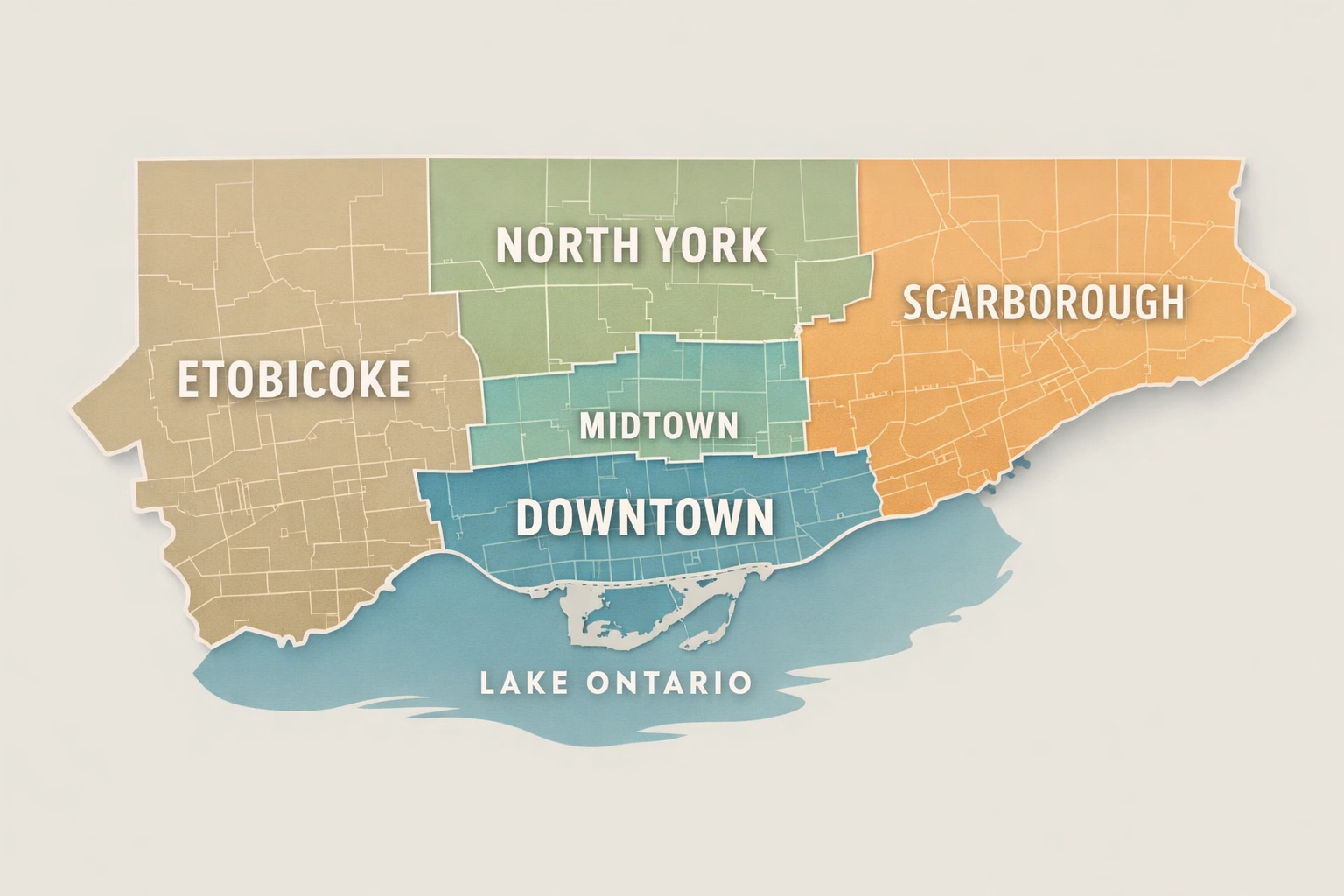
Toronto homeowners and property managers don’t search for “plumber near me” — they search for “plumber in The Beaches” or “emergency drain cleaning Leslieville” because they want someone who understands their neighbourhood, knows the area’s housing stock, and can arrive quickly.
Building a hyperlocal digital presence that mirrors these search behaviours is no longer optional; it is the foundation of a modern plumbing business’s online growth strategy.
Service-Area Pages for Etobicoke, North York, Scarborough, and More
Why do hyperlocal pages matter in Toronto’s market specifically? Because Toronto’s neighbourhoods are not interchangeable. A plumber who speaks to distinctions on dedicated location pages signals to both Google and potential customers that they possess genuine local expertise, not just a truck with a GPS.
Etobicoke represents one of the most valuable hyperlocal opportunities for Toronto plumbers. An Etobicoke-specific service page should reference the distinct characteristics which is the level of specificity cannot be achieved with a generic GTA page.
North York presents a different hyperlocal profile. As one of Toronto’s most populous districts, North York encompasses everything from the high-rise corridor to the single-family residential pockets where basement waterproofing and sump pump installation are common concerns. A North York service page should acknowledge this diversity while emphasizing rapid response times.
Scarborough has its distinct cultural and housing characteristics. With significant South Asian and Chinese communities, Scarborough homeowners often have specific service expectations and communication preferences. A Scarborough page that references these specific characteristics captures search intent that generic pages miss entirely.
The structure of effective location pages follows a consistent formula that balances SEO requirements with user experience.
- Each page needs a unique H1 heading that includes the neighbourhood name and primary service: “Plumber in Etobicoke | Emergency Plumbing Services 24/7.”
- The opening paragraph should establish geographic relevance immediately, mentioning local landmarks, major intersections, or well-known neighbourhoods within the district.
Content depth matters significantly. Each page needs 800-1200 words of substantive content covering: common plumbing issues specific to that area’s housing stock, local water quality concerns, seasonal considerations, and response time commitments. The goal is creating a resource that genuinely helps homeowners in that neighbourhood while signaling relevance to Google.
Internal linking between location pages creates a geographic content network that strengthens your entire site’s local SEO. Your Etobicoke page should link to your Toronto main page, your Mississauga page, and your downtown Toronto page. This internal linking structure helps Google understand the relationship between your service areas and distributes authority across your location pages.
Each location page should have unique content. Google’s algorithms in 2026 are exceptionally good at detecting templated content where only the neighbourhood name changes. If your Etobicoke, North York, and Scarborough pages share identical paragraph structures with swapped location names, they won’t rank. Each page needs genuinely distinct content that reflects the unique characteristics of that neighbourhood.
Postal Code Targeting and Its Role in GBP Rankings
While neighbourhood names capture broad search intent, postal code targeting captures the specific geographic precision that Google’s proximity algorithms prioritize.
In Toronto, where the 416 and 647 area codes overlap and neighbourhoods blend into one another, postal codes provide the granular location signals that can differentiate first-page rankings from obscurity.
The 416 area code carries psychological weight with long-time Toronto residents who associate it with the city’s core identity, while 647 represents the expanded city boundaries and newer development.
Postal code targeting works through your Google Business Profile service area configuration and your website’s location page optimization.
In GBP, you can specify service areas by postal code prefix — M4E for The Beaches, M5A for Corktown, M6S for Bloor West Village. This granular configuration tells Google exactly which neighbourhoods you serve and improves your visibility for searches originating from those postal codes.
A plumber who configures service areas for M4E, M4C, and M4M captures The Beaches, East York, and Leslieville specifically rather than hoping a broad Toronto radius catches them.
The relationship between postal codes and proximity ranking is direct and significant.
Google’s local algorithm uses the searcher’s location to rank businesses by proximity.
When someone in postal code M4E searches “plumber near me,” Google prioritizes businesses that have explicitly listed M4E as a service area over businesses with a generic “Toronto” designation.
This is why hyperlocal postal code targeting can outrank larger competitors who haven’t invested in granular location optimization.
Website content should reference postal codes naturally within neighbourhood pages. A Leslieville page might include: “Our Leslieville plumbing team serves the M4M postal code area, including homes along Queen Street East, Dundas Street East, and the side streets between Carlaw and Coxwell.”
This isn’t keyword stuffing — it’s providing useful geographic information that happens to include the postal code. Google recognizes this as legitimate local content rather than manipulation.
LocalBusiness schema should include your service area with postal code specificity, and your contact page should list the specific neighbourhoods and postal codes you serve.
This structured data helps Google understand your geographic relevance at the granular level that modern local search requires.
For Toronto plumbers, the combination of neighbourhood pages and postal code targeting creates a two-layer geographic strategy.
Neighbourhood pages capture the broad “plumber in [neighbourhood]” searches, while postal code optimization ensures you appear for the hyperlocal “near me” queries that generate the highest-intent leads.
In a market as competitive as Toronto’s, this level of geographic precision isn’t overkill — it’s the minimum requirement for consistent Map Pack visibility.
On-Page SEO for Your Toronto Plumbing Website
In 2026, Google’s local search algorithms have become sophisticated enough to reward plumbing companies that demonstrate genuine topical authority and geographic relevance on their own websites.
This section breaks down exactly how to achieve that.
Must-Have Service Pages for Toronto Plumbers
Every Toronto plumbing website needs a clearly defined set of service pages that speaks directly to what homeowners and property managers are searching for.
A single generic “Services” page is no longer sufficient in a competitive market like Toronto, where dozens of established plumbers are fighting for the same first-page rankings. Instead, each core service your company offers deserves its own dedicated, fully developed page that can rank independently for specific search queries.
The essential service pages every Toronto plumber needs in 2026 include dedicated pages for
- drain cleaning and drain repair
- emergency plumbing services
- water heater installation and replacement
- backflow prevention and testing
- bathroom and kitchen plumbing
- pipe repair and repiping
- sump pump installation.
Each of these services represents a distinct cluster of search intent.
When a homeowner in Leslieville has a blocked drain at 11 PM, they are not searching for a general plumber — they are searching for “emergency drain cleaning Toronto” or “24-hour plumber East Toronto.” A standalone emergency plumbing page optimized for those specific queries is infinitely more powerful than a combined services page.
Structuring service pages for maximum local SEO impact requires attention to both content depth and technical optimization.
Each page needs a minimum of 800-1000 words of substantive content that addresses the specific service in detail while incorporating local relevance signals.
Your drain cleaning page should discuss common drain issues in Toronto homes — the impact of mature tree roots in older neighbourhoods, the challenges of high-rise drain systems downtown, the seasonal flooding risks in low-lying areas — while naturally incorporating keywords like “drain cleaning Toronto,” “clogged drain repair GTA,” and “sewer line cleaning Etobicoke.”
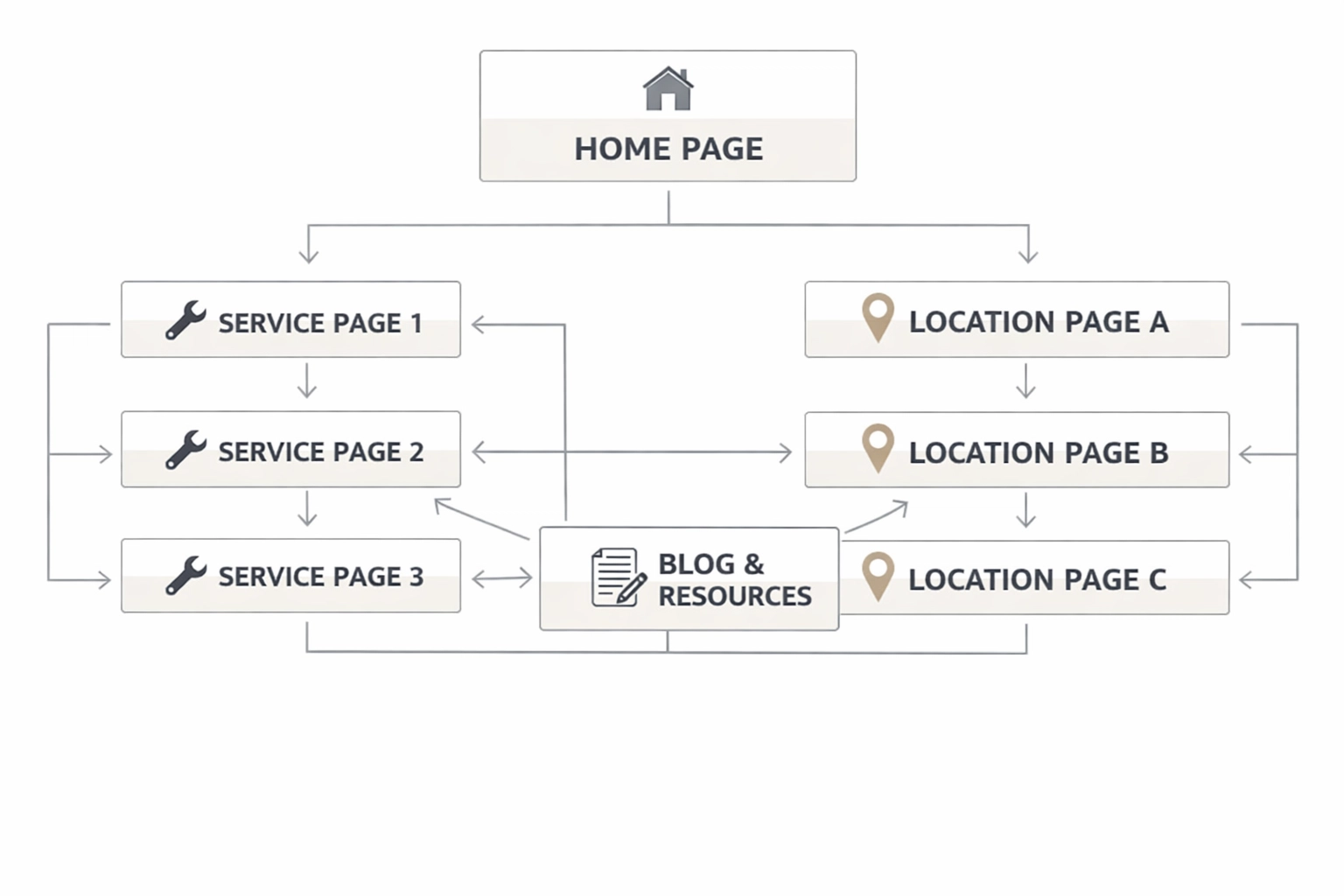
The relationship between service pages and location pages creates a matrix of SEO opportunity. Your drain cleaning page links to your Etobicoke location page, which links to your emergency plumbing page, which links to your North York location page. This internal linking structure distributes authority throughout your site while helping Google understand the full scope of your services and service areas.
Content requirements for service pages go beyond keyword inclusion. Each page needs to demonstrate expertise, authoritativeness, and trustworthiness — Google’s E-E-A-T criteria.
Internal linking strategy for service pages should follow a hub-and-spoke model with your homepage and main service category pages as hubs.
From your main “Plumbing Services” page, link to each individual service page. From each service page, link to related services — your water heater page should link to your pipe repair page because aging pipes often coincide with aging water heaters. From every service page, link to your location pages to reinforce geographic relevance.
This internal linking architecture helps Google discover and index all your pages while distributing ranking authority efficiently.
Schema Markup, NAP Consistency, and Technical SEO Basics
Technical SEO for Toronto plumbers starts with LocalBusiness schema markup which tells Google exactly what your business is, where it’s located, what services it offers, and how to contact you.
In 2026, schema markup is not optional for competitive local SEO. It provides the machine-readable signals that help Google display your business correctly in search results and can enable rich snippets that increase click-through rates.
Your LocalBusiness schema should include:
- your business name, address, and phone number (NAP)
- your service area (list specific Toronto neighbourhoods and postal codes)
- your business hours
- the services you offer
- your aggregate review rating.
For plumbers, using the more specific “Plumber” schema type within the LocalBusiness category provides additional relevance signals.
The schema should be implemented on every page of your website, not just the homepage, using JSON-LD format in the page header.
Service schema extends your structured data by marking up individual services you offer. This allows Google to understand that you provide “Drain Cleaning” as a distinct service from “Water Heater Installation,” potentially enabling your services to appear in specialized search features.
Each service page should include Service schema that specifies the service name, description, and area served. This granular markup helps Google match your pages to specific service-related queries.
FAQ schema has become particularly valuable for Toronto plumbers targeting featured snippets. By marking up frequently asked questions and answers on your service pages, you increase the likelihood of appearing in the “People Also Ask” boxes and featured snippet positions that dominate local search results.
Questions like “How much does drain cleaning cost in Toronto?” or “Do Toronto plumbers charge extra for emergency calls?” — when properly marked up with FAQ schema — can capture valuable search real estate above the traditional organic results.
NAP consistency remains a fundamental local SEO requirement in 2026. Inconsistent NAP data confuses Google’s algorithm and can suppress your rankings.
Your website NAP must match your Google Business Profile exactly, which must match your HomeStars listing exactly, which must match your Yelp listing exactly. Even small differences — “St.” versus “Street,” “Suite 100” versus “#100,” different phone number formats — can create consistency issues.
Technical SEO start with site speed. In 2026, Google uses page speed as a ranking factor, and mobile speed is particularly critical for local searches.
Most emergency plumbing searches happen on mobile devices, often from homeowners standing in flooded basements. If your site takes more than three seconds to load on a smartphone, you’re losing potential customers to faster competitors.
Compress images, minify code, leverage browser caching, and consider a content delivery network (CDN) to improve load times.
Mobile optimization goes beyond speed. Your website must be fully responsive, with click-to-call buttons prominently displayed, forms that work on small screens, and maps that display correctly on mobile devices.
HTTPS security is non-negotiable. Google marks non-HTTPS sites as “Not Secure” in Chrome, which deters potential customers and hurts rankings. Every Toronto plumbing website should have a valid SSL certificate and force HTTPS connections.
Toronto-specific technical considerations include ensuring your site can handle Canadian traffic efficiently.
- If you’re using a CDN, ensure it has edge servers in Canada to minimize latency for Toronto users.
- Your contact forms should accept Canadian postal codes and phone number formats.
- Your content management system should handle Canadian spelling conventions — “colour” not “color,” “centre” not “center” — which, while minor, contribute to the overall Canadian relevance signals that can differentiate your site from American competitors.
Finally, XML sitemaps and robots.txt files should be properly configured to help Google crawl and index your site efficiently.
Your sitemap should include all service pages, location pages, and blog posts, and should be submitted to Google Search Console.
Regular monitoring of Search Console helps identify technical issues — crawl errors, mobile usability problems, Core Web Vitals concerns — before they impact your rankings.
Building Local Authority in the Toronto Market
For Toronto plumbers competing in one of Canada’s most saturated home services markets, ranking on the first page of Google requires more than a well-optimized website. It requires building genuine local authority — the kind that signals to Google that your business is a trusted, established presence within specific Toronto communities.
In 2026, local authority is built through two interconnected pillars: consistent directory listings and citations, and high-quality locally relevant backlinks.
Understanding how each works, and how they work together, is the difference between a plumbing business that dominates the map pack and one that’s invisible to potential customers.
Getting Listed in Toronto Business Directories and BIA Sites
Citations are mentions of your business’s Name, Address, and Phone number across the web.
Unlike backlinks, citations don’t need to pass link equity to be valuable. Their primary function is to confirm to Google that your business exists at a specific location and serves a specific area. The more consistent and widespread these mentions are across reputable directories, the more confident Google becomes in displaying your business for local searches.
For Toronto plumbers, the essential starting point is Google Business Profile, but the directory work extends far beyond that.
- Toronto.com is one of the city’s most authoritative local directories, and a fully optimized listing there carries meaningful weight.
- HomeStars, which is widely used by Toronto homeowners searching for trusted tradespeople. A strong HomeStars profile with verified reviews and high ratings directly influences both your reputation and your local search visibility.
- YP.ca (Yellow Pages Canada) remains relevant in 2026. While younger Toronto homeowners primarily use Google, YP.ca captures a significant segment of the market that shouldn’t be ignored. Ensure your YP.ca listing is claimed, verified, and fully optimized with accurate NAP data and service descriptions.
- Business Improvement Area (BIA) directories represent a hyperlocal citation opportunity. BIAs are designated commercial districts with organized business associations, and many maintain online directories of member businesses. Getting listed in your local BIA directory provides geographically relevant citations that reinforce your local presence.
- The Toronto Board of Trade and various industry associations also maintain member directories that can serve as valuable citation sources. For plumbers, associations like the Mechanical Contractors Association of Toronto or the Ontario Plumbing Inspectors Association offer directory listings as part of membership benefits.
The more complete and optimized each listing is, the more value it provides for your local SEO.
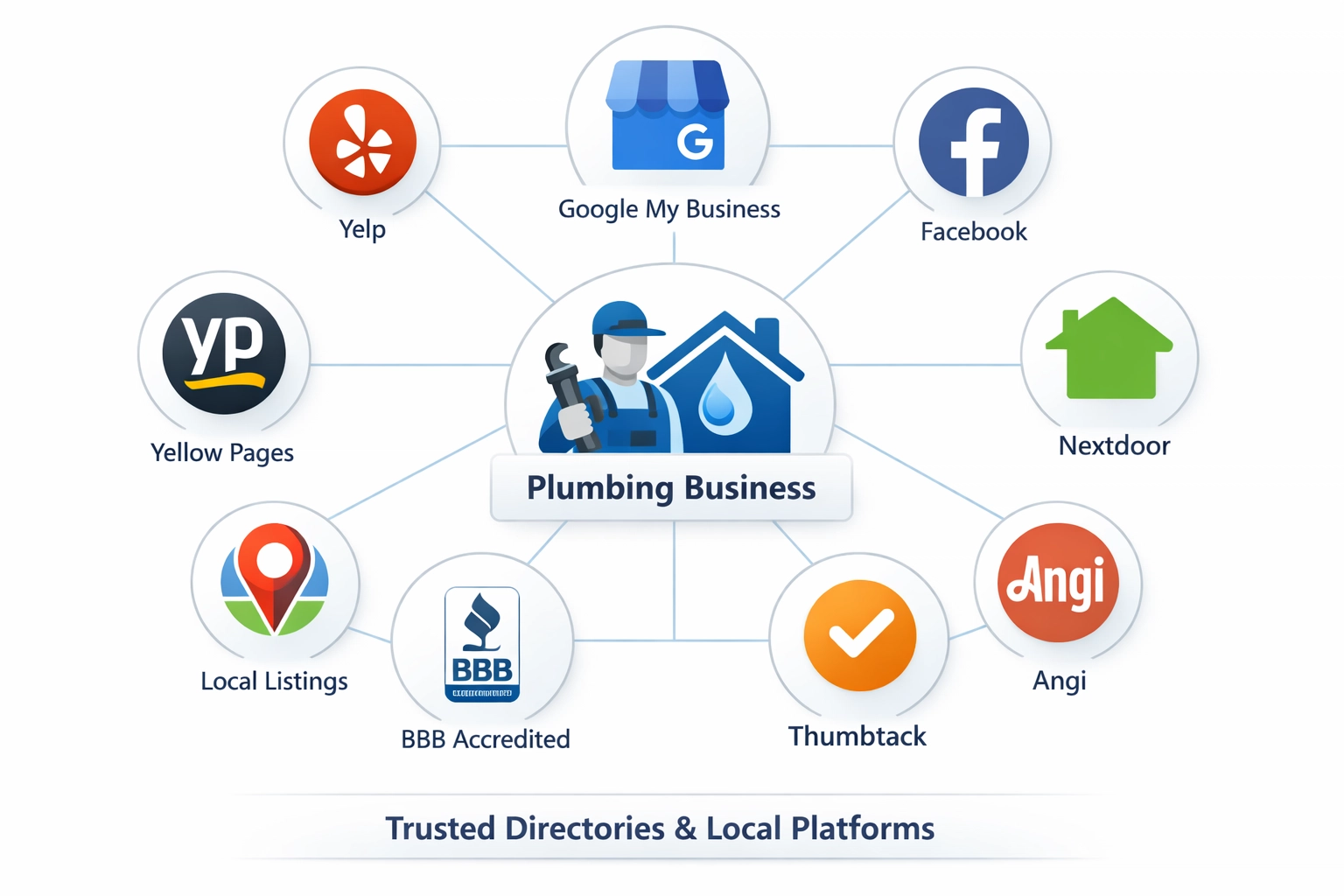
The distinction between Toronto-specific directories and national directories matters for local SEO strategy. While national directories like Yelp, Bing Places, and Apple Maps provide broad visibility, Toronto-specific directories send stronger geographic relevance signals.
A balanced approach that prioritizes Toronto and Ontario directories while maintaining presence on major national platforms provides the optimal citation profile. Google’s algorithm recognizes when a business has deep local roots versus shallow national presence.
Earning Local Links That Boost Your Toronto Rankings
While citations confirm your business exists, backlinks pass authority and trust signals that directly influence your rankings.
For local SEO in 2026, not all links are created equal. A link from a highly relevant local source carries more weight for Toronto plumber rankings than a link from an unrelated national site.
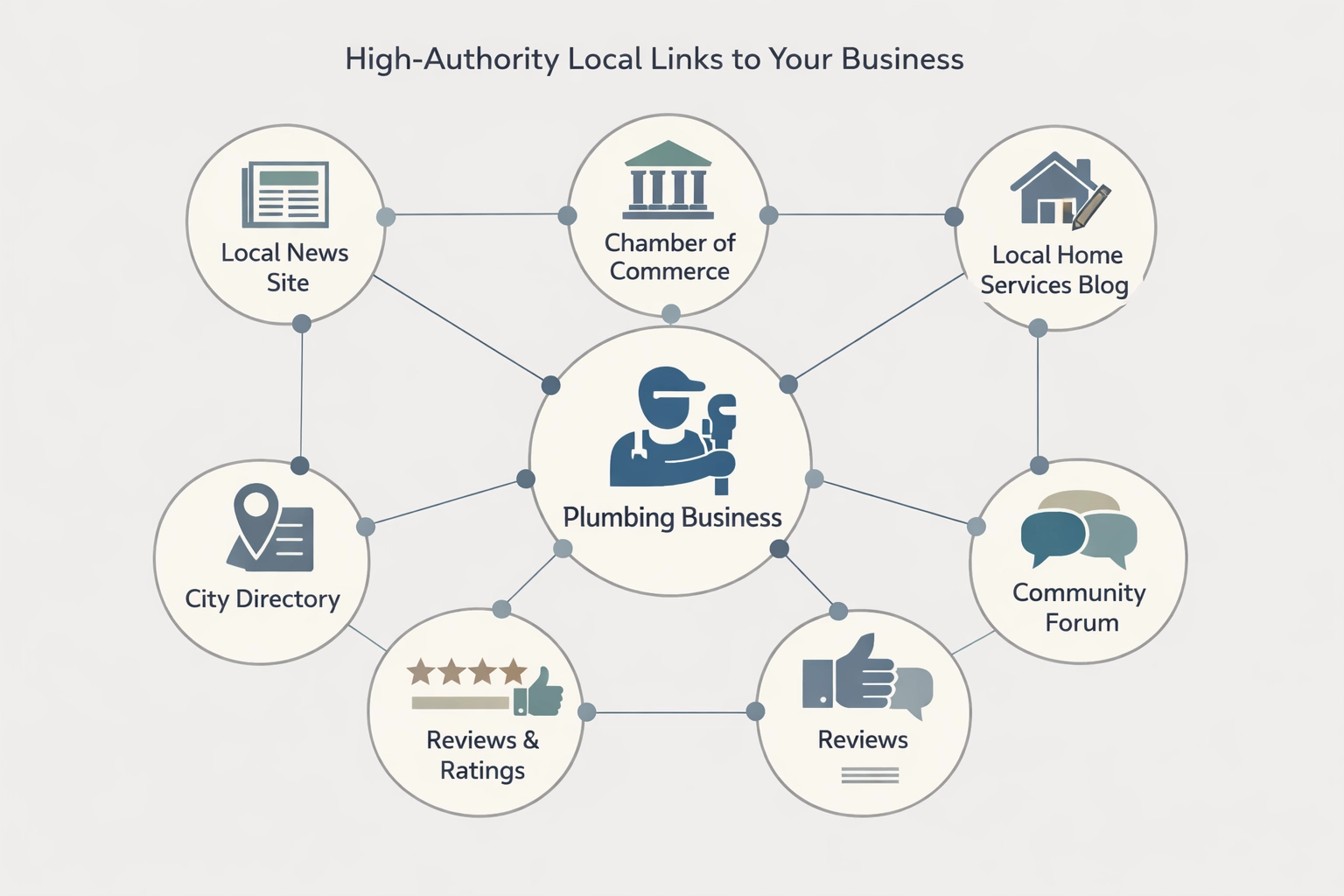
Local link value is determined by several factors: relevance to your industry and location, the authority of the linking site, the context of the link, and the traffic the link drives.
A link from the Toronto Star’s website mentioning your plumbing company in an article about winterizing homes is exponentially more valuable than a link from a generic business directory. The Toronto Star link carries local relevance, news authority, contextual relevance to plumbing, and likely drives qualified referral traffic.
For Toronto plumbers, effective local link building strategies start with community involvement.
Sponsoring local events often generates links from event websites, local news coverage, and community organization pages. These links are valuable not just for SEO but for building genuine community relationships that translate to word-of-mouth referrals.
Local media coverage represents one of the highest-value link opportunities for Toronto plumbers. Pitching story ideas to Toronto journalists can result in mentions and links from major outlets like the Toronto Star, Globe and Mail, CP24, and BlogTO. These media links carry significant authority and local relevance.
Educational institutions and non-profit organizations in Toronto often need plumbing services and may link to preferred vendors. If you provide discounted services to Toronto Community Housing, local schools, or non-profits, ask for a link on their partner or vendor pages. These .org and .edu domains carry inherent trust signals that benefit your SEO.
Toronto-specific link opportunities include local business associations, neighbourhood associations, and community websites. The Toronto Association of Business Improvement Areas, local chambers of commerce, and neighbourhood-specific sites like BlogTO, Toronto Life, and NOW Magazine all provide opportunities for relevant local links.
Guest posting on Toronto-focused blogs or contributing expert content to local publications can also generate valuable backlinks while positioning you as a local authority.
Sponsorships and scholarships represent another link building avenue. Sponsoring a scholarship at a Toronto high school or college, contributing to local charity events, or supporting community initiatives often results in links from .edu domains and organizational websites. These links are particularly valuable because they’re typically permanent and come from trusted institutional sources.
Avoiding link building mistakes is as important as pursuing good links.
- Never buy links from link farms.
- Avoid directory submissions to low-quality, spammy directories that exist solely for SEO purposes.
Focus on earning genuine links through real relationships, quality service, and community involvement. A smaller number of high-quality, relevant local links outperforms hundreds of low-quality links every time.
The relationship between citations and links creates a comprehensive local authority profile.
Citations establish your business’s existence and location across the web, while links pass authority and trust signals that help you outrank competitors.
Together, they tell Google that your Toronto plumbing business is real, established, trusted by the community, and deserving of prominent placement in local search results.
Tracking Your Toronto Plumber SEO Results
Running a plumbing business in Toronto without tracking your SEO performance is like snaking a drain blindfolded. You might make progress, but you have no way of knowing what’s working, what’s wasting your time, or where your next call is coming from.
In 2026, the most successful plumbing companies in neighbourhoods like Leslieville, North York, and Etobicoke are winning more jobs precisely because they measure everything. Here is how to build a results-tracking system that gives you clear, actionable data every single month.
Call Tracking for Plumbers: Why It Matters and How to Set It Up
For a plumbing business, the phone call is still the most valuable conversion.
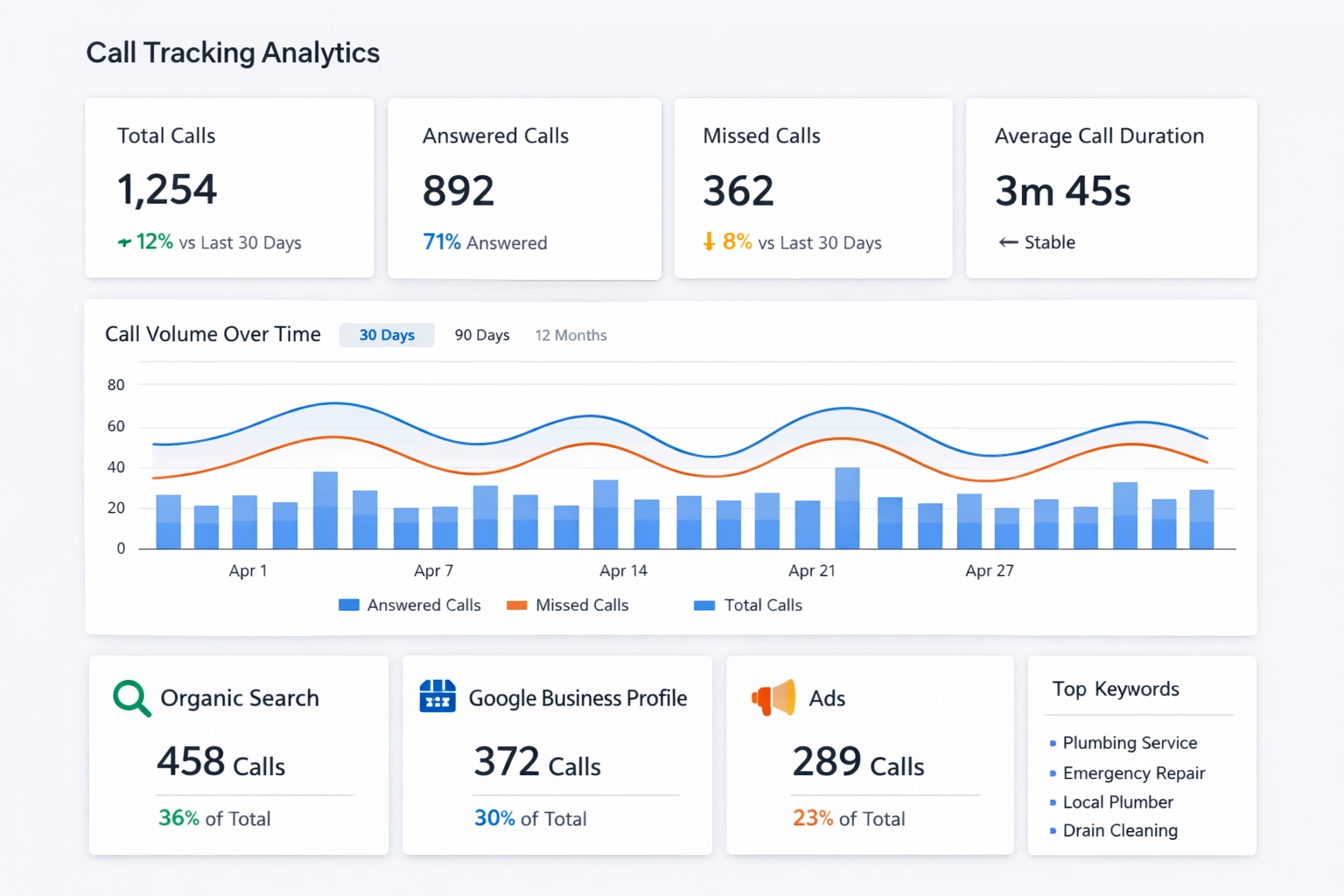
A homeowner in Etobicoke with a burst pipe is not filling out a contact form — they are calling immediately. This makes call tracking not just useful but essential. Without it, you have no reliable way to know whether that call came from your Google Business Profile, your organic website ranking, a paid Google Ads campaign, or a referral.
CallRail is the industry-standard tool for this purpose. By assigning unique tracking phone numbers to each traffic source, CallRail captures the origin of every inbound call.
In 2026, you can integrate CallRail directly with your Google Analytics 4 account and your Google Ads dashboard, creating a seamless attribution chain. For a North York plumber running both SEO and a local services ad campaign simultaneously, this distinction is critical.
If you are receiving 80 calls a month but cannot separate the 55 organic calls from the 25 paid calls, you cannot make smart decisions about where to invest your marketing budget.
Set up call tracking by placing dynamic number insertion on your website, which automatically swaps the displayed phone number based on the visitor’s source. A visitor from organic search sees your organic tracking number, while a visitor from your GBP sees your GBP tracking number.
This happens seamlessly without affecting user experience. The calls route to your main business line, but the tracking data captures the source, duration, and even records the call for quality monitoring.
Google Business Profile Insights and Metrics
In 2026, the key metrics Toronto plumbers should monitor include:
- direct searches (customers searching your business name specifically)
- discovery searches (customers searching for generic terms like “plumber Toronto”)
- total views (how many times your listing appeared in search results)
- and actions taken (website clicks, direction requests, and phone calls)
If your discovery searches are increasing month-over-month, your local SEO efforts are working. If your direction requests spike during certain months, you can correlate that with seasonal demand patterns.
Keyword Ranking Tracking for Toronto-Specific Terms
While GBP metrics tell you what’s happening with your listing, keyword rank tracking tells you where you appear in organic search results.
Tools like BrightLocal, SEMrush, and Ahrefs allow you to track your rankings for specific Toronto-focused keywords: “emergency plumber Toronto,” “drain cleaning Etobicoke,” “water heater repair North York,” and dozens of other location-specific terms.
Track rankings at the neighbourhood level, not just city-wide. Ranking #3 for “plumber Toronto” is valuable, but ranking #1 for “plumber Leslieville” might drive more qualified leads because the searcher is in your immediate service area.
Set up tracking for at least 20-30 keywords covering your core services and primary neighbourhoods. Monitor these weekly — in a competitive market like Toronto, rankings can shift rapidly as competitors adjust their strategies.
Google Search Console for Local SEO Monitoring
Google Search Console (GSC) is a free tool that provides direct data from Google about how your website performs in search.
For Toronto plumbers, the most valuable GSC reports include: the Performance report showing which queries drive impressions and clicks, the Average Position data showing where you rank for specific terms, and the Pages report showing which of your service and location pages get the most visibility.
Pay particular attention to the queries report.
You might discover that you’re getting significant impressions for “backflow prevention testing Toronto” even though you haven’t optimized specifically for that term. Or you might find that your “emergency plumber” pages are ranking well but not getting clicks, suggesting your title tags or meta descriptions need improvement.
Attributing Leads Correctly to SEO vs Other Channels
Accurate attribution is the foundation of smart marketing decisions.
A common mistake Toronto plumbers make is assuming that any call from a new customer is “SEO” simply because they found you online.
In reality, that customer might have seen your truck in their neighbourhood, heard your radio ad, and then searched your business name.
Train your office staff to ask every new caller: “How did you hear about us?” This simple question, consistently asked, provides invaluable attribution data. Combine this with your call tracking data to build a complete picture. If CallRail shows the call came from organic search but the customer says they saw your truck, the truck impression was likely the true source, and the Google search was just the lookup mechanism.
Benchmarking Against Toronto Competitors
Finally, track your performance relative to competitors.
Tools like BrightLocal’s Local Search Grid show you exactly where you rank compared to Drain King, Priority Plumbing, Mr. Rooter, and other Toronto competitors for your target keywords. This competitive intelligence helps you identify gaps — if you’re ranking #1 for “drain cleaning” but #7 for “emergency plumber,” you know where to focus your optimization efforts.
Final Thoughts
The Toronto plumbing market is unforgiving. With over 500 competitors vying for the same Google Map Pack positions, ranking on the first page requires more than basic SEO knowledge — it requires a comprehensive strategy tailored to the unique dynamics of the GTA market.
If you’re serious about growing your Toronto plumbing business through organic search, the next step is understanding exactly where you stand today.
Our plumber SEO services analyzes your current Google Business Profile optimization, website technical health, local citation profile, review generation velocity, and competitive positioning against top-ranked Toronto plumbers like Drain King, Priority Plumbing, and Mr. Rooter.
What You’ll Receive:
- A complete assessment of your Google Business Profile with specific optimization recommendations
- Technical SEO analysis identifying issues that may be suppressing your rankings
- Competitive gap analysis showing exactly what top-ranked Toronto plumbers are doing that you’re not
- A customized 90-day action plan prioritizing the highest-impact improvements for your specific situation
- Keyword opportunity analysis identifying the Toronto neighbourhood and service terms with the best ROI potential
Why VoltStudios?
We’re a Canadian digital marketing agency headquartered in Toronto with deep expertise in local SEO for home services businesses. We understand the GTA market because we operate in it daily.
We know that ranking for “emergency plumber Toronto” requires different tactics than ranking in smaller Ontario markets. We’ve helped plumbing companies across Etobicoke, North York, Scarborough, and downtown Toronto increase their organic call volume by 200% to 500% through strategic local SEO execution.
The longer you wait, the more calls your competitors are taking. Every day you spend on page two of Google is a day that Drain King, Priority Plumbing, or Mr. Rooter is booking the emergency calls that could have been yours.
Get Your Free Plumber SEO Audit Now