Before You Read: The Honest Context
There are over 400 agencies and freelancers in the Greater Toronto Area actively selling SEO services. Some are exceptional. Many are mediocre.
A meaningful number will take your retainer for six months, send you a monthly PDF of traffic graphs, and disappear when the contract renews.
This guide is to give you a framework that filters the signal from the noise — one built on how modern search actually works in 2026, not how it worked in 2018.
By the end, you’ll know exactly what to ask, what to audit, what to refuse, and what a genuinely productive SEO engagement looks like.
Why Hiring SEO Agency in Toronto is important?
In 2019, hiring an SEO agency in Toronto was relatively straightforward: find someone who understood Google’s ranking factors, could build decent backlinks, and would write content with the right keywords. The playbook was crowded but coherent.
In 2026, the rules have shifted in at least five significant ways:
- AI is inside the search results now. Google’s AI Overviews appear above traditional organic results for a rapidly expanding category of queries. ChatGPT Search, Perplexity, and Gemini are routing meaningful traffic volumes — traffic that never touches a search results page. If an agency’s entire strategy is built around ten blue links, they’re optimizing for a shrinking surface area.
- Topical authority has replaced keyword density. Google no longer rewards pages that repeat a keyword 18 times. It rewards websites that demonstrate comprehensive, entity-coherent expertise in a domain. This requires a completely different content architecture — one that most agencies in Toronto have not rebuilt their offerings around.
- Google’s E-E-A-T signals have become real ranking factors. Experience, Expertise, Authoritativeness, and Trustworthiness are no longer abstract guidelines. They are actively evaluated, especially in YMYL (Your Money or Your Life) categories — which includes legal, medical, financial, and home services businesses common in the GTA.
- Technical SEO has grown more complex. Core Web Vitals, crawl budget management, entity-structured data, hreflang for bilingual markets, JavaScript rendering issues — the technical surface has expanded significantly, and many “SEO agencies” don’t have the capability to address it.
- The Toronto market is uniquely saturated. The GTA is home to a high concentration of agencies competing for a smaller pool of genuinely sophisticated buyers. A low-priced offer that sounds reasonable is often white-labelled offshore work delivered under a local brand name.
Understanding this context is the foundation of making a good hiring decision.
Step 1 — Define What You Actually Need Before You Call Anyone
The single most common mistake Toronto business owners make when evaluating SEO agencies is starting the conversation without clarity on what outcome they need. This creates a power imbalance: the agency frames the engagement, and the buyer evaluates proposals they’re not equipped to compare.
Before you make a single call, answer these four questions:
- What does success actually look like?
- What type of SEO do you need?
- What is your realistic budget?
- What is your timeline?
What does success actually look like?
There is a critical difference between:
- Traffic growth — more people finding your website via organic search
- Lead growth — more people contacting you, filling forms, booking appointments
- Revenue growth — more attributable sales from organic channels
These are related but not equivalent. An agency can drive substantial traffic increases using informational content that attracts users who will never convert.
A high-quality engagement should produce all three, but you need to know which one your business is weakest in — and make sure your agency tracks and reports on it.
For most Toronto service businesses (HVAC, legal, dental, medical, trades), lead growth is the primary objective. For ecommerce, revenue attribution matters most. For a new brand trying to build market awareness, traffic and topical visibility come first.
What type of SEO do you need?
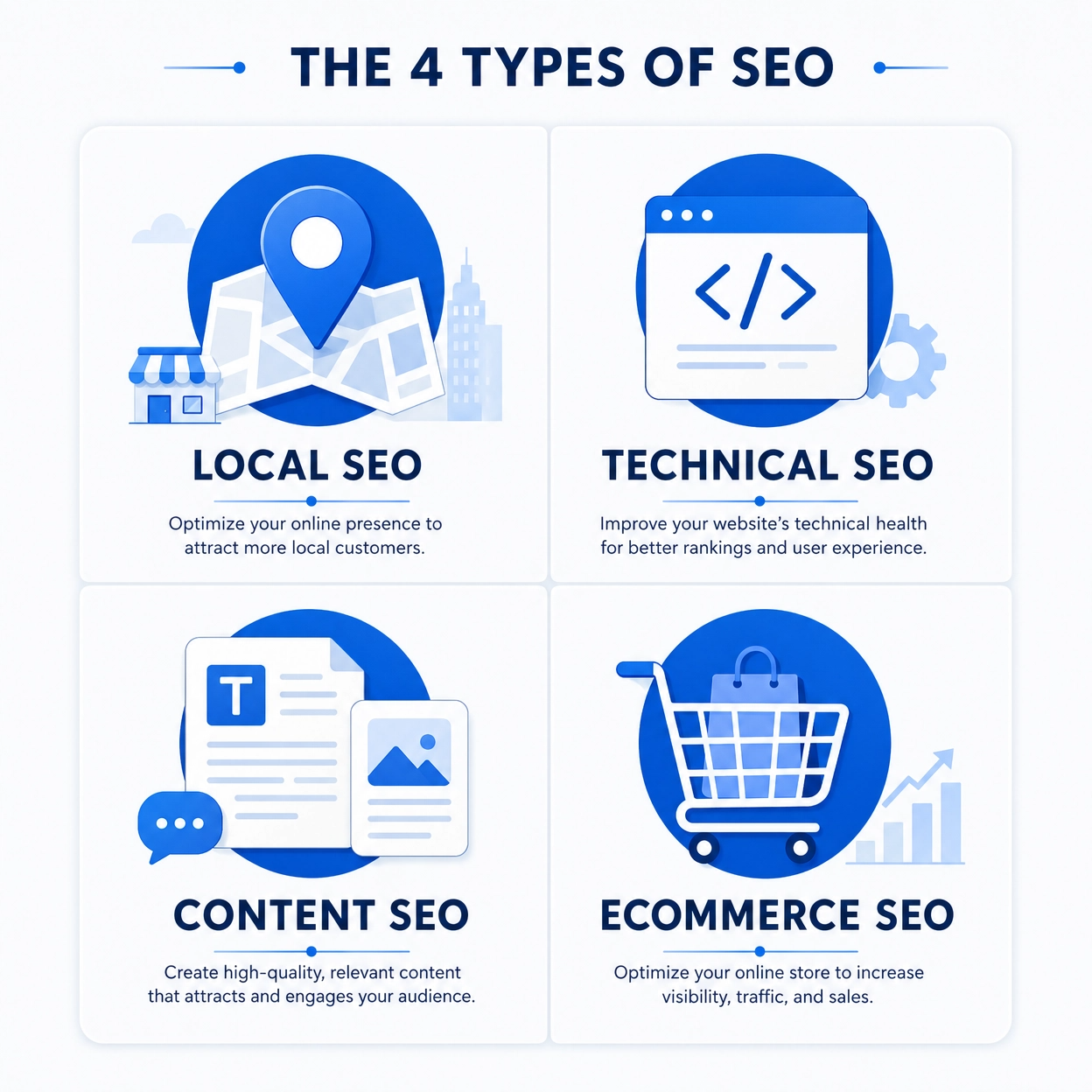
The term “SEO” encompasses at least four meaningfully different service categories:
Local SEO
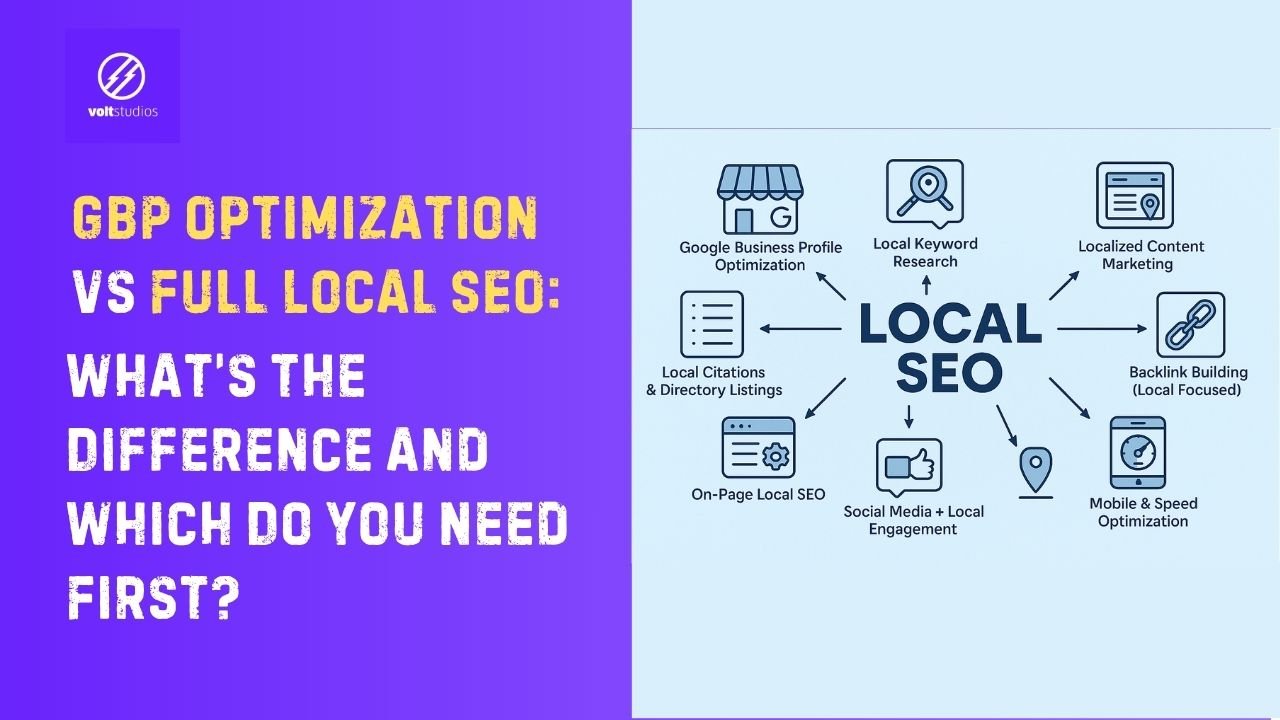
Local SEO is the practice of optimizing your digital presence to appear in geographically relevant searches — particularly the Local Pack (the three business listings that appear in Google Maps results above organic links).
This is the priority for any business serving customers in specific Toronto neighbourhoods or GTA suburbs.
National or ecommerce SEO
National or ecommerce SEO is the practice of competing for high-volume, non-geographic queries. This is appropriate for ecommerce brands, SaaS companies, and service businesses with a national reach. It requires a different content architecture, a larger site footprint, and different link building strategies.
Technical SEO
Technical SEO addresses your website’s infrastructure: crawlability, indexation, page speed, Core Web Vitals, structured data, and rendering performance. Most businesses need a technical SEO baseline, but the depth required varies enormously between a five-page local business site and a 20,000-product Shopify store.
Content-led SEO
Content-led SEO (topical authority building) is the sustained production and interlinking of content designed to signal comprehensive expertise to search engines. This is a long-term investment with compounding returns — and requires an agency with genuine editorial capability, not content farm output.
Most Toronto businesses need a combination of these, with local SEO and technical SEO as the foundation, content strategy as the growth engine, and link building as the authority accelerator.
What is your realistic budget?
Toronto SEO pricing reality in 2026:
| Tier | Monthly Investment | What You Get |
| Entry-level | $800 – $1,200 | Usually template reports, minimal custom strategy. Appropriate only for very early-stage local businesses. |
| Mid-market | $1,500 – $3,000 | Where most quality boutique agencies in the GTA operate. Expect custom strategy, regular reporting, and meaningful output. |
| Growth | $3,000 – $6,000 | Full-service engagements with dedicated strategist, content production, link building, and technical coverage. |
| Enterprise | $6,000+ | For large ecommerce, multi-location, or highly competitive markets. |
Any agency quoting below $800/month for a substantive engagement is almost certainly reselling offshore labour or running on automation. Any agency above $6,000 for a mid-sized local business should be asked to justify scope explicitly.
What is your timeline?
SEO is a compounding investment, not a pay-per-click channel. Early signals (ranking improvements on long-tail queries, indexed content) typically appear within 60–90 days.
Meaningful traffic growth for competitive keywords in Toronto markets takes 4–8 months. Sustained lead growth that justifies significant monthly investment typically manifests between months 6 and 12.
If you need leads next week, you need Google Ads, not SEO.
If you want a defensible, compounding organic traffic asset built over the next 12–24 months, SEO is the highest-ROI channel available. Knowing which situation you’re in prevents a category error in your vendor selection.
Step 2 — Understand the Toronto Agency Landscape
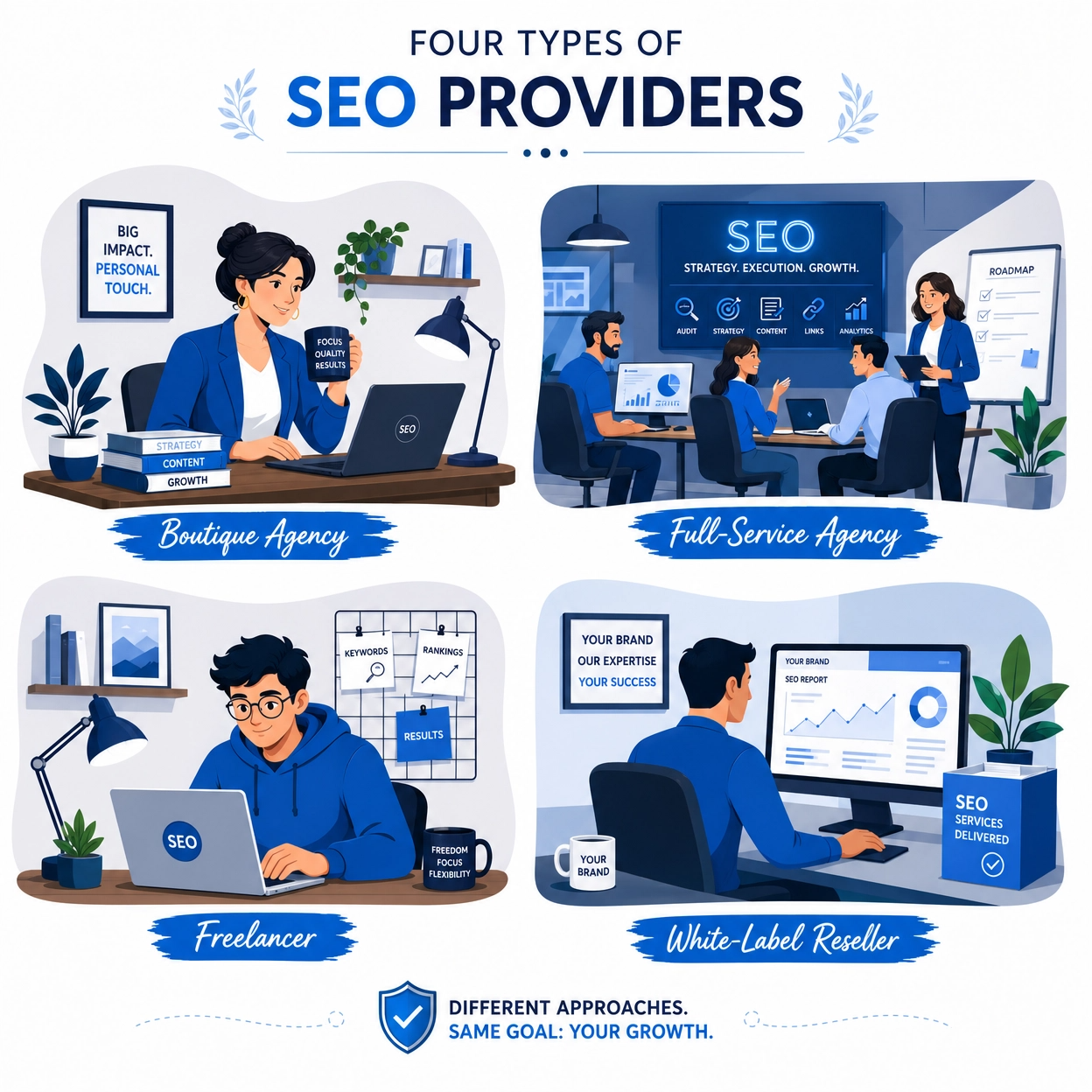
The Greater Toronto Area SEO market has four distinct types of providers. Knowing which type you’re talking to shapes how you evaluate them.
1. Boutique Specialist Agencies (10–30 person teams)
These are typically founded by practitioners who came from a larger agency or in-house SEO role. Strategy tends to be more deliberate and custom.
Client-to-strategist ratios are lower, which means more attention per account. The trade-off is that service breadth may be narrower — a boutique that excels at local SEO may not have deep ecommerce or technical capability.
Best for: Toronto service businesses, local and regional brands, professional services (legal, dental, medical).
2. Full-Service Digital Agencies
These agencies offer SEO alongside web design, Google Ads, social media, and often branding. The advantage is integration — your SEO, web design, and paid media teams share data.
The risk is that SEO is often a secondary service built on a templated system, not a custom strategy. Ask pointedly who leads SEO strategy and what their specific methodology is.
Best for: Growing businesses that want an integrated marketing partner and are willing to audit SEO depth carefully.
3. White-Label Resellers
This is the highest-risk category and unfortunately common in the GTA market. These are agencies (often with strong sales teams and polished websites) that resell offshore SEO services under their brand.
The work is produced by a third party using templated processes. The agency adds a margin, handles client communication, and typically has limited ability to customize the strategy.
Signs you may be talking to a reseller: they’re notably cheaper than comparable agencies, they can’t speak specifically to their SEO methodology, they use vague terms like “proprietary system” without detail, and their own website’s SEO health is poor.
Best for: Nobody. Avoid.
4. Solo consultants and freelancers
Toronto has a deep pool of experienced freelance SEO consultants, some of whom are exceptionally good. The trade-offs are capacity constraints (a single person can only do so much), often limited content production bandwidth, and no team redundancy if they’re unavailable.
For small local businesses with limited budgets, a strong freelancer can be excellent value. For brands that need a full-service engagement, a team is usually necessary.
Best for: Small businesses with specific, well-scoped needs; businesses that already have in-house content or dev resources.
Step 3 — Evaluate Methodology, Not Just Portfolio
This is the most important section of this guide. Most businesses evaluate agencies based on their portfolio and their pitch. This is backwards.
Past results can be misleading (industries vary, algorithm shifts happen, correlation isn’t causation). What actually predicts future performance is the agency’s methodology — how they think about and approach search visibility.
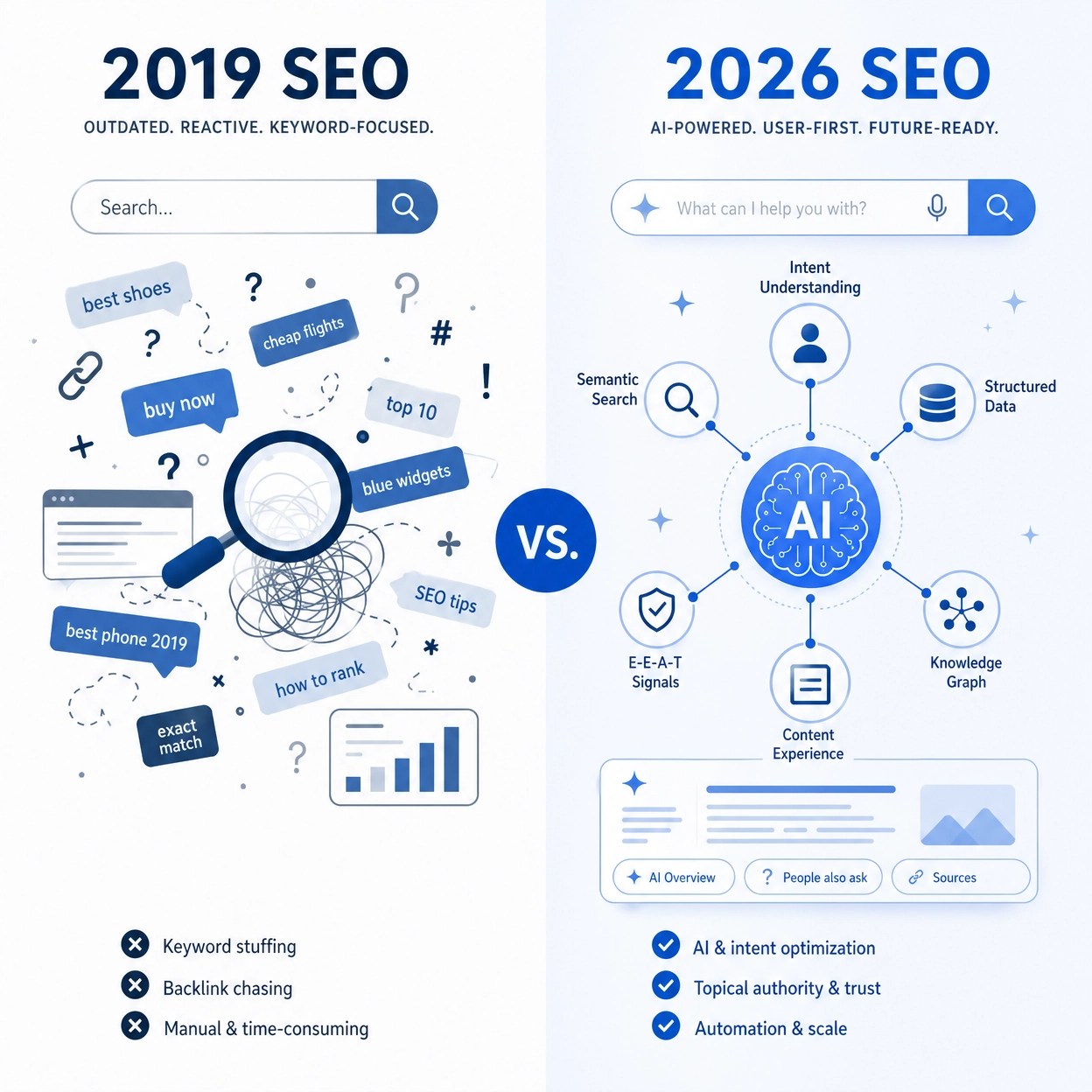
There are two dominant schools of SEO in 2026, and you need to know which one you’re looking at.
1. The Keyword-Density Approach (Legacy)
This approach treats SEO as a keyword matching exercise: identify high-volume keywords, write content that targets those keywords, build backlinks to those pages, rank. It worked well until approximately 2019–2021.
It still works partially for low-competition markets. It is structurally insufficient for competitive Toronto markets in 2026.
Agencies operating this way talk primarily about: keyword volume, page-level optimization, meta tag optimization, keyword rankings as the primary KPI.
2. The Entity-First, Topical Authority Approach (Modern)
Google’s Knowledge Graph treats the web as a network of entities (businesses, people, concepts, places) and relationships between them.
Modern SEO is about establishing your brand as a recognized, authoritative entity for a domain of expertise — not about matching keyword strings.
This approach involves:
Topical authority mapping — building a comprehensive architecture of content that covers a topic domain more thoroughly than any competitor, signalling to Google that your site is the most complete resource in your space.
Entity optimization — ensuring your brand, its expertise areas, the services it provides, and the locations it serves are clearly structured and cross-referenced across your website, your Google Business Profile, your citations, and external mentions.
Semantic content clustering — writing content in interconnected clusters where pillar pages, service pages, and supporting articles reinforce each other’s authority through deliberate internal linking.
Structured data implementation — using Schema.org markup to explicitly tell search engines what entities your content is about, what your business does, where it operates, and what relationships exist between your content.
This is what separates agencies that will still be producing results for you in two years from those whose strategy becomes obsolete the next time Google updates its algorithm.
The AI/GEO readiness test
This is a 2026 non-negotiable.
Ask every agency you evaluate: “How are you building your clients’ presence in AI-generated search results — Google AI Overviews, ChatGPT Search, and Gemini?”
- A genuinely capable agency will speak fluently about:
Optimizing content structure for AI citation (clear answers to specific questions, well-organized headings, concise factual statements that LLMs can quote) - Entity establishment across the Knowledge Graph (so AI systems recognize your brand as authoritative)
- Structured data that makes content machine-readable for AI crawlers
- Content formats preferred by AI Overviews (authoritative, specific, evidence-backed)
An agency with no real answer to this question is operating on a 2021 playbook in a 2026 search environment.
Step 4 — Audit the Auditors: Due Diligence Before the First Call
Before you get on a discovery call with any agency, spend 20 minutes doing this due diligence yourself. It will save you months.
1. Check their own Website’s SEO Health
An agency that cannot rank its own website in its target market is a significant warning sign. Use a free tool like Ahrefs’ free website checker or Google Search Console (if you have access through a referral) to evaluate:
- Does their website rank for relevant keywords in Toronto? (Search “SEO agency Toronto” and related terms — where do they appear?)
- What is their organic traffic trend over the past 12 months? (Rising indicates a living strategy; flat or declining is concerning)
- How deep is their own content? (An agency advocating topical authority should have an extensive, high-quality content library of their own)
2. Evaluate their Published Content
Read 3–5 pieces of their blog content.
Ask: Is this genuinely useful, substantive, and technically accurate? Or is it generic, thin, and could have been written by anyone?
An agency that produces excellent content for themselves has demonstrated they can produce it. An agency whose content is surface-level, full of filler phrases, and lacking real strategic depth will produce the same for your business.
3. Look at their Backlink Profile
Check their referring domain quality using Moz’s free link explorer or SEMrush’s free report. Are their backlinks from relevant, authoritative publications? Or are they from directories, link farms, and low-quality sites?
An agency building low-quality links to their own domain may be using the same tactics on client sites — tactics that Google’s Penguin algorithm and manual review teams continue to target.
4. Check their Google Business Profile
Search their agency name in Google Maps. Is their profile complete? Are they responding to reviews? Do they have recent posts? Do they have photos and accurate hours?
An agency that has not optimized its own Google Business Profile should not be trusted to optimize yours.
5. Verify their team’s E-E-A-T signals
Look at their team page.
Are there named individuals with verifiable expertise? Do those individuals have LinkedIn profiles with real professional histories? Are their strategists writing bylined content, speaking at conferences, or producing work that demonstrates personal expertise?
In 2026, Google’s quality guidelines increasingly value content created by people who have real experience in a field. An anonymous agency team with no verifiable credentials is a yellow flag in the context of E-E-A-T strategy.
Step 5 — Ask These 12 Questions in Your Discovery Call
The discovery call is your job interview for the agency.
Most businesses spend it listening to a pitch. Instead, make it a structured evaluation.
Ask these questions and listen carefully for the quality of the answers.
1. “Walk me through your typical onboarding process for a new client.”
What a good answer sounds like: Comprehensive technical audit, competitor analysis, keyword and entity mapping, a defined strategy document before any execution begins, clear KPI alignment with the client.
What a bad answer sounds like: “We get started right away” with no mention of discovery or strategy.
2. “How do you differentiate between optimizing for traffic and optimizing for leads or revenue?”
What a good answer sounds like: They immediately acknowledge the difference, explain how they identify high-intent keywords, how they optimize conversion pathways, and how they set up attribution.
What a bad answer sounds like: They talk only about rankings and traffic.
3. “What is your approach to content strategy? Do you write the content or do we?”
What a good answer sounds like: A clear content framework (topical clusters, pillar pages, supporting articles), transparent about who writes and how quality is controlled, and specific about how content is briefed.
What a bad answer sounds like: “We’ll produce X blog posts per month” with no mention of topical depth, internal linking structure, or entity optimization.
4. “How are you building your clients’ visibility in AI search results like Google AI Overviews, Perplexity, and ChatGPT?”
What a good answer sounds like: Entity-first content structure, structured data implementation, concise authoritative answer blocks, Knowledge Graph optimization.
What a bad answer sounds like: Confusion, vague reassurance, or “we’re monitoring that space.”
5. “Can you walk me through a client case study — specifically what you did and how you measured results?”
What a good answer sounds like: A specific story with an identified starting problem, a defined strategy, specific tactics deployed, and results measured in leads or revenue (not just traffic).
What a bad answer sounds like: “We grew traffic by 300%” with no context, no mention of tactics, and no revenue attribution.
6. “What happens if an algorithm update negatively affects a client’s rankings?”
What a good answer sounds like: A clear process for diagnosing the impact, transparency with the client, and a strategic response framework. Acknowledgment that some volatility is inevitable.
What a bad answer sounds like: Guarantees that algorithm updates “won’t affect” their work, or vague reassurance.
7. “Who will be working on our account day-to-day? Can I meet them?”
What a good answer sounds like: A named strategist with a verifiable background, a clear account structure, and willingness to introduce the team.
What a bad answer sounds like: “Our team” or “dedicated resources” with no specifics, and reluctance to introduce the actual people.
8. “What does your monthly reporting include, and what does the process look like?”
What a good answer sounds like: Regular reporting cadence (monthly minimum), access to live dashboards, reporting on KPIs aligned to your business goals (not just rankings), and regular strategic review calls.
What a bad answer sounds like: A PDF with traffic graphs sent once a month, no strategic context.
9. “What is your link building process? How do you acquire backlinks?”
What a good answer sounds like: Editorial outreach, digital PR, content-led link earning, relevant directory citations. Transparent about volume expectations and the time required.
What a bad answer sounds like: “We have a network of sites,” “we use PBNs (private blog networks),” or vague language that avoids describing the actual tactics. These are signs of black-hat link building that can result in Google penalties.
10. “What technical SEO issues do you typically find in your audits, and how do you prioritize fixing them?”
What a good answer sounds like: Crawl budget issues, indexation problems, Core Web Vitals (LCP, CLS, INP), structured data errors, site architecture, canonicalization — with a clear prioritization framework.
What a bad answer sounds like: “We’ll fix the meta tags and titles” — surface-level technical understanding only.
11. “What is your contract structure? What are the exit terms?”
What a good answer sounds like: Month-to-month or short initial commitment (3 months maximum), clear exit notice period, explicit ownership of all content and assets.
What a bad answer sounds like: 12-month non-cancellable contracts, vague IP terms, aggressive auto-renewal clauses.
12. “Do you outsource any part of the work you deliver?”
What a good answer sounds like: Honest disclosure of what’s done in-house vs. contracted, with clear quality control processes.
What a bad answer sounds like: “Everything is in-house” from an agency that is too small to plausibly execute all the services they’re offering, or complete unwillingness to discuss their production process.
Step 6 — Decode the Proposal and Pricing
Once you’ve completed your discovery call, you’ll receive a proposal.
Here’s how to read it intelligently.
What should be in a quality proposal
A well-structured SEO proposal for a Toronto business should include:
- An audit-based assessment of your current situation (not a generic overview)
- A defined strategy specific to your business, industry, and competitive environment
- Specific deliverables by month or quarter (content pieces, technical fixes, link acquisitions)
- Clear KPIs and how they’ll be tracked
- Reporting format and cadence
- Team structure and named contacts
- Pricing by line item, not as a single bundled number
- Contract terms including exit clauses
What a pricing breakdown should look like
A mid-market engagement for a Toronto service business might look like:
| Service | Monthly Value |
| Technical SEO (audit + ongoing) | Included in strategy |
| Content strategy and production | X posts/month, specified word count, specified topics |
| Link building | X editorial links per quarter, specified DA/DR minimums |
| GBP optimization | Initial setup + monthly management |
| Reporting and strategy calls | Monthly report + quarterly review |
If you’re receiving a single number with no breakdown, push back. “We charge $2,500/month” tells you nothing about what you’re buying or how to evaluate value.
Pricing red flags
Guaranteed rankings — no legitimate agency guarantees specific Google rankings. Anyone who does is either lying or planning to use tactics that will eventually result in penalties.
Unusually low pricing with unusually high promises — a $500/month package promising page-one rankings for competitive Toronto keywords is a sign of resold offshore work, black-hat tactics, or unrealistic expectations being set to close the sale.
No itemized deliverables — if you can’t see what you’re paying for month to month, you have no basis for evaluating performance.
Pay-for-performance only — performance-based pricing sounds appealing but often creates perverse incentives (chasing easy wins rather than sustainable strategy) and is unsustainable for the agency side.
Step 7 — Review the Contract Before You Sign
Contracts matter. These are the specific clauses to scrutinize:
IP ownership — Who owns the content produced during the engagement? Who owns the links built? In a properly structured contract, all content produced for your domain belongs to you upon creation (or upon payment). Be explicit about this.
Auto-renewal clauses — Many agency contracts auto-renew annually unless cancelled within a specific notice window (often 60–90 days before the renewal date). Read this carefully and set a calendar reminder.
White-label disclosure — If the agency uses white-label partners for any services, this should be disclosed in the contract. You have a right to know who is actually doing the work you’re paying for.
Exit notice period — A 30-day notice period is standard for a monthly retainer. A 90-day notice period in a month-to-month contract is excessive. A 6–12 month non-cancellable commitment for a new client relationship is a red flag.
Reporting commitments — The contract should specify what reporting you’ll receive and at what frequency. Verbal promises about “monthly calls” that aren’t in the contract aren’t enforceable.
Google Analytics and Search Console access — You should retain admin-level access to your own analytics properties at all times. An agency that insists on owning your GA4 or Search Console account is creating a dependency that complicates any future transition.
9 Green Flags That Signal a Trustworthy SEO Agency
When evaluating agencies in Toronto, these positive signals meaningfully raise your confidence:
- They ask more questions than you before making proposals. A good agency can’t prescribe a strategy without understanding your business. Heavy listening in discovery is a sign of a strategic mindset.
- Their own site ranks well for their target keywords. They demonstrate what they sell.
- They set realistic timelines upfront. They tell you early signals come in 60–90 days, real traction in 4–8 months, and compounding ROI in 12+ months.
- They publish substantive, technically accurate content on their own blog.
- They can explain their methodology without jargon. If they can’t explain topical authority or entity optimization clearly to a non-expert, they may not understand it themselves.
- Named team members with verifiable LinkedIn profiles. Real people with real professional histories.
- Client references they’ll provide on request. Ideally clients in your industry or adjacent to it.
- Transparent about what they don’t do. An agency that says “we don’t specialize in ecommerce” is more trustworthy than one that says yes to everything.
- Short initial commitment with month-to-month renewal. Confidence in results means they’re not dependent on contractual lock-in.
11 Red Flags That Should Make You Walk Away
These signals should end the conversation:
- They guarantee specific Google rankings. Nobody can guarantee rankings. Google does not sell or negotiate organic positions.
- They pitch links by volume alone. “We build 50 links per month” without any discussion of quality, relevance, or acquisition method is a sign of low-quality link schemes.
- Their own website has thin content, poor SEO health, or doesn’t rank for anything relevant.
- They can’t name the strategist who will work on your account.
- They use the phrase “proprietary system” without being able to explain what it actually does.
- They talk only about traffic, never about leads, conversions, or revenue.
- They can’t speak to AI search (AI Overviews, ChatGPT, Gemini) with any fluency.
- They request ownership of your Google Analytics or Search Console accounts.
- They require a 12-month non-cancellable commitment before demonstrating any results.
- Their case studies are vague, have no named clients, and show only traffic numbers with no business outcome context.
- They can’t explain what happens to your content and backlinks if you leave — or the answer is “they stay with us.”
The AI Readiness Test: A 2026 Non-Negotiable
This deserves its own section because it is the clearest differentiator between agencies operating at the frontier and those running on an outdated playbook.
Google’s AI Overviews now appear at the top of the results page for a significant and growing proportion of commercial queries — including “best [service] in Toronto,” “how to choose [service provider],” and a wide range of informational queries. These AI-generated answers pull from a set of sources that Google has determined are authoritative, well-structured, and entity-verified.
Appearing in AI Overviews requires a different optimization strategy than appearing in position one of traditional organic results. Specifically, it requires:
- Entity authority across the Knowledge Graph. Your business needs to be a recognized entity in Google’s understanding of the world — with consistent name, address, and phone data across all directories, structured Schema.org markup, and a verified Google Business Profile that accurately represents your expertise areas.
- Concise, citable answer blocks. AI systems quote from content that answers a specific question clearly and concisely. Pages optimized for AI citation include direct answer paragraphs (often called “answer blocks” or “position zero” content) that give Google’s AI a quotable, verifiable response to extract.
- Content breadth and topical coherence. AI systems favour sources that demonstrate comprehensive expertise in a domain — not single high-ranking pages, but interconnected content architectures that signal sustained depth.
- Cross-platform visibility. ChatGPT Search, Perplexity, and Gemini all have different crawling and citation behaviours. An agency with genuine GEO (Generative Engine Optimization) capability has a methodology for each, not a single SEO approach applied uniformly.
When you ask a Toronto SEO agency about their AI strategy and they either go blank or speak fluently — that single question may be the most efficient evaluation you conduct.
What a Well-Run Engagement Actually Looks Like
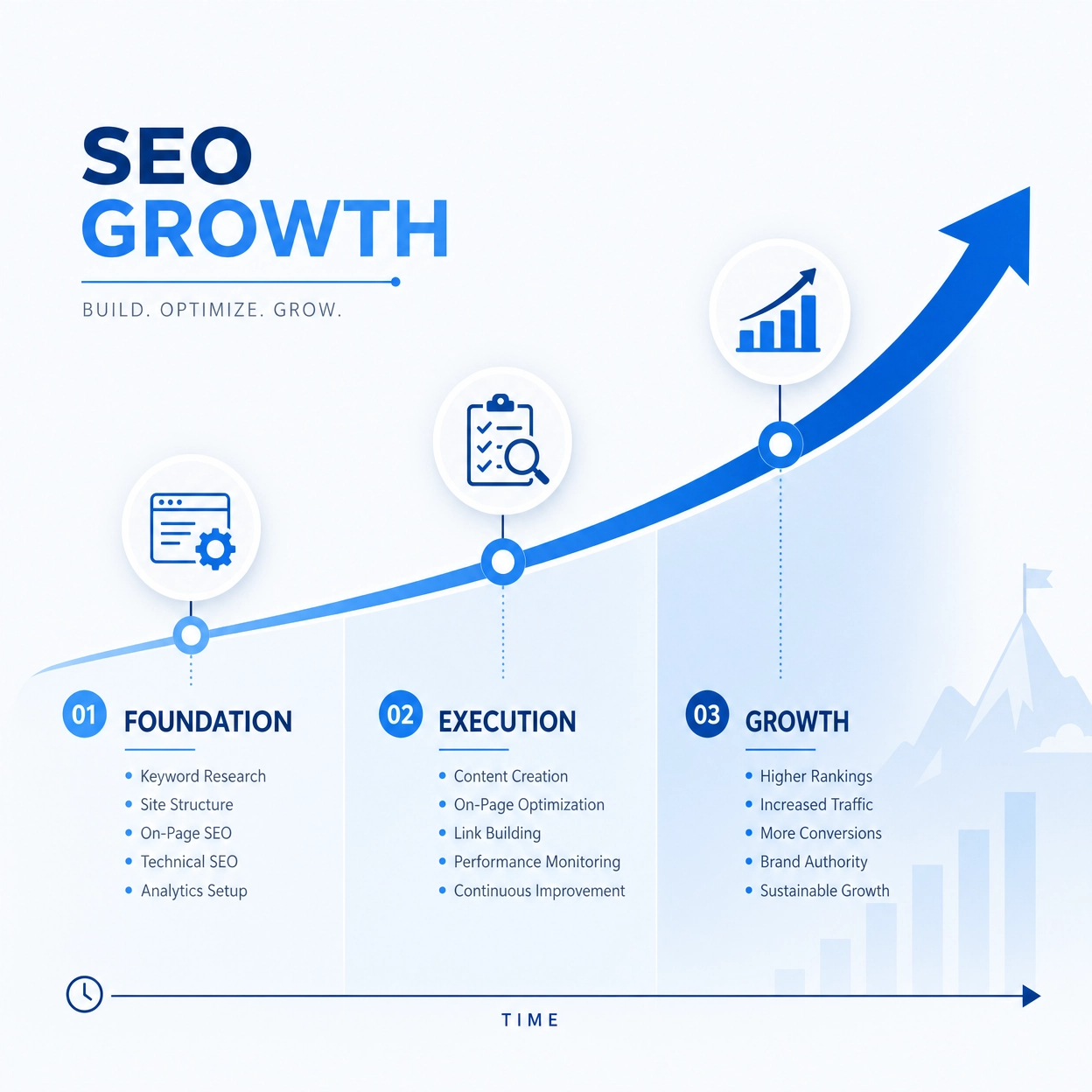
Understanding the realistic timeline of a quality SEO engagement helps you set appropriate expectations and identify underperformance early.
Months 1–2: Foundation and strategy
A reputable agency will spend the first 4–8 weeks doing groundwork before you see significant visible changes.
This includes:
- A comprehensive technical audit of your website
- Competitor analysis and gap identification
- Keyword and entity mapping for your specific market
- A content architecture plan (pillar pages, cluster content, internal linking structure)
- Initial technical fixes (crawl issues, structured data, site speed)
- Google Business Profile optimization (if local SEO is in scope)
- Baseline reporting setup (GA4, Search Console, rank tracking)
If an agency is producing deliverables in week one without having completed an audit, that is a warning sign that they’re operating on a template rather than a custom strategy.
Months 3–5: Execution and early signals
This is when content production, technical improvements, and link building begin in earnest.
Early indicators typically emerge during this phase:
- Improved rankings on long-tail and informational queries
- Indexed new content appearing in Search Console
- Improved Core Web Vitals scores
- Increased clicks on bottom-of-funnel service pages
Do not expect to dominate competitive “SEO agency Toronto” equivalent keywords for your industry in this period. That comes later. What you should see is measurable movement on less competitive terms and clear evidence that strategy is being executed.
Months 6–12: Compounding results
This is where the investment begins to compound. Content published in months 2–3 has accrued authority. Internal links are distributing equity effectively. Backlinks earned in the early months are passing signal. The Local Pack presence (if you have a Toronto GBP) is strengthening.
A well-executing engagement should show consistent month-over-month growth in organic impressions, clicks, and — most importantly — attributed leads or revenue by the end of month 6.
By month 12, a well-structured engagement should be demonstrably affecting your business outcomes. If it isn’t, the conversation needs to happen.
A Note on In-House vs. Agency
Before committing to an agency retainer, some businesses consider building SEO capability in-house. This is a legitimate option for larger organizations with the budget to hire experienced SEO professionals.
The honest comparison:
- In-house advantage: Deep domain knowledge, full alignment with company goals, faster iteration, no margin.
- Agency advantage: Breadth of expertise across industries and technical scenarios, established toolsets, link-building relationships already built, no hiring risk or employment overhead.
For most Toronto SMBs spending under $8,000/month, agency is almost always better value than an equivalent headcount hire, because a capable full-time SEO hire costs $70,000–$110,000 in salary alone, does not come with agency-level tooling, and represents a single skill set rather than a team.
The hybrid model — an experienced agency for strategy and execution, with one internal marketing person handling content — is increasingly common and often excellent.
How to Run Your Final Comparison
Once you’ve completed discovery calls with 2–3 agencies, compare them across these dimensions:
| Dimension | Questions to Score |
| Methodology depth | Can they explain entity-first SEO and topical authority coherently? |
| AI readiness | Do they have a real GEO/AI Overviews strategy? |
| Toronto market knowledge | Do they understand your specific competitive landscape? |
| Team transparency | Do you know who will work on your account? |
| Deliverable specificity | Do you know exactly what you’re getting each month? |
| Reporting quality | Can they show you a sample report from a real client? |
| Exit terms | Is the contract fair and reciprocal? |
| Reference availability | Will they connect you with a current client? |
| Their own SEO health | Does their website reflect what they’re selling? |
Score each agency 1–5 on each dimension. Add a weighted score based on which dimensions matter most to your business. The outcome often reveals a clear winner more efficiently than a gut-feel comparison.
Ready to Evaluate Volt Studios?
If you’ve read this far, you now have a more sophisticated framework for evaluating Toronto SEO agencies than 95% of buyers in this market.
Volt Studios operates on a methodology built around entity-first optimization, topical authority architecture, and full GEO integration — the approach described throughout this guide as the standard for 2026 and beyond.
We apply every standard in this guide to our own website, our own content, and our own backlink profile. We’ll show you the data.
Start with a free technical and competitive audit. We’ll assess your current site’s SEO health, map the competitive gap in your market, and give you a clear picture of what’s needed and what’s realistic — before you spend a dollar.