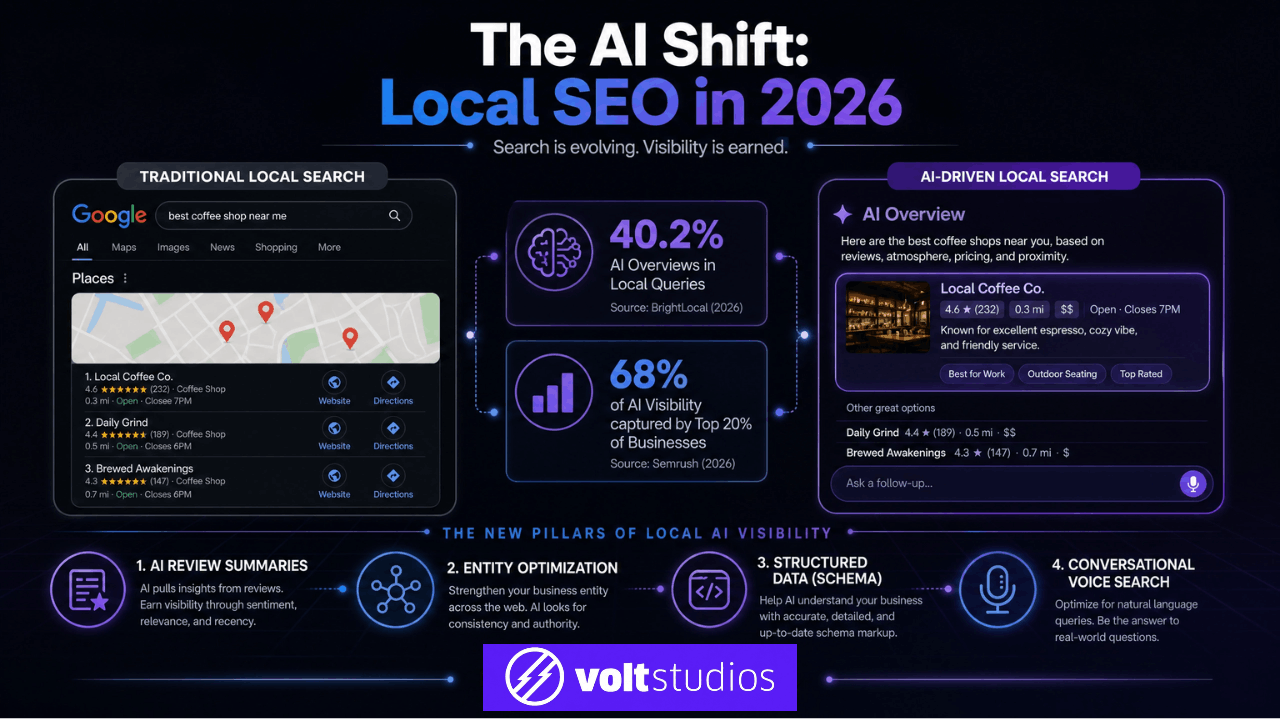
Most visibility issues are downstream of inconsistent profile data and weak entity signals — both of which are addressed in a structured Google Maps optimization engagement.
The gap between having a Google Business Profile and ranking on Google Maps is wider than most GTA business owners realize.
Here’s what we find when we look under the hood.
We hear this constantly from business owners across Toronto, Mississauga, Vaughan, Barrie, and Scarborough. They claimed their Google Business Profile. They filled in the address.
They might have uploaded a logo. And when a potential customer searches for their service nearby, they’re nowhere in the results — while competitors sit in the top three, collecting calls and direction requests.
Having a listing is not the same as ranking. The gap between those two states is where most local SEO work actually happens, and it’s almost never caused by one thing.
It’s a combination of technical gaps, content deficiencies, and profile misconfigurations that compound quietly over time until the business is functionally invisible to the customers most likely to convert.
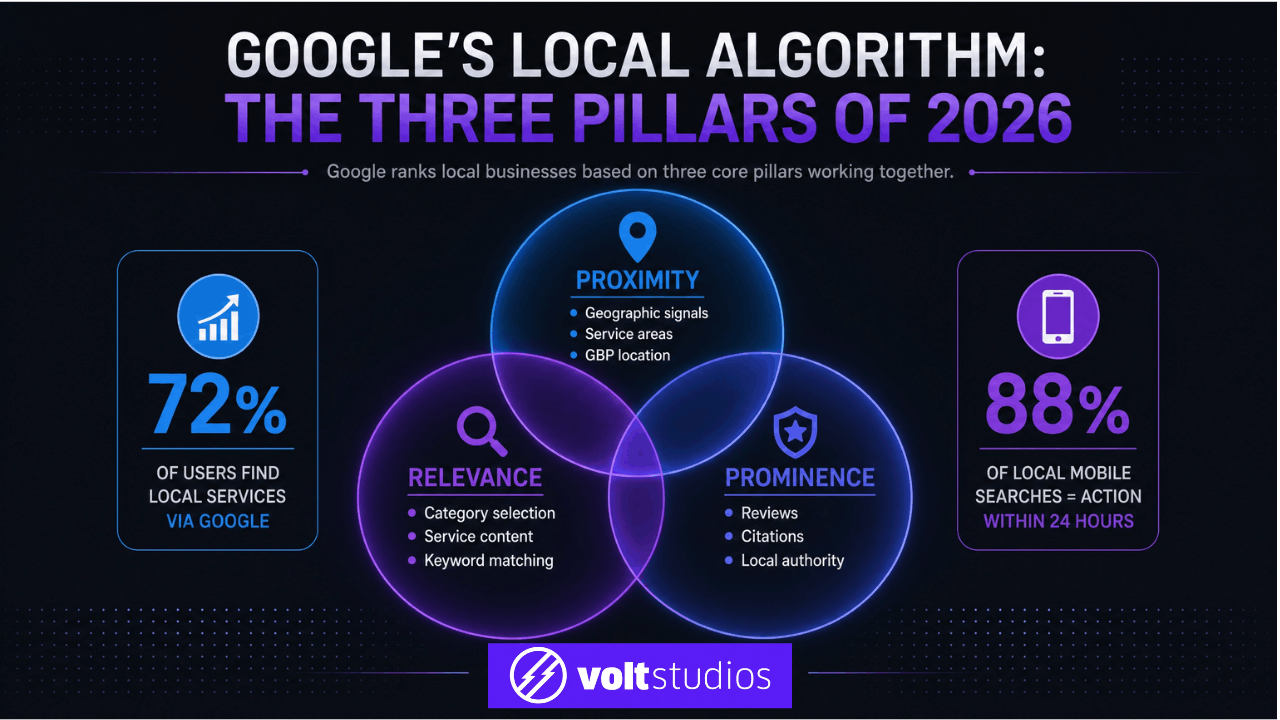
88% of consumers use Google Maps to find local businesses. 48% of all local searches result in a GBP action — a call, a direction request, a website visit — within 24 hours. That’s immediate commercial intent. When your business doesn’t appear for it, someone else captures it.
The Six Reasons We Find Most Often
After auditing hundreds of GBP profiles across the GTA, the causes of Maps invisibility cluster around the same failures in roughly the same order.
The first and most overlooked: the profile is suspended or unverified. 36% of businesses have unverified Google Business Profiles. Without verification, visibility is severely limited.
Suspensions have increased significantly since 2024 as Google’s AI enforcement has tightened — the leading causes are address verification failures, business name violations from keyword stuffing in the name field, and review manipulation.
Many business owners have no idea their profile is suspended until they search for themselves and find nothing. When a GBP is suspended, the business vanishes from both Maps and local search results entirely.
The second cause is category misselection. Primary category is the single strongest signal Google uses to match a business with relevant searches. A plumber in Vaughan who selected “Home Services” as their primary category is losing to competitors who selected “Plumber”.
A dental clinic categorized as Health & Medical instead of “Dentist” is discarding ranking potential on every relevant search. The fix is precise: primary category should reflect the core revenue-generating service, not a broad descriptor of what type of business you are.
The third cause is a website that provides no local reinforcement. Google doesn’t evaluate a GBP in isolation — it cross-references the profile against the website, looking for consistency and local relevance.
A thin website with no location-specific content, no LocalBusiness schema, and no dedicated service area pages sends weak trust signals regardless of how well the GBP itself is configured.
NAP data that differs even slightly between the website and the profile — “123 Main St, Unit 5” versus “123 Main Street, Suite 5” — creates verification uncertainty that suppresses rankings.
The fourth cause is review stagnation. The Local 3-Pack heavily favours businesses with recent, high-volume, consistently arriving reviews. Top-ranking businesses typically have 200+ reviews with steady incoming velocity.
A business with fifty 5-star reviews from two years ago will lose to a competitor with thirty reviews from the past six months. Review recency is a live signal. In competitive GTA markets, a burst of reviews collected at launch followed by years of silence is a slow-motion visibility problem.
The fifth cause is NAP inconsistency across the web. If the website lists “123 Main St, Unit 5,” the GBP says “123 Main Street, Suite 5,” and Yelp shows “123 Main St #5,” Google struggles to confirm these represent the same business.
Abbreviated versus full street names, suite and unit number formatting differences, old phone numbers still live on directory sites, business name variations with and without “Inc.” or “Ltd.” — each one fragments the citation authority that local rankings depend on.
The sixth cause applies specifically to service area businesses — plumbers, HVAC contractors, electricians, mobile services. Misconfigured service area settings, either undefined or dramatically overreaching the business’s actual operating radius, both suppress visibility and risk triggering suspensions.
A contractor based in Barrie claiming to serve downtown Toronto without legitimate local presence or authority signals in that area is fighting an algorithmic headwind that citation building and content alone won’t overcome.
What Fixing It Actually Looks Like
Suspended profiles require the same discipline as any Google policy issue — audit for the actual violation before filing a reinstatement request, remove the problem completely rather than working around it, and submit with supporting documentation. Creating a new listing to replace a suspended one compounds the problem rather than solving it.
Category corrections are among the highest-impact changes available and among the quickest to implement. Primary category to the most specific accurate descriptor of the core service.
Secondary categories, up to nine of them, covering the related services the business actually provides. Quarterly review of category performance in the Insights dashboard to catch drift.
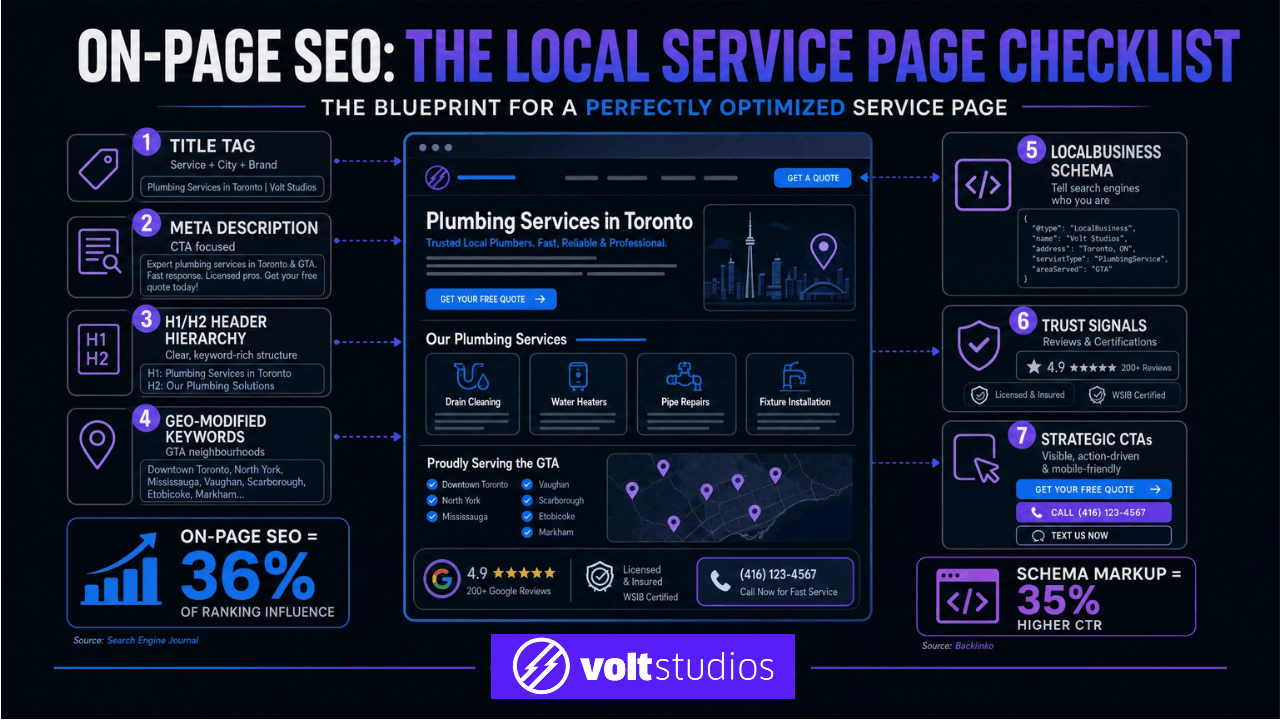
Website local signals require actual investment: location-specific landing pages for each major service area, LocalBusiness schema with accurate NAP and geo-coordinates, locally-focused content that references the neighbourhoods and communities served.
A Vaughan-based HVAC company should have dedicated pages for furnace repair in Vaughan, air conditioning installation in Richmond Hill, and HVAC services in Thornhill. Not because Google rewards volume, but because each page signals genuine local presence in a specific community.
Review generation needs to become a systematic process rather than an occasional request. Asking at the point of service completion when satisfaction is highest, following up via automated SMS or email for customers who don’t respond immediately, responding to every review within 48 hours.
A minimum of five new reviews monthly maintains the velocity signal Google rewards. Responding to 25% or more of reviews correlates with revenue improvements of up to 35% — the reviews themselves matter, and so does the visible evidence that the business engages with them.
NAP cleanup follows the same citation audit framework that applies to any local SEO work: document every instance of the business’s information across the web, identify discrepancies, standardize to a canonical template, and update every listing to match. Consistency across even twenty major directories significantly strengthens local authority.
The Pattern We See in Businesses That Win Local Search
The businesses that dominate Google Maps in competitive GTA markets are not necessarily doing better work than their competitors. They’re simply operating with better-maintained digital infrastructure.
They verify and maintain pristine GBP hygiene. They invest in local content that demonstrates genuine community presence rather than generic city-name mentions. They generate reviews systematically and respond to them consistently.
They treat NAP consistency as non-negotiable across every platform. They monitor for drift — new duplicates, outdated listings, category changes — rather than assuming the profile they set up two years ago is still accurate.
None of this is sophisticated. All of it requires ongoing attention. The businesses that treat GBP optimization as a one-time setup task fall behind slowly, without a visible signal that it’s happening, until a competitor with a better-maintained profile is answering the calls that should be theirs.
If you want to know exactly why your business isn’t appearing where it should on Google Maps — which of these issues are present in your specific profile and what the priority order for fixing them is — we offer a free Google Business Profile audit for GTA businesses.
We’ll identify hidden suspensions or verification issues, category gaps, NAP inconsistencies, review velocity problems, and technical website issues suppressing your rankings, and give you a clear roadmap for what to address first.