What a systematic review strategy actually looks like, why timing and response consistency matter more than volume, and the pattern we see in businesses that win the Local Pack.
98% of consumers read online reviews before deciding on a local business. 28% of local searches result in a purchase within 24 hours. The window between a customer discovering your business and making a decision is razor-thin — and in that window, your Google review profile is doing more work than your website, your ads, or your backlink profile.Google reviews now surpass backlinks as the top signal for local pack visibility.
The algorithm has adjusted to reflect how consumers actually make decisions. For GTA businesses competing in dense local markets, a weak or neglected review profile isn’t just a reputation issue. It’s a rankings issue, and it compounds quietly every month a competitor’s review velocity exceeds yours.
The Three Gaps We Find on Almost Every Audit
Most GTA businesses aren’t losing review visibility because they have unhappy customers. They’re losing it because they have no system for converting satisfied customers into visible social proof.
The failure pattern is consistent enough that we can describe it before looking at the profile.
The first gap is volume and recency. Consumers read an average of ten reviews before trusting a local business enough to act.
A trades contractor in Vaughan with eight reviews, a dental clinic in North York with four, or a bakery in Mississauga with six is functionally invisible to the discerning buyer — regardless of the star rating on those individual reviews. Volume signals credibility.
Recency signals that the business is still active and still earning trust.
When the last review on a profile is fourteen months old, the implicit message to a prospective customer is that something has changed. A thin, stale review profile drains revenue quietly while the business assumes everything is fine.
The second gap is response consistency. Businesses that respond to 32% or more of their reviews see up to 80% higher conversion rates compared to those that don’t respond at all.
Yet the majority of GTA businesses either respond sporadically or not at all, treating their review section as a passive archive rather than an active part of the customer acquisition process.
Every unanswered review — positive or negative — is a missed signal to both Google and prospective customers that the business is attentive and worth engaging with.
In competitive markets like downtown Toronto or Barrie’s growing commercial districts, that responsiveness gap is often the decisive differentiator.
The third gap is the temptation to shortcut. Google blocked over 56 million fake reviews in a single year. The FTC now levies penalties ranging from $51,000 to $53,000 per violation for businesses caught purchasing or incentivizing fake reviews.
Building a review strategy on fabricated feedback isn’t just an ethical problem — it’s an existential business risk at a scale most SMBs in the GTA can’t absorb.
What a Systematic Review Strategy Actually Requires
The businesses winning local search on reviews aren’t doing anything sophisticated. They’re doing three things consistently that their competitors are doing inconsistently or not at all.
Timing the request correctly is the first discipline. For service businesses, the optimal window is 24 to 48 hours after service completion — when the experience is still vivid and the customer’s emotional investment is highest.
Wait longer and the motivation to act fades. For retail or e-commerce, wait three to five days after purchase so the customer has received and engaged with their product before being asked to evaluate it. A review request that arrives before the order does creates friction rather than goodwill.
Personalization matters more than most businesses realize. Generic mass requests convert poorly. Referencing the specific service performed, the team member involved, or a detail from the customer interaction dramatically increases response rates.
Customers respond to being treated as individuals. A message that acknowledges what actually happened in their interaction performs significantly better than a boilerplate template sent to an entire contact list.
The cadence that earns algorithmic reward is steady accumulation over time, not periodic bursts. Targeting two to four new reviews monthly establishes the consistent, credible velocity Google’s algorithm treats as a trust signal.
A hundred reviews collected in a single month followed by months of silence looks like a campaign. Steady monthly accumulation looks like a business people genuinely and continuously trust. Google knows the difference.
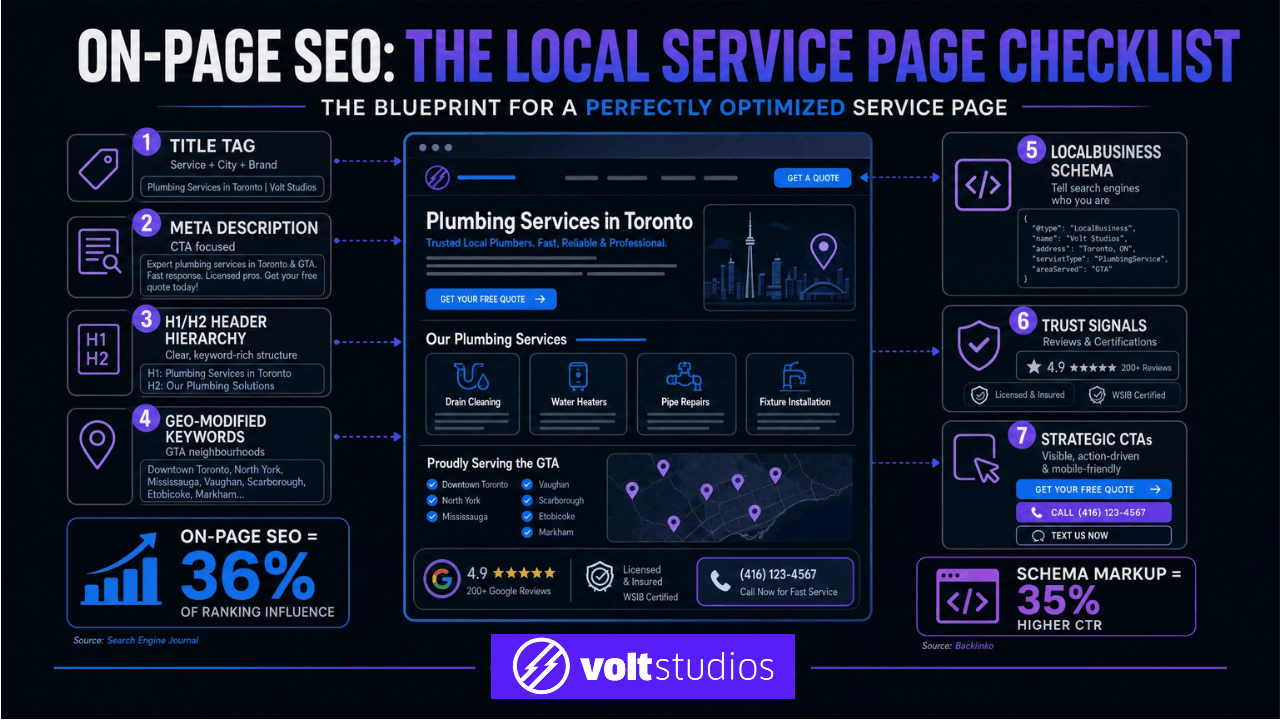
Review schema markup closes the loop on the technical side. JSON-LD structured data communicates aggregate ratings directly to Google’s search algorithms, enabling star ratings to display in search results beneath the business listing.
Schema markup increases click-through rates by 20–35% on average. When correctly implemented, it packages rating data in a format Google can immediately read and display — visual authority that competitors without schema simply don’t have in the results.
Validate implementation using Google’s Rich Results Test before going live, and keep rating data synchronized with actual review profiles.
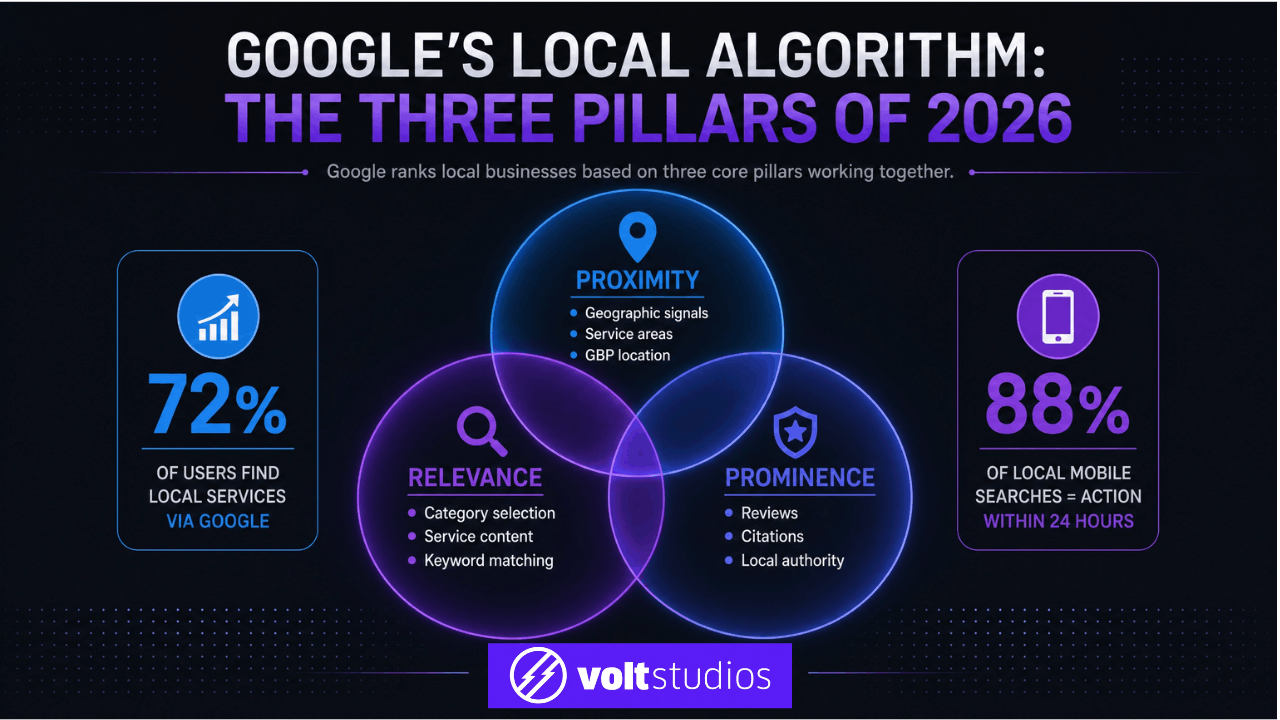
Reviews are one signal in a broader local SEO program that also covers entity consistency, citations, and on-page intent.
Two Patterns That Make the Difference Concrete
Two plumbing companies operating in the same Mississauga postal code. Company A had eleven years in business and fourteen Google reviews averaging 3.8 stars. Company B had been open three years and had 87 reviews averaging 4.9 stars.
Company B dominated the Local Pack for every high-intent local keyword. The differentiator wasn’t service quality or business longevity. It was review volume, recency, and response consistency.
A family-owned Italian restaurant in Vaughan was struggling to fill tables on weeknights despite strong word-of-mouth. After implementing a post-visit review request — a simple follow-up text sent 90 minutes after dining — they went from 23 reviews to 141 in under five months.
Google Business Profile impressions increased over 60%. Direct reservation calls climbed noticeably within the first quarter. The menu hadn’t changed. The food hadn’t changed. Their visible reputation had.
Both patterns point to the same truth: the review gap between winning and losing local businesses is almost never about actual service quality. It’s about whether happy customers are systematically being converted into visible evidence of that quality.
Read Also: Local SEO Audit Checklist
The Compounding Logic of Review Investment
Every week a GTA business operates without a structured review strategy is a week competitors are building the review velocity and response consistency that compounds into durable Local Pack visibility.
Unlike paid advertising, which stops producing the moment budget stops, a strong review profile accumulates authority over time, makes every other local SEO investment work harder, and creates a competitive moat that takes sustained effort for a competitor to close.
The businesses that dominate local search in competitive GTA markets treat reviews as an ongoing operational discipline — requests built into the customer journey, responses written within 24 hours, schema keeping the technical layer current.
None of this is complex. All of it requires consistency, which is precisely why most competitors aren’t doing it well.
If you want to know exactly where your review profile stands relative to the businesses currently ranking above you — how your volume compares, where your recency sits, whether your schema is implemented correctly, and what the fastest path to competitive review velocity looks like for your specific market — we offer a free Google Business Profile audit for GTA businesses.