What we’ve learned after a decade of local SEO work across Toronto, Mississauga, Vaughan, and Barrie — and the specific mistakes that keep service businesses invisible at the moment customers are ready to buy.
46% of all Google searches carry local intent. Nearly half of every query typed into Google is someone looking for a product, service, or business in a specific location.
Yet the majority of service businesses we audit across the GTA are optimizing for generic, high-volume keywords that their ideal customers aren’t actually searching for at the moment they’re ready to book.
The shift in how Canadians search for services has been significant. A homeowner in Scarborough with a burst pipe at 11 PM isn’t searching “plumbing services Canada.
They’re searching “emergency plumber near me” or “plumber Scarborough open now.” The businesses appearing in those results win the call. The businesses optimizing for the wrong terms never enter the conversation — regardless of how much they’ve invested in everything else.
The Mistakes We See Repeatedly
After working with service businesses across the GTA since 2012, the keyword errors follow consistent patterns.
The most common is competing for broad, national-level terms when the business only serves a defined geographic area. A dental clinic in North York optimizing for “dental implants” is competing against every dental school, manufacturer, and national chain in Canada.
That same clinic optimizing for “dental implants North York” faces a fraction of the competition and attracts searchers who can actually become patients. 84% of local searches are discovery-based — the searcher doesn’t have a specific business in mind. Generic keyword targeting makes you invisible to that entire segment.
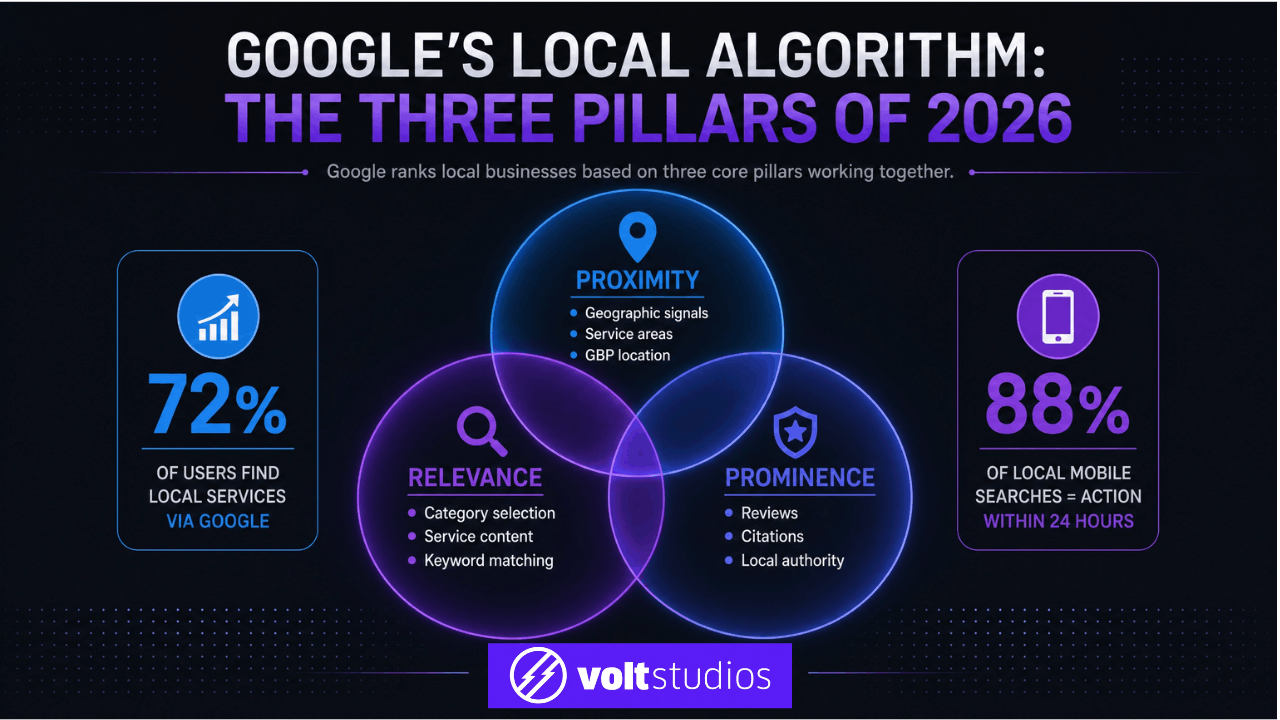
The second mistake is underestimating proximity-based search intent. “Near me” searches have grown over 900% in the last decade. This isn’t a trend — it’s a fundamental shift in how people search for services. 88% of smartphone local searchers visit or call a business within a day of searching.
Businesses that don’t optimize for proximity-based queries are ignoring the highest-converting segment of their potential market.
The third mistake is treating all local searches as equivalent.
A search for “how to unclog a drain” and a search for “emergency plumber Mississauga open now” represent completely different buyer stages. The first is problem awareness — that person might try a DIY fix before calling anyone. The second is a decision-stage buyer ready to pay immediately.
Most service businesses create generic service pages that neither address the specific questions of early-stage searchers nor convert the urgency of decision-stage ones.
The fourth mistake is GTA-specific and gets missed constantly: targeting city-level keywords without going deeper. A landscaping company targeting “landscaping Toronto” competes against hundreds of businesses.
That same company targeting “landscaping contractor Woodbridge” or “landscaping services near Weston Road” faces dramatically less competition and captures searches from prospects in their immediate service radius. Google’s local algorithm prioritizes proximity. Neighbourhood-level keyword targeting is how you earn Map Pack visibility in the areas where you actually work.
How Local Search Intent Actually Works
Before keyword research produces useful output, it helps to understand how Google interprets local intent — because this determines which keywords are worth targeting in the first place.
Local searches split into two types. Explicit local intent includes a location in the query: “plumber Toronto,” “HVAC repair Barrie.” Implicit local intent omits a location but Google infers it from device location and query context: “emergency plumber,” “furnace repair near me.” Both matter.
Implicit intent queries often represent higher urgency and lower competition because they require more sophisticated local optimization to capture.
The signals Google uses to identify local intent include query modifiers like “near me,” “open now,” and “closest,” service-based nouns that are inherently local in nature, the searcher’s physical location, and prior search history.
A practical test: if Google shows a Local Map Pack for a query, that query has local intent and belongs in your keyword strategy. If it doesn’t, you’re likely targeting a national or informational search that local SEO alone won’t win.
The Framework That Actually Works
Effective local keyword research follows a repeatable process, not intuition.
It starts with your core service offerings stripped to their simplest form — the language your customers use, not industry terminology.
“Residential electrical panel upgrade” is how an electrician thinks. “Electrical panel replacement” is how a homeowner in Vaughan searches at 9 PM.
From there, geographic modifiers get layered systematically across three categories: city and region names across your service area, neighbourhood and landmark references that match how locals describe their location, and proximity terms like “near me” and “close to me.
” The combinations produce high-intent targets — “HVAC repair Mississauga,” “emergency plumber Scarborough,” “roofing contractor Vaughan” — used by people who are ready to book, not just browse.
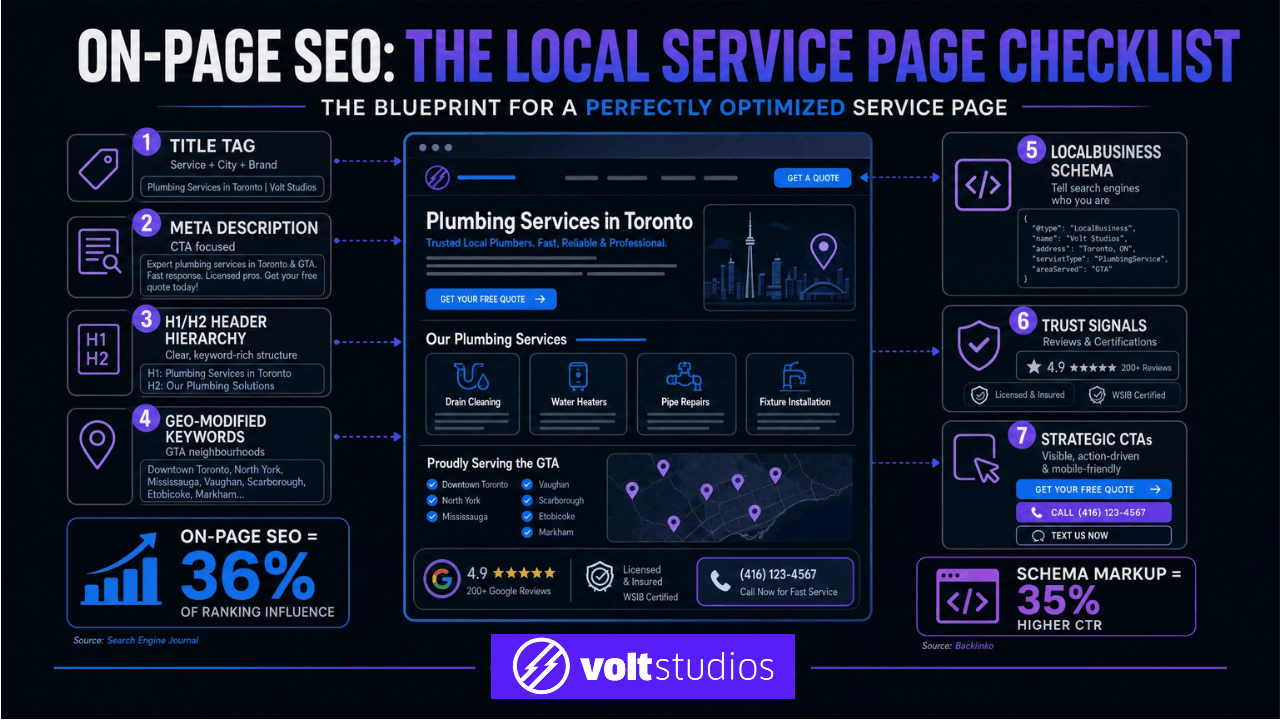
Those combinations then map to a content grid: services on one axis, service areas on the other. Every intersection is a potential landing page target. A business serving five cities with ten core services has fifty potential location-specific pages.
Priority goes to highest-margin services first, areas closest to your physical location for Map Pack advantages, and combinations where current rankings show opportunity.
Search intent analysis on each combination determines content type. If Google shows Map Pack results for a keyword, you need Google Business Profile optimization. If it shows blog posts, you need educational content.
If it shows service pages, you need optimized location pages. Matching content type to search intent is what determines whether you rank for the right queries or waste effort on the wrong ones.
What This Looks Like in Practice
A roofing company in Vaughan shifted focus from “roofing services” — a generic term competing nationally — to “roofing contractor Vaughan” and “roof repair near me.” Traffic volume decreased. Conversion rate tripled.
Qualified lead form submissions were up 40% within 90 days. Less traffic, more revenue, because the traffic that arrived was actually in the service area and ready to buy.
An HVAC company serving the full GTA created individual service pages for Mississauga, Brampton, and Vaughan — each with unique content, local context, and neighbourhood-specific information rather than duplicated copy with a city name swapped in.
Map Pack appearances increased 65% within six months, concentrated in the specific cities they’d targeted. The pages that treated local content as a real investment rather than a template exercise were the ones that earned visibility.
The pattern is consistent across service categories. Geographic specificity in keyword targeting reduces competition, improves conversion rates, and earns Map Pack placements that generic optimization never reaches.
Why This Compounds Over Time
The businesses investing in local keyword strategy right now are building a compounding advantage. Every location-specific page that earns Map Pack visibility generates calls and direction requests that feed Google’s local ranking signals — which improves Map Pack visibility further.
Every review earned through those calls strengthens the trust signals that convert future searchers. The infrastructure builds on itself.
The 46% of searches with local intent aren’t slowing down. “Near me” search volume keeps growing. The GTA keeps getting more competitive. Every month without a geographic keyword strategy is a month competitors are earning the calls you should be getting.
If you want to know which local keyword opportunities you’re currently missing — and which geo-modified terms in your specific service areas have the highest conversion potential — we offer a free local SEO audit for Canadian service businesses.We’ll review your current keyword targeting, identify the neighbourhood-level gaps, and give you a clear priority order for what to address first.