Businesses that consistently rank in the Map Pack work the fundamentals of their Google Maps optimization service every month — not just at launch.”
After more than a decade helping local businesses crack the top three, here’s what we know about the factors that determine who shows up and who gets left behind.
Somewhere in Mississauga right now, a homeowner with a burst pipe is searching “emergency plumber Mississauga” on their phone. Three businesses appear at the top of the results. The homeowner calls the first one.
If your business isn’t in those three positions, that call — and dozens more like it every week — is going to a competitor. Not because they’re better at plumbing. Because they’re better at showing up.
42% of local searchers click directly on Map Pack results, bypassing organic listings entirely. 87% of consumers use Google to evaluate local businesses before making contact. 46% of all Google searches carry local intent.
The Map Pack is where the majority of local commercial decisions get made — and most GTA businesses are not in it, for reasons that are entirely fixable.
Read Also: Local SEO Audit Checklist
Why Most Businesses Aren’t Ranking
After auditing hundreds of Google Business Profiles across Toronto, Mississauga, Vaughan, Barrie, and Scarborough, the failure patterns are consistent enough to describe before opening the account.
The most pervasive error is the set-and-forget approach. A business claims their GBP, fills in the basic information, and assumes the work is done. In 2026, that assumption is catastrophic.
Google’s local algorithm rewards active, consistently updated profiles and deprioritizes stagnant ones. A profile that hasn’t been touched in six months signals to the algorithm that the business may not be active.
Competitors posting weekly updates, responding to reviews within hours, and continuously refining their profiles are passing that business by — not because they’re better operations, but because they’re better at signalling ongoing relevance.
Profile incompleteness compounds the problem. 75% of businesses ranking in the top three Map Pack positions have complete, fully optimized profiles. The majority we audit are missing service descriptions, have incomplete business hours, few or no photos, and no regular posts.
An incomplete profile doesn’t just represent missed opportunity — it actively hurts rankings. Google interprets missing information as uncertainty, and it doesn’t surface uncertain results.
Review neglect is the third consistent failure. Review velocity — the pace at which new reviews arrive — controls an estimated 40–45% of review-related ranking authority.
Profiles receiving eight or more reviews per month rank an average of 4.2 positions higher than those receiving fewer than two monthly. A three-month drought in new reviews can cause a drop of three to twelve positions.
The counterintuitive finding that surprises most business owners: a profile with 120 reviews and steady velocity of eight new reviews per month will outrank a profile with 300 reviews and no recent activity. Recency beats volume. Google is measuring ongoing trust, not historical accumulation.
NAP inconsistency ties it together as the fourth failure. When a business’s name, address, and phone number differ across their website, GBP, Yelp, and directory listings — “St.” versus “Street,” suite numbers formatted differently, old phone numbers still live on aggregator sites — Google’s confidence in surfacing that business accurately to searchers drops. Even minor variations dilute ranking power in competitive GTA markets where the margin between appearing and not appearing is thin.
The Three Pillars Google Actually Evaluates
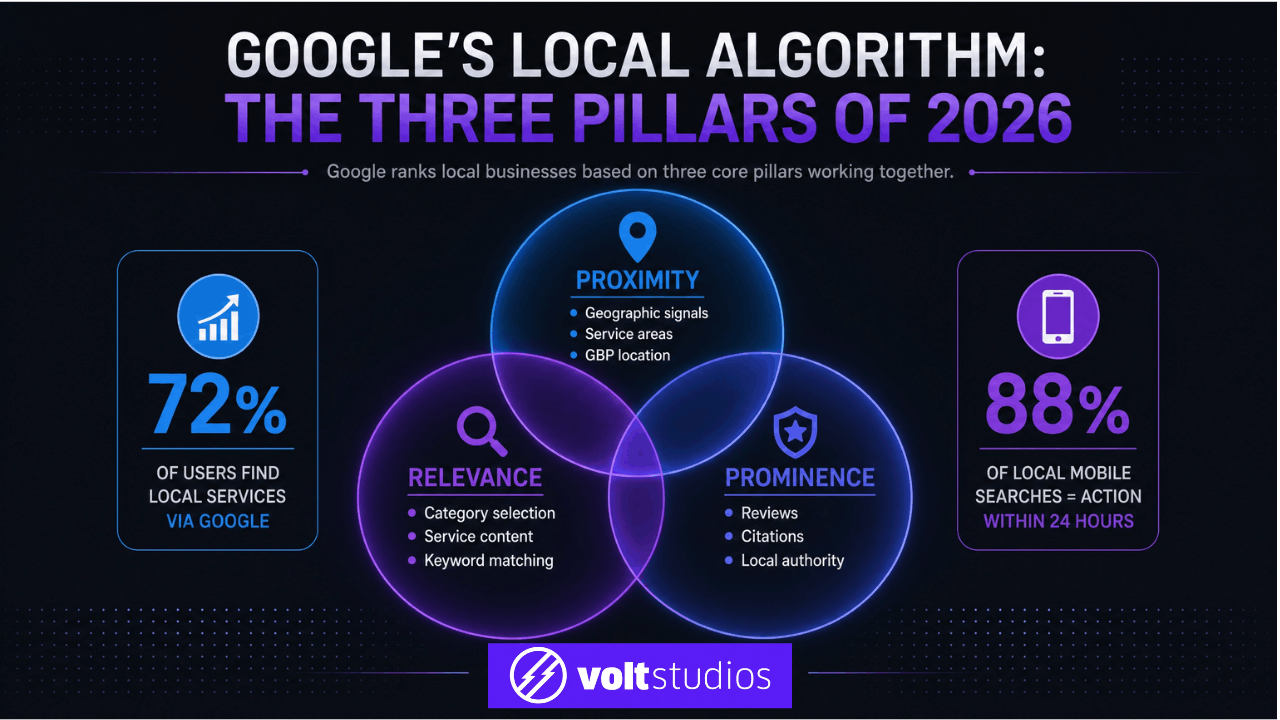
Everything in local search rolls up to three factors: proximity, relevance, and prominence.
Proximity is the one factor you can’t change — your physical address relative to the searcher. But it isn’t destiny. Accurate service area definitions in your GBP, location-specific content on your website, and consistent geographic signals across the web all help Google match your business to relevant searches outside your immediate block.
For service-area businesses operating across multiple GTA municipalities, clearly defining where you work is essential to appearing in Map Pack results throughout your actual service area.
Relevance measures how precisely your business matches what the searcher needs. Primary and secondary category selection is the highest-leverage decision here.
A dental clinic selecting “Cosmetic Dentist” as its primary category will rank for different queries than one selecting “Dentist” or “Emergency Dental Service.”
Service listings, business description, attributes — wheelchair accessible, onsite parking, free Wi-Fi — all contribute. The critical requirement is consistency between GBP and website.
If your profile claims emergency plumbing services but your website makes no mention of emergency calls, Google detects the disconnect and downgrades your relevance score.
Prominence is where active SEO work produces the most dramatic improvements and where most businesses fall short. It’s built through reviews, backlinks, citations, brand mentions, and the behavioural signals your listing generates — clicks to call, direction requests, photo views.
Prominence is the tiebreaker that allows a business farther from the searcher to outrank a physically closer competitor who has done less work to establish local authority. It’s also the area where sustained effort produces compounding returns over time.
Read Also: Fix Google Maps Visibility
What Systematic Execution Actually Looks Like
- GBP completeness is the foundation. Every relevant field filled — categories that precisely match services, a business description with natural keyword inclusion, service areas accurately defined, hours kept current including holidays.
- Photos of storefront, interior, team, completed work — businesses with 15 to 20 high-quality images significantly outperform those with sparse visual content. New photos added monthly to signal ongoing activity.
- Google Posts at minimum twice per week — offers, updates, tips, events — as a freshness signal that tells the algorithm this profile is actively managed.
- Review generation needs to become a systematic process, not an occasional ask. Every satisfied customer, contacted within 24 to 48 hours of service completion while the experience is still vivid.
- Direct links to the GBP review form to remove friction. A follow-up if the first request goes unanswered. Every review — positive and negative — responded to within 24 to 48 hours.
- Monthly review count tracked as a key performance metric. The target is three to five new reviews monthly as a minimum inflection point for meaningful Map Pack improvement.
- Local link building and citation consistency provide the prominence signals that separate top-ranked businesses from everyone clustered just below them.
- Local Chamber of Commerce membership, community sponsorships, local press coverage, supplier and partner directory listings — each one tells Google the business is legitimately embedded in the local community.
- And NAP standardized to a canonical template, applied consistently across every directory and platform, so Google can confidently verify the business identity it’s being asked to surface.
- Behavioural signals close the loop. High-quality photos, current hours, active posts, and a compelling service list all increase the likelihood that searchers engage with the listing — clicks to call, direction requests, website visits.
- High engagement tells Google the listing is relevant and appealing, which improves rankings, which produces more visibility, which generates more engagement. That virtuous cycle is what durable Map Pack positioning looks like.
The Compounding Advantage Being Built Right Now
The businesses ranking in the GTA Map Pack in 2026 are not necessarily the largest or the most established. They’re the ones that have treated local SEO as an ongoing operational discipline rather than a one-time setup task.
Every week of consistent GBP posting, review generation, and citation maintenance builds compounding authority that becomes harder for a competitor to close.
Every month a business neglects these fundamentals, a competitor is widening the gap — not dramatically, not visibly, but steadily and cumulatively.
The three positions at the top of local search results for your target keywords represent a predictable pipeline of high-intent, same-day customers. The path to earning those positions is not mysterious.
It requires consistency across the fundamentals that most competitors are executing inconsistently or not at all.
If you want to know exactly where your Map Pack performance stands — which factors are suppressing your rankings, how your profile compares to the businesses currently in the top three, and what the priority order for improvement is in your specific market — we offer a free local SEO audit for GTA businesses.