Local Landing Pages: Why Most GTA Businesses Built Them Wrong — and What Actually Makes Them Rank
The structural mistakes we find on nearly every local page audit, and the framework that consistently produces top-three local results.
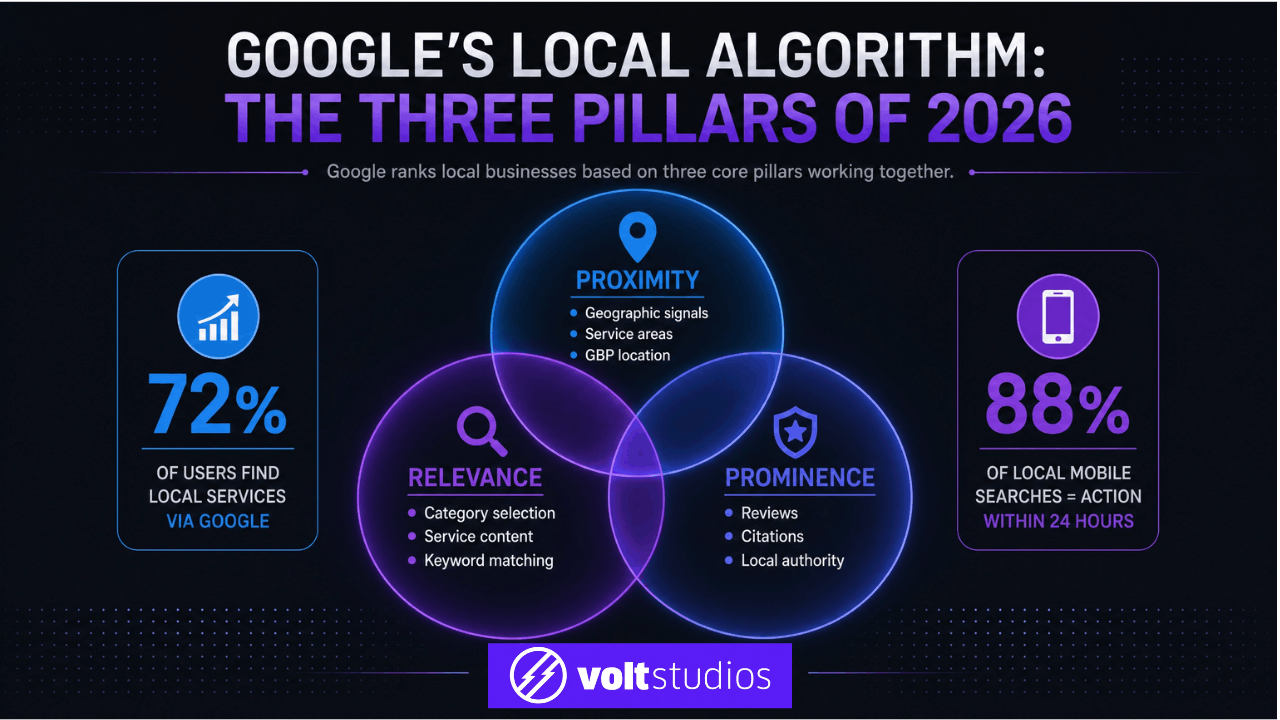
46% of all Google searches carry local intent. Nearly half of every query typed into Google is someone looking for a business, service, or product nearby. 88% of those mobile searchers visit or call a business within a day of searching. This is not consideration-stage traffic. It’s wallet-out, decision-ready behaviour — and it moves fast.
Most local landing pages across the GTA are not capturing any of it. They’re technically live, Google-indexed, and functionally invisible. The reasons are consistent enough that we could describe them before opening the URL.
The Mistake That Undermines Most Multi-Location Businesses
The most damaging error we see — and we see it constantly — is treating location pages as a find-and-replace exercise. Copy the Toronto page, swap every instance of “Toronto” with “Mississauga,” publish. Repeat for Vaughan, Barrie, Scarborough.
This approach doesn’t produce a penalty. It produces something worse: Google filters the near-duplicate pages, selects whichever version it considers most authoritative, and suppresses the rest.
The business thinks they have five location pages. In practice, they have one that competes and four that consume crawl budget and contribute nothing.
Approximately 47% of multi-location businesses fail to rank locally because their near-identical pages are filtered out this way. The solution isn’t adding more words to the page — it’s making each city page genuinely distinct in a way that could only apply to that location.
A Toronto page that references Liberty Village, Leslieville, TTC proximity, and Bay Street office towers is doing something different than a page that mentions Toronto in the headline and nowhere else.
A Mississauga page that speaks to the Square One business corridor, the Cooksville and Port Credit communities, and commercial plumbing needs specific to that district is doing something a swapped-template page never will.
A Vaughan page that addresses the fast-growing business ecosystem around VMC, the Maple GO corridor, and the concerns of businesses relocating from Toronto — that page earns local relevance the generic version cannot.
The practical threshold: each city page needs at minimum 300 words of content that could not logically appear on any other location page. That’s the floor. In competitive GTA markets, the ceiling is wherever your best-ranking competitor sits.
The Technical Gaps That Suppress Rankings Regardless of Content
Even well-written location pages get suppressed when the technical foundation is incomplete.
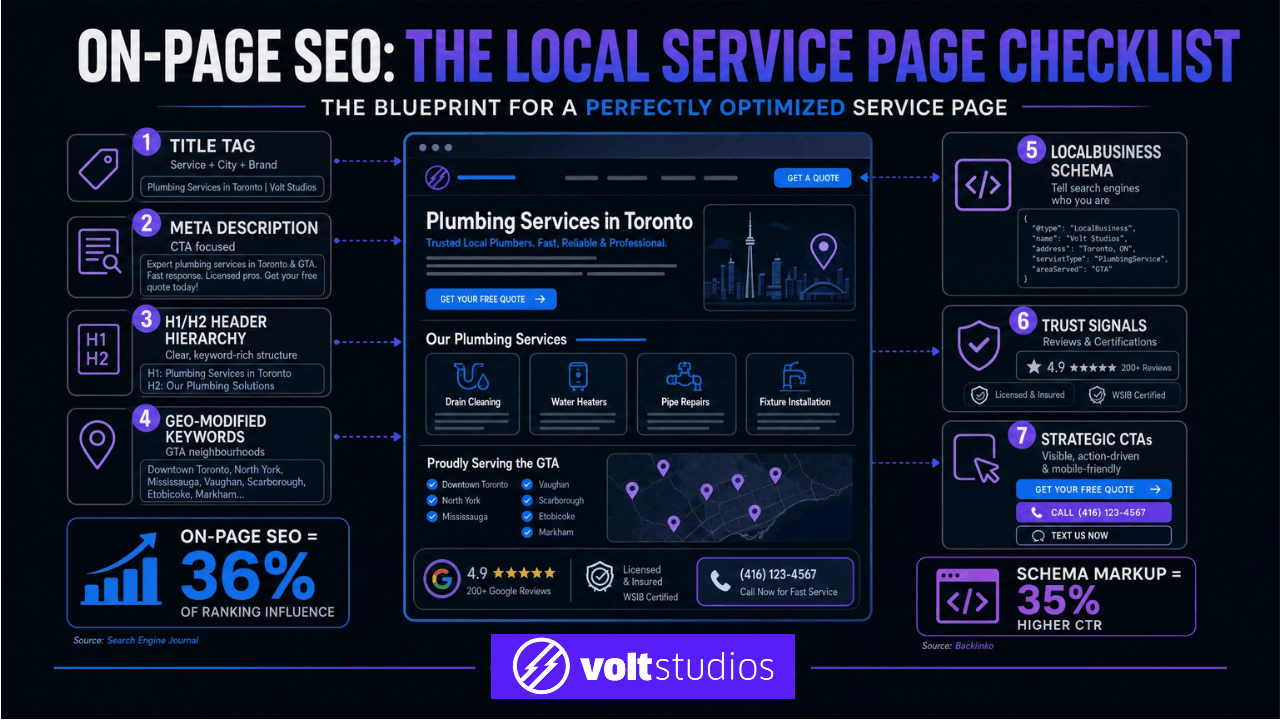
Schema markup is the most common omission. 72.6% of top-ranking local pages use schema, yet the majority of local business sites we audit either lack it entirely or implement it incorrectly.
Local Business schema — with precise address, geo-coordinates, phone number, hours, service area, and business category — tells Google explicitly what your page represents and where it operates. Without it, Google is guessing. Incorrect schema is worse than no schema; it signals an unreliable technical foundation.
NAP consistency on the location page itself is the second gap. The name, address, and phone number displayed on each location page must match your Google Business Profile, your Yelp listing, and every other citation exactly — not approximately. “Suite 100” and “Ste 100” are treated as different addresses.
Local area codes matter; toll-free numbers signal a non-local business regardless of the address next to them. The location page should function as a citation anchor, reinforcing the same information Google is verifying across the rest of the web.
Mobile experience is the third. 88% of local searches that convert happen on smartphones. If your location page loads slowly, buries the phone number, or makes contact information difficult to tap, conversions bleed before rankings are even relevant.
The phone number needs to be tap able and visible without scrolling. Contact options need to be immediate. Every second of load time between search and contact is an opportunity for the next result to win the call instead.
What the Pages That Actually Rank Have in Common
Beyond unique content and correct schema, the location pages earning consistent top-three local results share a few structural characteristics.
Location-specific social proof.
Testimonials and case studies that reference recognizable local contexts — a homeowner in Scarborough’s Woburn neighbourhood, a commercial client in the Square One district, a drainage issue specific to Thornhill’s older housing stock — signal genuine local experience in a way that generic five-star quotes don’t. Google can’t evaluate the authenticity of your reviews, but it can see whether your content is locally differentiated or templated.
Embedded maps that reinforce geographic relevance. A map showing your actual service location, set to a zoom level that makes your service area legible, linked back to your GBP listing — this creates a reinforcement loop between your website and your Business Profile.
For multi-location businesses, each page embeds the map for that specific location. Not a generic GTA overview.
City-specific FAQ content. Questions about local regulations, seasonal service considerations specific to the area, neighbourhood-specific service nuances — this is content that demonstrates local expertise rather than just claiming it.
A Barrie HVAC contractor answering questions about cottage country heating requirements is producing content that a Toronto competitor’s page can’t replicate.
What This Framework Delivers
One project that makes this concrete: a plumbing company serving Toronto, Mississauga, and Vaughan with three location pages that were 95% identical. Their Toronto page sat on page two.
Their Mississauga and Vaughan pages were indexed and invisible — not appearing in the first ten pages of results. Combined organic traffic from all three local pages was under 100 visits a month.
We rebuilt each page with 400+ words of genuinely unique content, implemented Local Business schema with geo-coordinates, embedded neighbourhood-specific maps, and added location-specific testimonials.
The Vaughan page addressed the challenges of older homes in the Thornhill area. The Mississauga page spoke to commercial plumbing in the Square One district.
Within 90 days all three pages ranked in the top five for their target city keywords. The Toronto page moved to position three. Combined local page traffic reached over 800 visits a month.
Contact form submissions from local pages increased from three or four per month to more than twenty.
The pages, the content, and the technical configuration changed. The service, the reputation, and the markets they were targeting didn’t.
The Compounding Case for Getting This Right
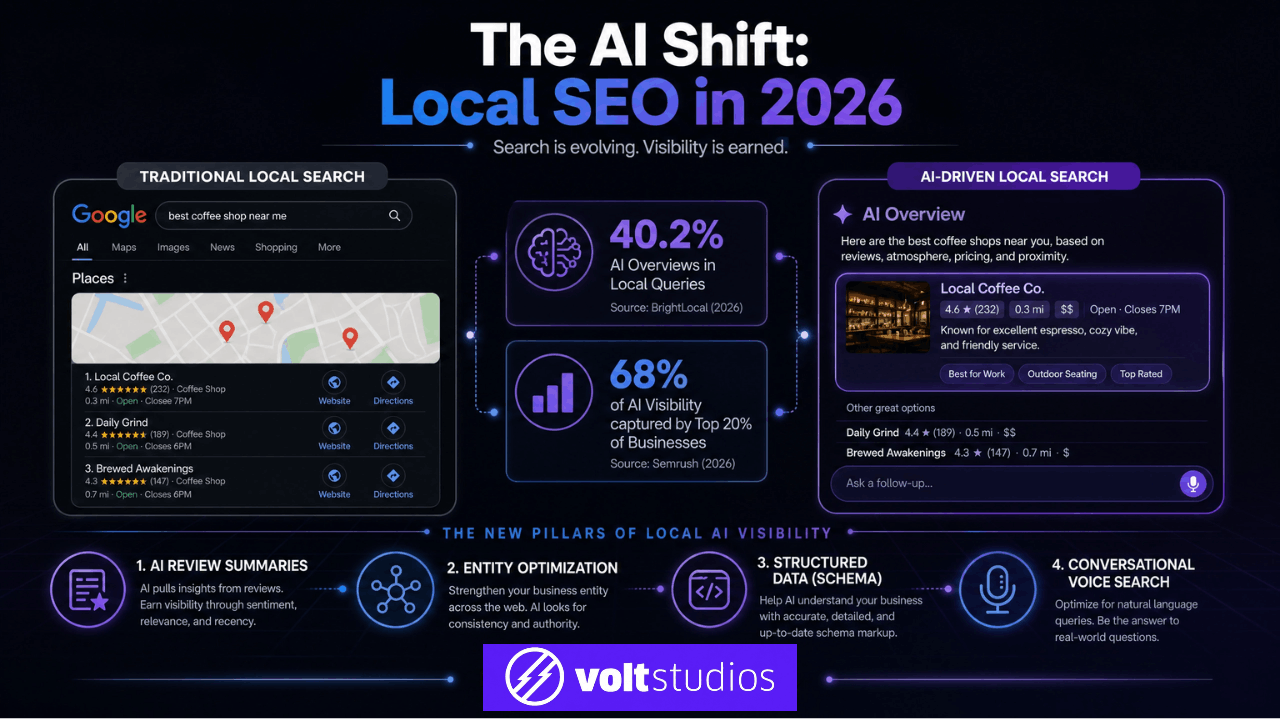
AI Overviews now appear in 40% of local queries, pushing traditional organic results further down the page. The businesses securing top-three Local Pack positions and the first organic local result are capturing traffic competitors can’t touch. Everyone below that threshold is competing for a shrinking share of what’s left.
Local landing pages are not a set-and-forget asset. They need ongoing optimization as Google’s algorithms evolve, competitors improve their own local strategies, and new neighbourhoods and developments become relevant to your service area.
But the foundational investment — genuinely differentiated content, correct schema, consistent NAP, mobile-ready experience — compounds over time in a way that templated pages never will.
If you want to know exactly where your current location pages stand — which are being filtered as near-duplicates, which have schema gaps, and what the highest-priority fixes are for your specific markets — we offer a free local SEO audit for Canadian businesses.
We’ll analyze your location pages against the businesses currently ranking above you and give you a clear action plan for what to address first.