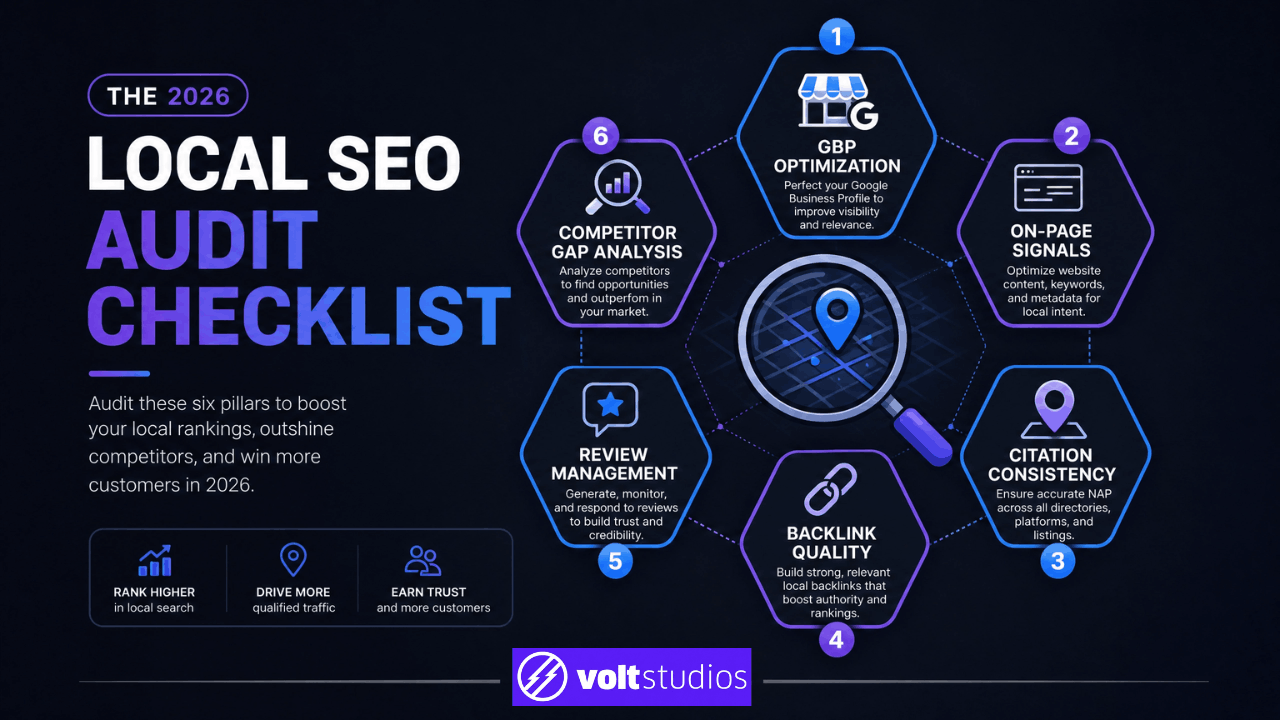
On-page signals account for 36% of local search ranking influence — more than backlinks, more than GBP optimization alone. Here’s what that means in practice.
A homeowner in Mississauga. February. Furnace gone. Phone out, searching “emergency HVAC repair near me.” They click one of the first three results. That business gets the call. Positions four through ten get nothing — not a click, not a call, not a dollar.
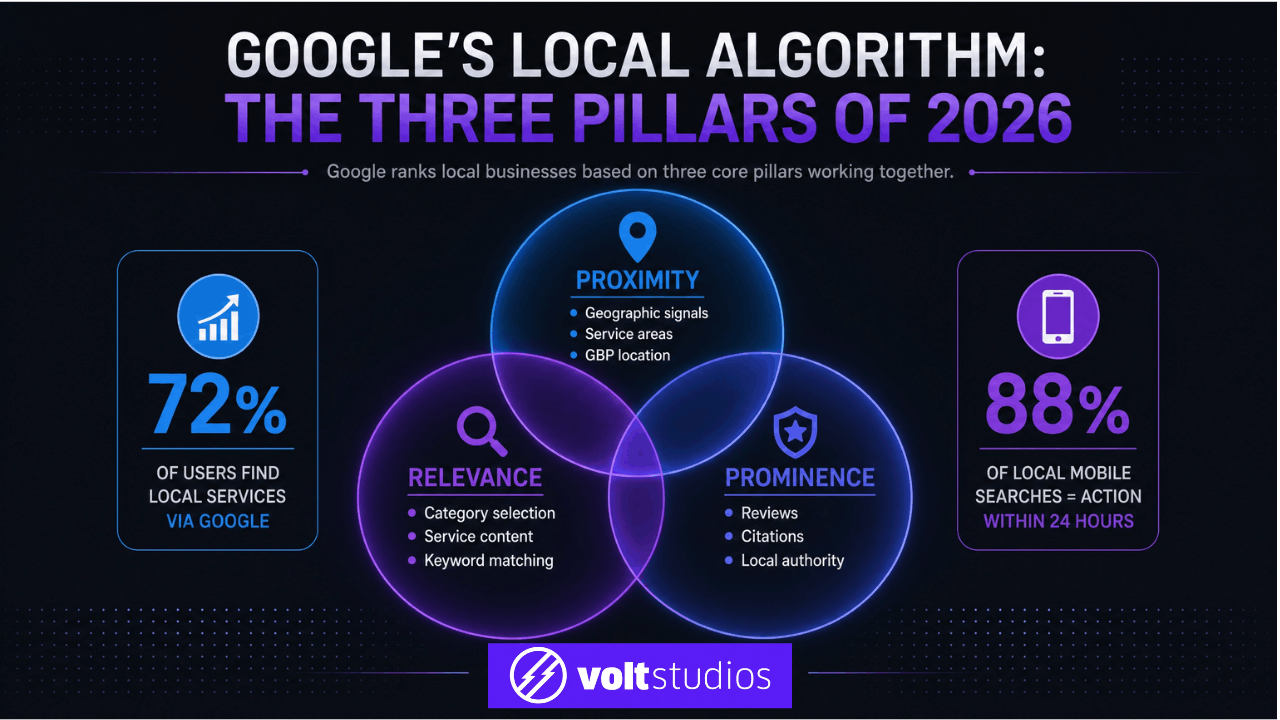
76% of users visit a business within 24 hours of a local search. 28% purchase within that same day. For service businesses in the GTA, local search isn’t a marketing channel — it’s the primary mechanism by which emergency revenue arrives.
And the factor determining who captures that revenue, more than any other single category, is on-page SEO. Most local service pages in Toronto, Mississauga, Vaughan, Barrie, and Scarborough aren’t built to compete for it.
The Mistakes We See on Almost Every Service Page Audit
The most common structural failure is the single generic services page carrying the entire local SEO strategy. A plumber in Vaughan with one page titled “Our Plumbing Services” is attempting to rank simultaneously for “emergency plumber Vaughan,” “drain cleaning Mississauga,” and “water heater repair Toronto.
” Google’s algorithm has become exceptionally good at matching intent to content. When someone searches “burst pipe repair Etobicoke,” Google wants to surface a page specifically about burst pipe repair in Etobicoke — not a services list that mentions the term somewhere in the copy.
One page targeting multiple services and geographies satisfies none of them properly. Title tag execution is the second consistent failure. We regularly audit GTA business websites and find title tags running 80+ characters, getting truncated in search results, cutting off the geographic modifiers that signal local relevance.
Others fall to the opposite extreme — 20-character titles that waste ranking real estate. Title tags between 40 and 60 characters generate approximately 8.9% higher click-through rates than those outside this range.
When three local businesses are competing for the same click, that compound advantage becomes meaningful revenue. Schema markup is absent on the majority of small service business sites we review.
Local Business schema tells Google explicitly what your business is, where it operates, what services you offer, your hours, and how to contact you. Search results with schema-enabled rich snippets earn up to 35% higher CTR than those without.
The businesses not implementing it are leaving both visibility and clicks on the table — invisibly, without any signal that it’s happening. Trust signals are the fourth gap. Local service purchases involve high stakes.
A homeowner letting someone into their house to fix a gas line needs confidence before they call. Many local service pages offer nothing beyond a phone number and a vague service description.
Displaying certifications, professional photography of the actual team, satisfaction guarantees, and review ratings directly on the service page reduces perceived risk at the moment the decision is being made.
Businesses responding to 32% or more of reviews see 80% higher conversion rates — the trust signal created by visible engagement matters even before a prospect picks up the phone.
What On-Page Optimization Actually Requires
Every service page needs a dedicated URL, a title tag following the Service + City + Brand Name formula within 40–60 characters, and an H1 that includes the primary keyword and geographic modifier. The H1 should match or closely align with the title tag. H2s cover major content sections.
H3s break those sections into specific subtopics. This hierarchy signals topical authority to Google and makes content scannable for mobile users — which is the majority of local searchers — who need to find the call button before they’ve read three paragraphs.
Geographic relevance needs to be woven throughout the content, not dropped once in the headline. Primary city in the title, H1, and opening paragraph.
Neighbourhood-specific terms across the body — North York, Etobicoke, Scarborough, East York for a Toronto-area business; Maple, Thornhill, Woodbridge for a Vaughan operation.
Not listed mechanically but integrated into sentences that demonstrate local knowledge: “we’ve been serving the Thornhill community for over a decade, helping homeowners prepare their furnaces for harsh Ontario winters”.
A service area section listing specific cities and neighbourhoods covered helps capture “near me” searches where the user hasn’t named a specific city.
LocalBusiness schema should be implemented and validated using Google’s Rich Results Test before the page goes live.
The implementation needs to include business name, address, phone number, hours, service area, accepted payment methods, aggregate rating, and review count.
Errors in structured data eliminate the rich snippet advantage entirely — incorrect schema is worse than no schema because it signals technical unreliability.
CTAs need strategic placement at three points: above the fold where a phone number or “get a free quote” button is impossible to miss, after the benefits section where engaged users are considering action, and at the end of the page for those who read every word before deciding.
Action-oriented language — “Call now for 24/7 emergency service,” “Book your free estimate online,” “Get an instant quote” — makes the next step obvious and frictionless.
What This Looks Like When Done Properly
The click-through rate math makes the stakes concrete. The top search result captures 27.6–39.8% of clicks. Position two gets 18.7%. Position three gets 10.2%.
For a GTA service business generating $500 per call-out, the difference between ranking first and third for a keyword with 500 monthly searches represents tens of thousands of dollars in annual revenue. For a single keyword. Multiply across a full service portfolio and the cost of neglect compounds significantly.
Local SEO leads close at nearly 15% — a figure that dwarfs most digital marketing channels. The businesses ranking at positions one through three for “emergency electrician Toronto” or “furnace repair Vaughan” at 2 AM on a Tuesday night are capturing buyers who are ready to spend immediately.
The combination of optimized title tags and schema markup producing compounding CTR improvements, paired with content that matches search intent precisely, is what earns those positions consistently.
The competitive dynamic in the GTA makes this increasingly urgent. When the businesses investing in on-page fundamentals are pulling ahead every month and the gap between their visibility and everyone else’s keeps widening, waiting isn’t a neutral choice.
Where to Start
The highest-impact, fastest changes for most service pages are also the most commonly overlooked: rewriting title tags to the Service + City + Brand formula within the right character count, adding Local Business schema and validating it, placing a visible CTA above the fold, and splitting a single generic services page into dedicated pages per service and geography.
Beyond those, the work compounds: content that weaves geographic specificity naturally throughout, trust signals that reduce risk at the moment of decision, header structure that signals topical authority to crawlers and readability to mobile users.
If you want to know which specific on-page gaps are suppressing your service page rankings — and what the priority order for fixing them is in your market — we offer a free on-page SEO audit for Canadian service businesses. We’ll review your current pages, identify the optimisation opportunities you’re missing, and give you a clear roadmap for what to address first.