Picture a Vaughan homeowner searching for the dental clinic you just opened in their neighbourhood. Your business appears twice in the results — your Vaughan location page and your Mississauga location page, both targeting the same keywords, both with nearly identical content.
Google can’t determine which one is more relevant, so it suppresses both. The homeowner scrolls past you entirely and books with the single-location competitor three blocks away whose website is structured correctly.
You built a second location to grow. Instead, you lost ground you already had.
This is the cannibalization trap, and it catches the majority of GTA businesses the moment they try to scale their local search presence. The scale of the opportunity makes getting this right urgent.
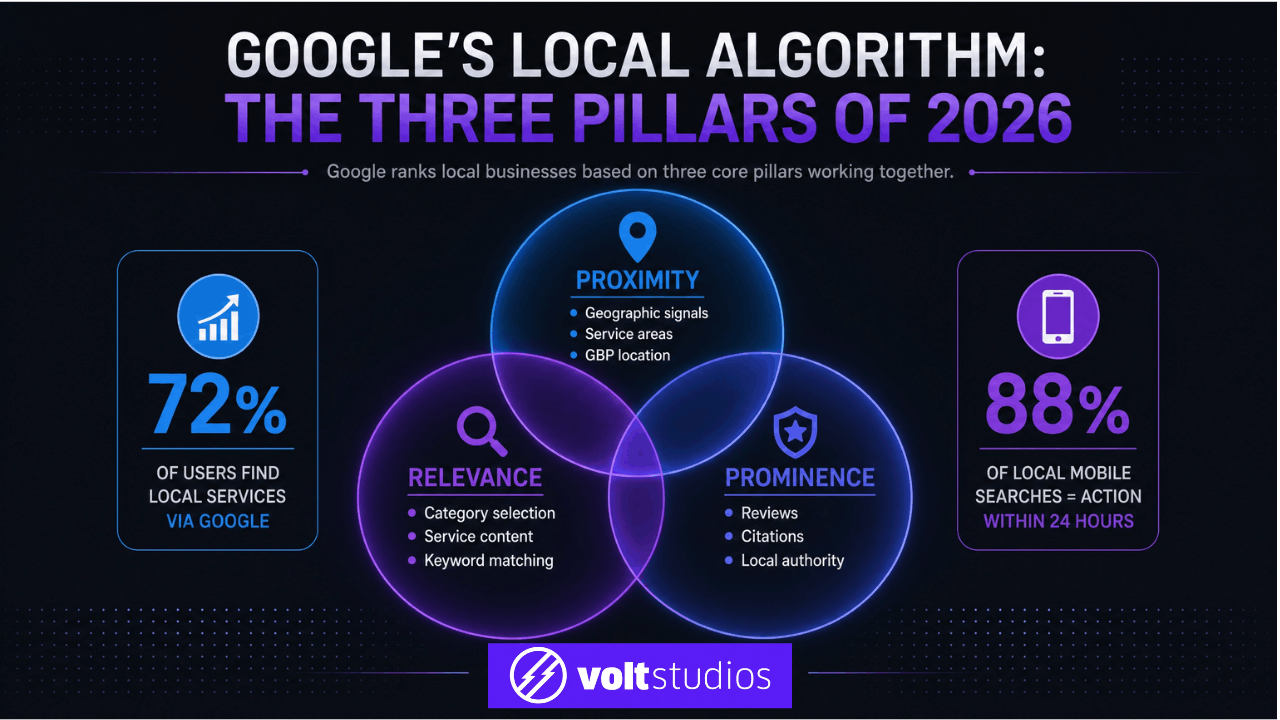
Seventy-four percent of consumers use Google for local searches, and 80 percent of those searches lead to a conversion. Forty-six percent of all Google searches carry local intent — nearly half of every query typed into Google comes from someone looking for a business near them.
And 48 percent of local-intent searches lead to a Google Business Profile interaction within 24 hours, which means your window to capture a motivated buyer is extraordinarily narrow.
Multi-location SEO done wrong doesn’t just underperform — it actively destroys the rankings you’ve already built. This article will show you exactly how to scale across the GTA without triggering the structural problems that are quietly costing businesses thousands in lost monthly revenue.
The Problem: Why Your Locations Are Competing Against Each Other
Keyword cannibalization occurs when two or more pages on the same website target identical search terms, leaving Google’s algorithm unable to determine which page should rank.
In a multi-location context, this happens with painful consistency: your Mississauga location page and your Vaughan location page both target phrases like “best dental clinic near me” or “Toronto plumbing services,” with no meaningful differentiation between them.
Google, confronted with two pages from the same domain offering essentially the same content, typically suppresses one or both. The result is that neither location ranks well, and competitors with properly structured sites capture the traffic that should be yours.
The data behind this is unambiguous. Research from multi-location SEO audits shows businesses using templated, cookie-cutter location pages have experienced a 22 percent year-on-year decline in Map Pack appearances.
Google’s algorithms have grown sophisticated enough to detect content similarity at scale, and pages with up to 95 percent textual overlap risk outright suppression from local search results — not ranking drops, but near-total removal from the searches that matter most.
The template approach became standard because it seems logical: build one great location page, clone it for every new market, swap the city name and address, and launch. It may have produced acceptable results five years ago.
Today it is actively harmful. Google’s local search algorithm now prioritizes hyper-local relevance, proximity signals, and demonstrable uniqueness over domain authority alone.
When your Scarborough and Vaughan pages share identical service descriptions, identical testimonials, identical FAQ sections, and identical meta tags, Google has no basis for geographic distinction. It sees two pages trying to rank for the same terms from the same domain — and ranks neither.
For businesses operating in the GTA’s tightly clustered suburbs, this is a particularly acute problem. A customer searching from Etobicoke may be physically closer to your Mississauga location than your Toronto location, but if both pages are templated duplicates, Google cannot make that geographic assignment with any confidence.
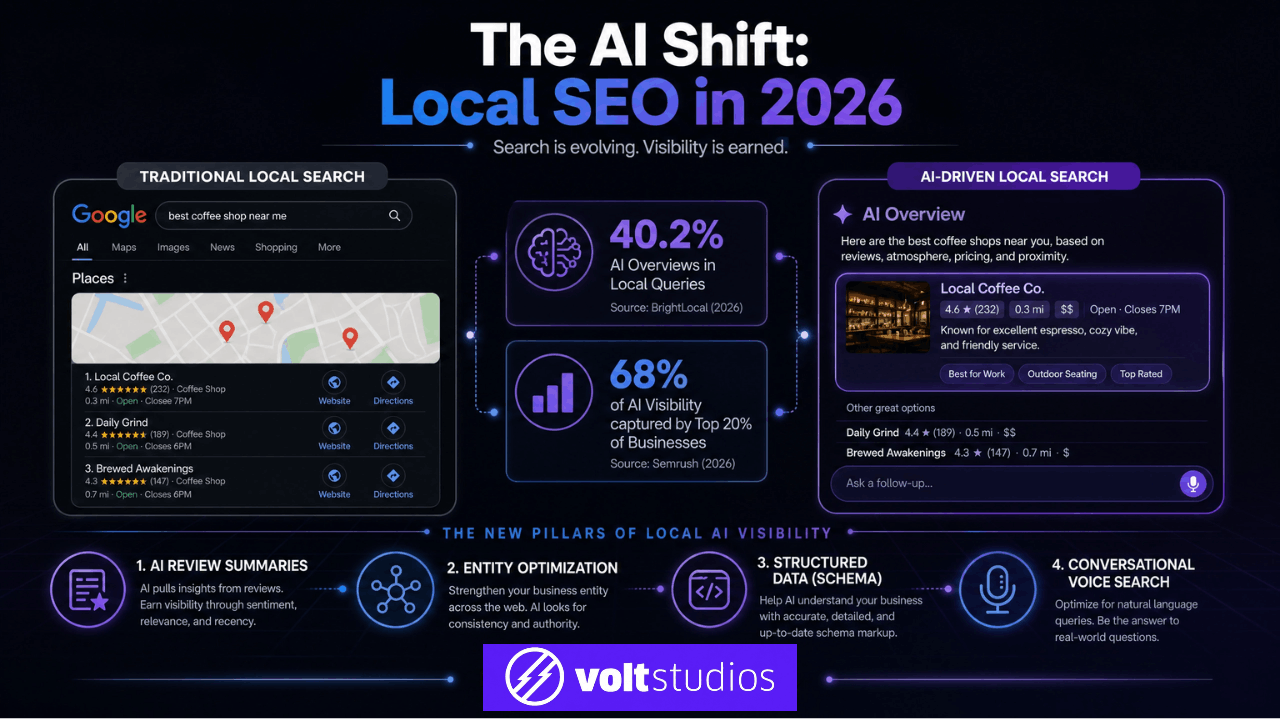
The customer ends up at a competitor. And because 58 percent of businesses haven’t optimized their presence for local search at all, the businesses that dominate are simply those that got the structure right.
Differentiate intent on each city-level service page — service-area page for Toronto SEO ≠ service-area page for Toronto Web Design.
Optimized multi-location brands now achieve 33.4 percent Google 3-Pack presence, up from 23.8 percent in 2022. Businesses with cannibalization issues often see their visibility drop to near zero for competitive terms.
The Framework: Treating Each Location as Its Own Digital Entity
Running multi-location SEO without cannibalization is one of the most common patterns we solve in our local business growth solution.
Scaling local SEO across multiple locations without cannibalizing rankings requires one foundational mindset shift: each location must function as a distinct digital entity with its own content strategy, its own Google Business Profile, and its own local relevance signals — all while remaining part of a cohesive brand.
The businesses that execute this correctly turn their multi-location structure from a liability into their strongest competitive advantage.
Google Business Profile Strategy, Location by Location
Your Google Business Profile is the cornerstone of local visibility, and for multi-location businesses, each profile demands individual attention. A single neglected profile can undermine an entire network’s performance.
The numbers here are compelling: complete GBP profiles drive 70 percent more clicks than incomplete ones, and businesses that upload photos to their profiles see 45 percent more direction requests from potential customers.
In a market like the GTA — where dozens of businesses compete for the same neighbourhood-level searches — those percentages represent concrete monthly revenue differences.
Each profile needs its own primary and secondary category selections tailored to that location’s service mix. A downtown Toronto location might prioritize “Emergency Dentist” while a suburban Vaughan location emphasizes “Family Dentist.”
These distinctions help Google understand the unique value of each location and surface the right profile for each searcher’s intent.
Business descriptions should reference local landmarks and communities by name. A Mississauga profile that mentions proximity to Square One or Celebration Square, and a Scarborough profile that references Scarborough Town Centre or Agincourt, signals hyper-local relevance to both Google’s algorithm and to the potential customer reading the description.
Each location should also have its own posting schedule reflecting local events, promotions, and seasonal context — your Barrie location promoting winter services in October while your downtown Toronto location addresses holiday parking logistics.
And because 91 percent of users read Google Business Profile reviews before making contact, active review management is not optional. Optimized profiles yield 87 percent higher daily search appearance odds.
Each GBP profile should be actively managed month over month, not set up once and left to accumulate dust.
Location Pages Built from the Ground Up, Not Cloned from a Template
Your location pages are where the battle against cannibalization is won or lost, and the standard is clear: a minimum of 300 to 500 words of genuinely unique content per page — content that couldn’t apply to any other location in your network.
This means location-specific service details that reflect what that location actually offers, not a generic description of your brand. It means staff bios featuring the actual people who work at that address, with photos that create real differentiation.
It means testimonials and case studies sourced from customers who visited that specific location — a review from a patient at your Etobicoke clinic is worth considerably more to your Scarborough page than a generic five-star rating with no geographic context.
It means neighbourhood-specific information: transit access, parking details, nearby landmarks, and community involvement that helps both Google and the customer understand where this location lives and what makes it distinct.
URL structure matters as well.
A subdirectory format — /locations/mississauga/ or /locations/toronto-downtown/ — clearly signals location hierarchy to search engines. Parameter-based URLs like ?location=mississauga dilute local authority and should be avoided entirely.
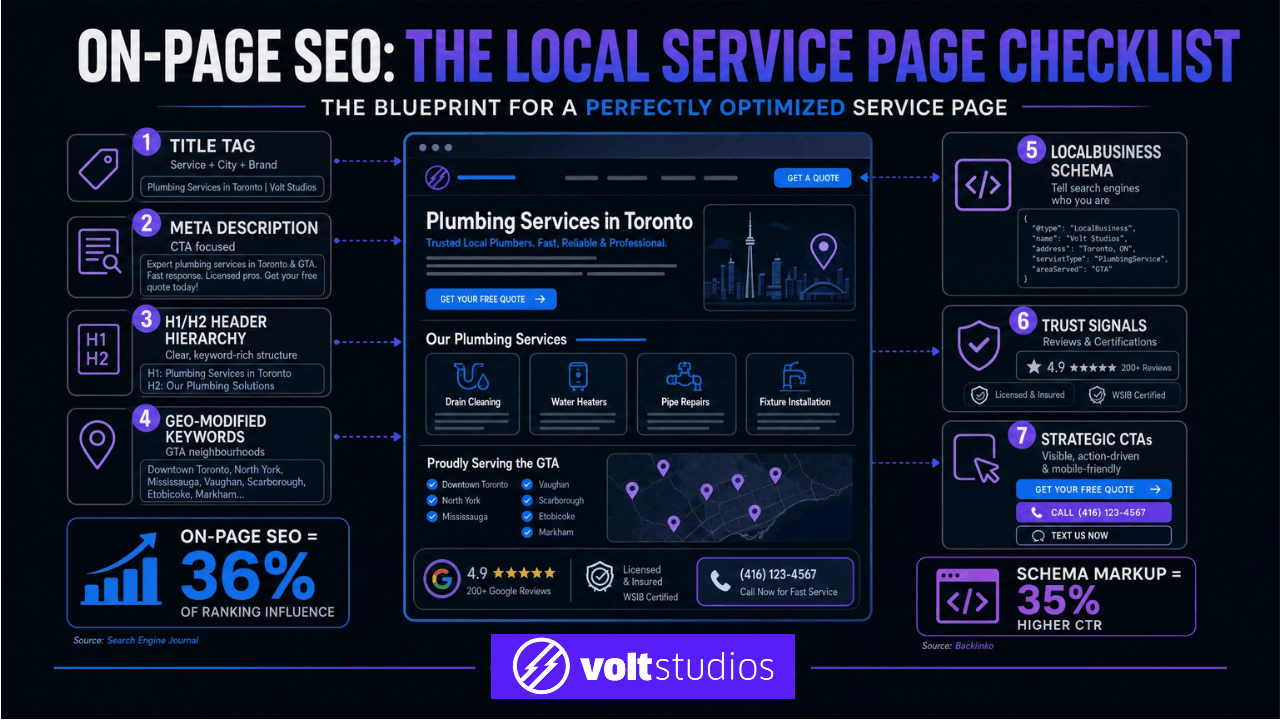
Each page needs unique title tags and meta descriptions that reflect the actual differentiation between locations, not just a city name appended to an identical template phrase.
The investment in unique content compounds over time. Data shows dynamic, location-specific pages have gained 14 percent in Map Pack visibility while templated pages continue to decline. The gap between these two approaches is widening as Google’s local algorithms grow more precise.
Schema Markup That Tells Google What You Can’t Show in Content
LocalBusiness schema markup is the structured data layer that allows search engines to understand your location architecture contextually. For multi-location businesses, implementing it correctly means nesting each location’s LocalBusiness schema within your broader Organization schema — telling Google that each location is part of your brand while maintaining its distinct local identity.
Each location’s schema should include a unique identifier, location-specific address and phone data, geo-coordinates for precise mapping, and hours of operation that reflect that location’s actual schedule.
If different locations offer different services, Service schema should mark those distinctions explicitly — your Mississauga location’s orthodontic services are separate from your Vaughan location’s general dentistry focus, and Google should understand that from the code as clearly as from the content.
Review schema should aggregate ratings by location, not blend them across your entire network, so that a customer researching your Scarborough location sees ratings from that location specifically.
Schema markup works by aligning your website data with your GBP data, giving AI crawlers a consistent signal to verify your business information across sources. It is one of the highest-leverage technical investments a multi-location business can make, and it is consistently underutilized.
Internal Linking Architecture That Strengthens Without Confusing
How your location pages link to each other carries significant weight for both user experience and search equity. The most effective approach is a hub-and-spoke model built around a central Locations or “Find a Location” page that links to all individual location pages, includes an interactive map of your full network, and allows users to navigate to the nearest location based on their geography.
Contextual links between geographically adjacent locations add usability and local relevance. A link from your Mississauga page noting that your Etobicoke location is ten minutes away and offers evening appointments serves both the user who landed in the wrong place and the search engine trying to understand your geographic coverage.
Breadcrumb navigation — Home > Locations > Mississauga — reinforces that hierarchy for both audiences.The discipline here is restraint: linking every location page to every other location page creates a confusing web that dilutes local relevance for all of them. Geographic adjacency and the hub page are the connective tissue that matters.
Review Management at the Location Level
Review generation, monitoring, and response must be managed at the location level, not the brand level. When a customer visits your Vaughan location, the follow-up should link to that location’s GBP review page directly.
When a response is written, it should reference that location specifically. A complaint about wait times at your Scarborough clinic should prompt a response from the Scarborough team — not a corporate communications template.
Eighty-eight percent of multi-location businesses now use automation tools for review monitoring — not to generate or replace human responses, but to alert location managers when new reviews appear and to suggest personalization-ready templates.
At scale, manual monitoring across a six- or eight-location network is simply not sustainable. But the automation should serve the local relationship, not replace it.
The Compounding Advantage of Getting This Right
For Canadian SMBs operating across the GTA, the local search market is one of North America’s most competitive digital environments — high population density, affluent consumers, and business owners who increasingly understand the value of organic visibility.
In that environment, multi-location SEO is not a technical detail. It is the architecture on which local revenue is built or lost. When your Vaughan location cannibalizes your Scarborough location’s rankings, you’re not losing abstract visibility — you’re losing actual customers with actual purchasing intent who found you, evaluated you, and left because the experience wasn’t right.
In a market where 48 percent of local-intent searches lead to a business interaction within 24 hours, every lost ranking represents a real transaction that went to someone else.
The businesses that win are those that treat each location as a genuine entity: a unique content strategy, an actively managed GBP profile, a schema implementation that mirrors its physical reality, and a review presence that reflects the local team. The businesses that lose are those that shortcut the process with templates and automation, hoping Google won’t notice. Google notices.
How Volt Studios Can Help
Since 2012, Volt Studios has helped local businesses across the GTA navigate the structural complexities of local search at scale. Our AI-driven Growth System begins with a comprehensive cannibalization audit — analyzing your existing location pages to identify precisely where your own content is competing against itself — and builds from there with our Location Authority Framework.
That framework includes original content development for each location written by local market specialists who understand the nuances of Toronto, Mississauga, Vaughan, Scarborough, and surrounding communities; GBP optimization and management across every profile in your network; schema markup implementation tailored to your specific business type and location structure; internal linking architecture that strengthens your overall domain while preserving individual location authority; and review generation and response systems that scale with your business without sacrificing the local relationships that drive conversion.
We don’t use templates. Every location page we build starts from the ground up — unique content, local context, and strategic keyword targeting that prevents cannibalization and maximizes Map Pack visibility across your entire network.
Book your free multi-location SEO audit with Volt Studios today.
We’ll analyze your current location pages, identify where your own content is working against you, and give you a clear roadmap for scaling your local presence without sacrificing the rankings you’ve already built.
Whether you’re operating two locations or twenty, in a market where 80 percent of local searches lead to a conversion, the only question worth asking is: how many of those searches are you winning?